NOTE: The following is a DRAFT VERSION of this FAQ.
Because of the rapid surge in public interest in the Quiz, we have decided to go ahead and post it for informational purposes, even though it still has some rough edges. Polishing and additional material will be coming soon.
Questions about unfinished sections or other matters? Contact information for the Advocates is below.
Thank you!
* * *
Frequently Asked Questions (FAQ) About the "World's Smallest Political Quiz"
So you’ve taken the World’s Smallest Political Quiz and you want to learn more about it. You’ve come to the right place!
(If you haven’t taken the Quiz yet, a lot of what’s here won’t make much sense. You can take the Quiz – it only takes a few moments -- at http://www.self-gov.org/quiz.html .)
This FAQ (Frequently Asked Questions) answers some of the most commonly-asked questions about the Quiz, and gives a detailed look at the history and purposes of the Quiz. This FAQ was written by James W. Harris, editor of the Advocates' magazine The Libertarian Communicator and co-editor of the Advocates’ free bi-weekly email newsletter The Liberator Online. (The Liberator Online, incidentally, is the world’s largest libertarian email newsletter. Subscriptions are FREE; to subscribe, visit: http://www.self-gov.org/liberator/maintain.html .)
Contributing ideas, insights, and suggestions were Advocates Founder and Quiz inventor Marshall Fritz, Advocates President Sharon Harris, Quiz Chart inventor David Nolan, Advocates Board Chairman Carole Ann Rand, writer Glen Raphael, and Advocates Internet Coordinator Paul Schmidt. Many others have contributed as well by reading, by making suggestions, and answering questions. Thanks to all!
Contents:
1: WHO PRODUCES THE QUIZ?
2: WHY THE QUIZ WAS CREATED
3: HOW THE QUIZ WAS CREATED: A SHORT HISTORY
4: PURPOSES AND USES OF THE QUIZ
5: IS THE QUIZ A TRICK? …AND OTHER CRITICISMS OF, AND QUESTIONS ABOUT, THE QUIZ
6: YOUR SCORE AND WHAT IT MEANS
7: THE QUIZ OUTSIDE THE UNITED STATES
8: THE QUIZ IN OTHER FORMATS: CARDS, DISKS
9: THE QUIZ IN THE MEDIA
10: CAN I USE THE QUIZ IN MY…
11: THE QUIZ IN CLASSROOMS
12: QUIZ WEB SITE NUMBERS AND EXPLANATIONS FOR THE NUMBERS
13: HOW MANY AMERICANS ARE LIBERTARIANS?
14: OPERATION POLITICALLY HOMELESS
15: HOW WOULD LIBERTARIANS ANSWER THE QUIZ QUESTIONS?
16: CONCLUSION
1: WHO PRODUCES THE QUIZ?
The Quiz is produced by the Advocates for Self-Government, a non-profit, non-partisan libertarian educational organization, and we are the sole distributors and copyright owners. (We are not affiliated with any political party or candidate.) We encourage reproduction and distribution of the Quiz, so long as it is reproduced in full and credited to the Advocates. Please tell us when you reprint the Quiz. (For more on reproduction, see "10: CAN I USE THE QUIZ IN MY…" below.)
We’ve been producing a pocket-sized cardstock version of the Quiz since 1987. The Quiz has been on the Web since 1995. An ASCII text copy of the Quiz has been circulated on Usenet (the Internet newsgroups) since the late 1980s.
Advocates for Self-Government
5 South Public Square
Suite 304
Cartersville, GA 30120
1-800-932-1776
Fax: 770-386-8373
Email us by clicking here: mailto: Advocates@self-gov.org
2: WHY THE QUIZ WAS CREATED
The goal of the Quiz is to give a fast, fun, and accurate assessment of a person’s overall political views, and to place those views on a new multi-spectrum "political map" that is far more accurate, insightful, and diversified than older political guidelines (such as the "left-right" line).
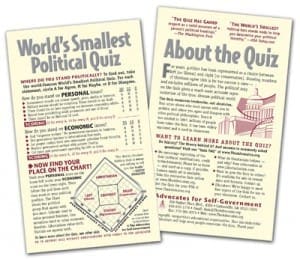
The Quiz is composed of two parts: a new political map or chart, and ten questions on specific political issues to help a Quiz taker find his place on that new political map.
Primarily, to replace the flawed, misleading "left-right" or "liberal-conservative" line (see next question) with a better, more accurate, more insightful visual political map. (Other reasons – and other ways the Quiz is used – are discussed in Section 4: PURPOSES AND USES OF THE QUIZ.)
The next few sections will explain what "left-right" or "liberal-conservative" line is, why replacing it is important, and how the Quiz attempts to accomplish that.
Ten years ago the standard view of politics -- the mental "map" almost everyone used when thinking of political positions -- was the old "left-right" line. It is still widely used today.
You've probably seen it in textbooks and newspapers. It looks something like this:
ß ---------------left--------------center---------------right---------------à
or, when expanded a bit:
ß ---crazies--communist/socialist--far left--liberal--centrist--conservative--far right--fascist--crazies---à
This model is misleading and fatally flawed. It doesn’t have a place for many millions of people who don’t fit neatly into some variant of liberal or conservative. In effect, it disenfranchises the millions of Americans who don’t feel that "left," "right," "liberal," "conservative" etc. accurately describe their views. Thomas Jefferson, for example, wouldn’t fit comfortably on that chart under any of those labels. Neither would Jesse Ventura or Huey Long or Pat Buchanan. America’s real political spectrum is more complex than this simplistic "Crossfire" model allows.
Nor does the "left-right" line give any useful insight into the differences between the various political categories. It doesn’t tell us what the important differences are between liberals, conservatives, fascists, and so on. It tells us nothing of the views of these and other groups.
Furthermore, the left-right model is inherently illogical. The model implies that if you "go too far" (i.e., are consistent) with any political idea, you end up, in some weird and unexplained way, at totalitarianism or anarchism (or maybe both!). Pursue conservative thought to its logical extreme, according to this model, and you somehow end up at fascism (which is national socialism), or white supremacy or some other authoritarian position. If you pursue liberal thought too far, you supposedly end up at socialism or communism. This is inconsistent, and ignores gigantic philosophical differences between, say, liberalism and communism, or conservatism and fascism.
To see another major reason why this model is irredeemably flawed, try to fit libertarians on that line. Libertarians believe that people should be free to live as they choose, in both the economic and personal realms, as long as they don’t harm others. So libertarians believe in a free market economy – which should put them on the "right," right? But they also oppose censorship, the drug war and other attempts by government to control the personal lives of peaceful individuals. Does that put them on the left? Well, no. Does it put them in the "middle?" No. There’s just no place for libertarians on that map.
Consider that millions of Americans are libertarian or libertarian-leaning. Libertarians and libertarian thought are a large and important part of American politics, and have been since the country’s founding. (See 13: HOW MANY AMERICANS ARE LIBERTARIANS? below for estimates of the number of libertarians in America.) Indeed, libertarian ideas have played a central role in world history for centuries. But the left-right line simply pretends that libertarians don’t exist. It does the same for others as well.
No wonder, then, that many Americans – used to thinking about politics with this familiar left-right map -- couldn't figure out what libertarians were. Libertarians weren't left-wing, they weren't right-wing, they weren't centrists – so they, in effect, didn't exist. Libertarians literally weren't on the map!
The left-right model thus gives a skewed, distorted, inaccurate picture of American politics. It’s a "flat earth" political map – inaccurate and misleading.
A new, more accurate, more inclusive political map was desperately needed. That’s what led to the creation of the Quiz – as an alternative to this failed, flawed model.
It’s important to note that it’s not just libertarians who reject the "left-right" model. Increasingly, prominent educators, journalists and others from across the political spectrum are calling for a more accurate model.
A few examples:
"Welcome to an era of brand-name confusion in American politics. Everyone agrees the hoary liberal-conservative labels are meaningless." Howard Fineman, Newsweek, October 15, 1985.
"However analysts strain to construe the outcome in conservative vs. liberal terms, the truth is far more complex. Indeed, the increasing failure of these two terms to describe the divisions and nuances of U.S. politics merits renewed attention… The truth is that ‘conservative’ and ‘liberal’ are terms that came into common usage only in the early 19th century following the French and Industrial revolutions, and their descriptive utility is more and more limited in today’s new political economy. Our political nomenclature…needs an overhaul." – Kevin Phillips, "Old Political Labels No Longer Fit," Wall Street Journal November 27 1984. (Phillips is the author of several books, including the bestseller The Death of Politics.)
"In popular usage, liberals favor a greater scope of government, and conservatives favor a narrower scope. However, this traditional distinction has faded over time and now oversimplifies the differences between liberals and conservatives… Obviously, most American opinions do not fit a one-dimensional liberal-conservative continuum." – Janda, Berry, Goldman, "The Challenge of Democracy," college textbook published by Houghton Mifflin Company.
"…there is no logical reason why voters could not be liberal on some issues and center or conservative on others…" – Hugh LeBlanc and Mary Beth Merrin, Parties and Candidates in 1972: Objects of Issue Voting," Western Political Quarterly, 32 (1979).
*********THIS SECTION NOT YET COMPLETED***************************
3: HOW THE QUIZ WAS CREATED: A SHORT HISTORY
We believe the World’s Smallest Political Quiz offers a far better political map, and helps people quickly and easily and accurately place themselves on that map.
The Quiz is composed of two parts:
The following sections explain how they came together to form the Quiz.
The chart that is the centerpiece of the Quiz is based on a chart devised in 1969 by political scientist David Nolan. Nolan, a libertarian (he co-founded the Libertarian Party in 1971) came up with the chart because he was frustrated by the old "left-right" line that leaves no room for libertarians and others.
Nolan’s insight was that the major difference between various political philosophies, the real defining element in what a person believes politically, is the amount of government control over human action that is advocated.
Nolan further reasoned that virtually all human political action can be divided into two broad categories: economic and personal.
The "economic" category includes what you do as a producer and consumer – what you can buy, sell, produce. Where you work, who you hire, what you do with your money. Examples of economic activity: starting a business; buying a home; constructing a building; working in an office.
The "personal" category includes what you do in relationships, in self-expression, and in general what you do with your own body and mind. Examples of personal activities: marriage; choosing what books you read and movies you watch; what foods, medicines, and drugs you choose to consume; sports; your religious choices; organization you join; who you choose to associate with.
Since, Nolan realized, most government activism (or government control) occurs in these two major areas, economics and personal, *political positions can be defined by how much government control a person favors in these two areas.*
The extremes are no government at all in either area (anarchism) or total or near-total government control of everything (various forms of totalitarianism).
Most political philosophies fall somewhere in between.
In broad terms:
* Conservatives and those on the right tend to favor more freedom in economic areas (example: a free market), but more government control in social areas (example: censorship).
* Liberals and those on the left tend to favor more freedom in personal areas (example: no military draft), but more government activism or control in economics (example: a government-mandated minimum wage).
* Libertarians favor both personal and economic freedom, and oppose most (or all) government intervention in both areas. Like (some) conservatives, libertarians believe that people should be free to make economic choices for themselves. Like (some) liberals, libertarians believe in personal freedom.
* Authoritarians favor a lot of government control in both the personal and economic areas.
Of course, liberals, conservatives, and others may disagree among themselves on particular issues, and hold different positions. Examples: a liberal might be opposed to censorship and draft, but want to continue the Drug War and end the minimum wage. Or a conservative may oppose censorship and the draft, but favor restricting free trade. But the broad division generally holds true.
Another way of expressing this (a sort of "libertarian-centric" view): conservatives tend to be more libertarian on economic issues; liberals tend to be more libertarian on issues of personal freedom.
In order to visually express this insight, Nolan came up with a two axis graph. One axis was for economic freedom, and the other was for personal freedom.
Once both areas were on a graph, it was possible to put a scale on each of the two axes of that graph. Nolan’s scale started at zero (total state control) to 100% (no state control). 100% in economics would mean a free market; 100% in personal issues would mean no government control in your private, personal life.
By using the scale on each of the two axes, it was possible to measure the amount of personal liberty and economic liberty a person, political organization, or political philosophy advocates, and then plot that on the graph.
Thus, while the old "left-right" line attempted to measure politics along a one-dimensional line, Nolan’s graph divided political issues into two dimensions: economic and social.
Nolan’s original graph looked like this:
**********
insert diagram here
**********
So, instead of classifying all political opinion as being some variant of liberal or conservative, Nolan’s chart allowed a far more accurate measurement: how much (or little) government control a person favored in personal and economic matters.
*This is a breakthough concept that instantly gives far more insight into politics.* By using this simple but accurate chart, it becomes much easier to see and understand the differences between liberals, conservatives, libertarians, and others. The chart more accurately places totalitarian or interventionist philosophies – fascism, state communism, and so on – next to each other, instead at opposite ends of a single line. And it is far more inclusive, with room for libertarians and others; indeed, virtually every political philosophy can be put onto that chart, unlike the one-dimensional "left-right" line.
Nolan introduced his chart in an article entitled "Classifying and Analyzing Politico-Economic Systems" published in the January 1971 issue of The Individualist, a libertarian newsletter.
(In 1999, Nolan learned that he had been named one of the "2,000 Outstanding Intellectuals of the 20th Century" by the Cambridgeshire, England-based International Biographical Centre (IBC), and he will be included in their reference work of the same title, to be published in late 2000. Nolan speculates his inclusion in the book is due to his creation of the Nolan Chart, which has gained international fame as the core of the World's Smallest Political Quiz.)
In 1985, Marshall Fritz founded the Advocates for Self-Government. Part of the Advocates mission was to introduce and explain libertarian ideas to the public. Fritz found that Nolan’s chart was a great help in explaining how libertarianism was distinct from conservatism and liberalism. Fritz also came to believe that the inaccurate "left-right" line was a major obstacle to the public understanding libertarianism, since that line left libertarians off entirely. The "left-right" line forced people to keep trying to shoe-horn libertarians (and others) into the liberal or conservative camps, when actually libertarians are neither. The left-right line also marginalized libertarians, by making them essentially invisible. (See "2: WHY THE QUIZ WAS CREATED" for more on this.)
Fritz saw Nolan’s chart as a way to challenge all this.
Convinced of the validity of the chart, Fritz wanted to popularize it, while also keeping it accurate so it could be accepted by academics and other political thinkers. A great way to do this, he decided, would be to turn Nolan’s chart into a self-scoring computer game. In order to do this, he came up with the idea of asking a series of questions covering each of the chart’s two broad areas, personal liberty and economics. A person would answer several important and significant questions on civil liberties and economics, and then the computer would use those answers to instantly plot his or her score on Nolan’s chart.
Fritz spent hundreds of hours testing and revising questions for the proposed computer Quiz, seeking issues and wording that would consistently produce accurate and meaningful scores on Nolan’s chart. He circulated print-outs of the chart and different sets of questions to numerous people, ranging from friends and neighbors to political scientists, to get their reactions.
Then longtime libertarian Bernie Baltic looked at one of these print-outs and suggested to Fritz that he could simply shrink the chart and questions down to a business-card size handout. The result, Baltic suggested, would be a unique and valuable tool that could be cheaply produced and easily distributed.
Great idea, Fritz thought. He played with the layout a bit, then ran off some test copies of the little business-card-size quiz in 1987 in a Fresno, California copy shop.
The little card didn’t have a name yet. After printing it, Fritz asked the copy-shop clerk, "How’d you like to be the first person in the world to take the world’s smallest political quiz?"
As Fritz recalls: "His eyes lit up at the words ‘world’s smallest political quiz,’ and then I knew I had the name."
Thus was born the "World’s Smallest Political Quiz" card
The first mass printing of the Quiz was 3600 copies. They went fast. The next order was 15,000. They went fast, too. Then 30,000. As demand kept growing, so did the print runs. The biggest so far (as of November 1999) has been 400,000 copies.
As of September 2000, over 5 million Quizzes have been printed.
It was clear from the beginning that the Quiz was something special. The diagram was an eye-opener, and the questions stimulated political thinking and helped people place themselves on the chart.
The wording and the graphics have undergone considerable change since Marshall’s first Quizzes. But the basic concept has remained the same.
The Quiz, then, is a combination of two elements: Nolan’s graph, and Marshall’s idea of ten short questions to quickly and easily help a person find their place on that graph.
Marshall Fritz thanks the many people who contributed their time and thought to helping shape the questions on the Quiz. These people include Steve Alexander, David Bergland, Barry Conner, Dave Dawson, Don Ernsberger, Joe Fuhrig, Jeffrey Hummel, David Nolan, Perry Willis. There are many others who played important roles as well. Fritz notes that literally hundreds of phone calls and hundreds of hours of conversations with these people went into formulating the Quiz.
Both are important – it’s the combination that gives the Quiz its appeal and makes it work quickly and accurately.
But the most central element is the chart. The questions are important, but their function is to help people quickly and accurately place themselves on the chart.
This is frequently overlooked by many people. The questions are the most provocative part of the Quiz, the part that people think about and ponder. But the questions, important as they are, are just guides to help you find your best place on the more accurate, more inclusive political map.
Excited by the great success of the business-card-size Quiz, Fritz put aside the idea of a computer version of the Quiz, and in the pre-Web days, it was quickly forgotten. But others picked up the idea a few years later.
In 1993, the Quiz returned to its computer roots. Programmer Brian Towey, with the help of his wife Ingrid, produced a full-color, instant-scoring computer Quiz on disk, for DOS and Windows. Programmer Jon Kalb created an equally outstanding version for Macs. These computer Quizzes were a big hit, and were loaded onto hundreds of bulletin boards and computer networks across the country, in the pre-Web days.
These are still available on disk from the Advocates. (Though the easiest way to get a copy of the Quiz for your computer is simply to download it from our site. You can do so by clicking here: http://www.self-gov.org/download.html.)
(A tip of the Advocates' cap to the pioneer programmers who worked with Marshall Fritz in the early attempts to turn to Quiz into a computer game: Dave Dawson, Virgil Swearingen, and Al Weiss.)
Advocates supporter and computer programmer Toby Nixon created an ASCII text copy of the Quiz in the pre-Web days, and this version was circulated widely across the Internet, in newsgroups, computer networks, bulletin boards, and on software. This version of the Quiz was bundled with other information about libertarianism by software designer Paul Schmidt, and this package too was widely circulated. The ASCII text version still circulates on Usenet (the Internet newsgroups) and elsewhere.
In 1995, Paul Schmidt -- by then serving as Advocates Internet coordinator -- created the Advocates’ Web page, the centerpiece of which was, and remains, the interactive World's Smallest Political Quiz you find there today.
The Quiz quickly become extremely popular on the Web, as we’ll discuss further below. (Or see Section 9: THE QUIZ IN THE MEDIA .)
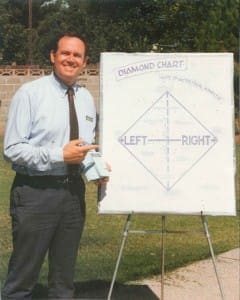
A few years after the creation of the Quiz, Marshall Fritz decided to rotate Nolan’s chart from a square to its current diamond shape, thus creating the visual image called the Diamond Chart. (It looks rather like a baseball diamond.) The reason? It put the left and right at, logically enough, the left and right. And it also created a sort of vertical scale – almost like a thermometer -- that measures support for maximum government (the bottom, a zero-zero score) to little or no government (the top, a 100-100 score). Logically, visually, and aesthetically, the change made sense and made the Chart more useful. And Nolan himself had offered a diamond shape in his early writings about the Quiz.
(In his 1974 book "Key Influences in the American Right," Ferdinand V. Solara also advocates a diamond-shaped map of the political spectrum, very similar to the current Quiz chart.)
4: PURPOSES AND USES OF THE QUIZ
We have two major goals with the Quiz. The primary one, as discussed above, is to replace the flawed "left-right" model with a more accurate map -- such as the Quiz chart -- that includes libertarians. The second use of the Quiz is as a tool to help libertarians better explain their views to other people -- in other words, as an introductory or outreach tool.
For either of these purposes, it is crucial that the Quiz be as fair and accurate as possible.
Since its creation, the Quiz has been used by a variety of people in different ways. Here are the four most popular.
1) As a more accurate political map to replace the flawed and inaccurate "left-right" line.
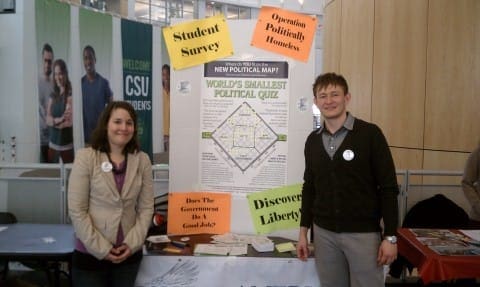
2) As an outreach tool for libertarians. Because the Quiz makes it far easier for libertarians to explain their positions and where they fit in American politics, it has become the most popular outreach and educational tool among libertarians. (That doesn't mean it's a trick, however. In fact, the Quiz’s value as an outreach tool depends upon its accuracy. For more on this, see Section 5: IS THE QUIZ A TRICK? …AND OTHER CRITICISMS OF, AND QUESTIONS ABOUT, THE QUIZ, below.) The Quiz is also used by libertarians in "Operation Politically Homeless" (OPH) outreach booths. For more on OPH, see Section 14: OPERATION POLITICALLY HOMELESS,
below.
3) As a way of clarifying and stimulating political discourse. Too much political talk ducks or avoids issues. And many important political issues are left out of political debates. The Quiz raises fundamental, serious political issues, including some issues that receive far too little attention. This is one reason many classrooms use the Quiz, to stimulate discussions of import political issues.
4) As a way of clarifying differences between various types of conservatives, liberals and so on. The Quiz questions make it easy to see where people who share the same political label may disagree among themselves. (Examples: some conservatives favor ending the Drug War, some don’t. Some liberals favor free trade, some don’t.) The Quiz helps make such distinctions clearer.
Again, for any of these purposes, it is crucial that the Quiz be as fair and accurate as possible. Which brings us to the most common criticism of the Quiz…
5: IS THE QUIZ A TRICK? …AND OTHER CRITICISMS OF, AND QUESTIONS ABOUT, THE QUIZ
That’s an instant reaction of some people when they first encounter the Quiz. And it’s an understandable one. (It’s good to be skeptical.)
But the answer is no. The Quiz is not a trick, and it’s not designed to produce false libertarian scores.
It would be very easy to produce a Quiz in which lots of people who weren't libertarians or libertarian-leaning nevertheless scored libertarian. In fact, it’s very easy to take the 10 questions on the Quiz, reword them, and create a Quiz on which virtually everyone will score libertarian – or, alternately, a version in which no one will.
It’s much harder to come up with a short, fast Quiz that gives accurate scores, and new political insights, to the vast majority of takers. But that has been our goal from the beginning – because there are very good reasons for NOT wanting a Quiz in which non-libertarian-leaning people score libertarian.
Here’s why:
1) If the Quiz were obviously fake, routinely giving phony and inaccurate scores, people would simply ignore it. Our goal of changing the political map to include libertarians and others would never be accomplished. From the start, we’ve realized that the Quiz must be accurate if it (and most importantly, the idea of a multi-spectrum political map) is to be taken seriously by scholars, journalists, teachers, and others as a tool of political analysis. Liberals must score liberal, conservatives conservative, libertarians libertarian, etc.
It’s because it is so accurate that the Quiz model is today being taken seriously by more and more opinion leaders.
2) People who are momentarily tricked into defining themselves as "libertarians" aren't going to be very happy when they find they've been deceived. People don’t like to feel they’ve been tricked or used. A deceptive Quiz in which non-libertarians consistently scored "libertarian" would win libertarians more enemies, not friends. And it would put more ammunition into the hands of our enemies. It certainly wouldn't benefit the libertarian movement.
3) A Quiz in which almost everyone scored libertarian would be enormously wasteful of the limited resources of libertarian activists and the various libertarian groups who use the Quiz as outreach, to identify libertarians and libertarian-leaning people. These groups want a tool that will "filter out" poor prospects (i.e., persons not open to libertarian ideas), and that will let them quickly identify those people most favorable to libertarian ideas. A Quiz in which conservatives, liberals, moderates, socialists and so on scored libertarian or libertarian-leaning would be worthless for outreach.
4) A softcore Quiz in which virtually everyone scored libertarian would devalue or dumb-down the word "libertarian," making it almost meaningless. The Advocates has always emphasized the importance of presenting the full, uncompromising libertarian philosophy to the public, and it would be counter to this goal for us to publicize a Quiz that watered down the meaning of "libertarian."
Incidentally, one proof that the Quiz isn’t designed to make many or most people score libertarian is obvious: most people who take the Quiz DON’T score libertarian. The percentage of libertarian scores seems to match very nicely the 20%-30% estimates from various sources of how much of the American population is libertarian or libertarian-leaning. In September 2000, Rasmussen Research, one of the leading poll companies in America, administered the Quiz to a cross-sampling of Americans and found that 16% scored libertarian. Obviously, if the Quiz is designed to make most people score libertarian, we’ve done a pretty a pretty lousy job of it. (For more on this topic, see Section 13: HOW MANY AMERICANS ARE LIBERTARIANS?, below)
The percentages of libertarian scores at the Quiz Web site are currently higher than that --around 40% -- but there are good reasons for that, which are explained in Section12: QUIZ WEB SITE NUMBERS AND EXPLANATIONS FOR THE NUMBERS, below.
A simple reading of the Quiz questions shows they are serious questions on a variety of hot political topics that a typical cross-section of the American public would disagree on.
In over a decade of giving the Quiz we've found that the great majority of people agree that their scores are accurate. Furthermore – and this is an important point -- the increasing serious media attention the Quiz is getting is possible only because people who take the Quiz find it to be generally accurate.
We believe our Quiz model is more sophisticated, more inclusive, and gives far more insight into American politics than the left-right line. And thus it is far more useful to anyone who wants to understand American politics – students, political scientists, journalists, and others.
We are very pleased that Gallup Polls has, during the past several years, begun exploring a multi-spectrum political model similar to ours, as are increasing numbers of political scientists.
We believe that our model – or one very like it – eventually will completely replace the old, inaccurate left-right line. Because it simply is a better model.
17. Doesn’t the fact that the Quiz is used as an outreach tool by some libertarians mean that it isn’t objective or accurate, and therefore has no real scholarly or practical value?
No, for at least two reasons:
1) As we’ve written elsewhere in this FAQ, there are several major reasons why it is vital for the Advocates and for libertarians that the Quiz be an accurate tool, and not be slanted as a "trick" to get people to score libertarian. Our goal is that the Quiz be an accurate tool.
Libertarians are probably the largest group that the "left-right" line excludes. A more accurate political map shows that many people now labeled "liberal" or "conservative" are actually more libertarian than anything else – but they don’t know it, because the rigid and artificial division of American politics into "left-right" doesn’t allow for that. Libertarians thus have a big stake in seeing a more accurate map accepted. But that doesn’t mean the map is therefore inaccurate.
2) It is common for partisan groups to use objective information from polls and surveys to bolster their positions. Example: many polls indicate that a majority of Americans favor legalizing marijuana for medical use. Groups that favor legalizing medical marijuana naturally use these poll results to argue for passage of laws to accomplish that. That doesn’t mean the polls are inaccurate or politicized. However, for that information to be useful, it must be accurate. Phony polls and surveys don’t bolster a cause in the long term – they harm it.
Actually, the Quiz can be (and often is) used by non-libertarians to point out that libertarians hold positions that they (non-libertarians) find objectionable, such as ending the War on Drugs, opposing the minimum wage, opposing censorship, and supporting free trade. This is possible only because the questions are strong, clear questions on important political events. The Quiz can be, and is, used by non-libertarians to show how they differ from libertarians and other groups.
Libertarians like, and use, the Quiz model because, unlike the "left-right" line, it doesn’t exclude them. They value it precisely because it IS accurate, and ISN’T a trick.
One typical way a test can be rigged to show false levels of support (called "framing bias") is by excluding the middle; that is, by forcing people to answer either "yes" or "no" to questions, even if they really don't agree with either side, or are uncertain. (Example: "Public schools should be run by -- pick one -- the federal government or local government." Such a question doesn’t allow for the libertarian response, which is "Neither – schools should be private.") Our Quiz is designed not to do this. The Quiz has a "maybe/sometimes/need-more-information" answer as well as "Yes" and "No," and we explicitly ask Quiz-takers to pick that answer if that reflects their view, or if they have any problem with the nature of the question. If you were to answer "maybe/sometimes/need-more-information" to all ten questions, you would score right in the middle, or "Centrist." So any "buts" or uncertainties a taker may have about the questions are NOT filtered out, and you are not shoe-horned into any category. The "buts" are an important part of the scoring. (Thanks to Glen Raphael for suggestions used in this analysis.)
No. None of the questions are obviously "Yes" questions to all people. Here are the ten Quiz questions. Note that these are serious questions about a wide variety of controversial issues. Ask these questions to a cross-section of the public, and you'll get a similarly wide variety of responses. They aren’t easy or obvious questions, and they certainly shouldn’t trick anyone into scoring libertarian. We've worked hard to have questions that accurately place a Quiz taker on the Quiz chart, for the reasons explained above.
PERSONAL ISSUES
*Military service should be voluntary. (No draft)
*Government should not control radio, TV, the press or the
Internet.
*Repeal regulations on sex for consenting adults.
*Drug laws do more harm than good. Repeal them.
*People should be free to come and go across borders; to live and work where they choose.
ECONOMIC ISSUES
*Businesses and farms should operate without govt. subsidies.
*People are better off with free trade than with tariffs.
*Minimum wage laws cause unemployment. Repeal them.
*End taxes. Pay for services with user fees.
*All foreign aid should be privately funded
Those ten questions include two "weed-out" questions that almost no one would answer "yes" to (along with answering "yes" to the other questions) unless they were genuinely libertarians -- specifically, the questions about opening borders and ending taxes. This is to insure that the Quiz has integrity -- that the higher libertarian scores truly reflect a consistent, across-the-board libertarianism. (We recognize that some libertarians have recently expressed reservations about having open borders until welfare is abolished. Even so, a consistent libertarian answering "no" or "maybe" to the immigration question on the Quiz would still have a very, very high libertarian score.)
Some people have proposed that the Quiz be reworded to focus more on individual choice rather than government policy. For example, instead of asking (as the Quiz does):
* Drug laws do more harm than good. Repeal them.
Some would prefer something like:
* Who can better decide whether or not I should be able to use drugs? Choose one:
a) me
b) the government
The idea behind such a suggestion is that people are more inclined to answer that they, not the government, can best decide how to manage most (or all) areas of their lives. And this, the argument goes, means they are libertarians or libertarian-leaning. Such wording therefore is more likely to prompt them to accept the label "libertarian."
But that’s exactly what’s wrong with this form of question. Granted, many people do feel THEY are perfectly capable of making personal and economic decisions for themselves. But that’s only PART of libertarianism. Libertarianism also means extending the right to OTHER people to similarly make such decisions. Libertarianism doesn’t just mean that YOU should be able to control your personal and economic life, or that you are capable of doing so. (Most people already believe that.) It means that EVERYONE should have that right. And that’s where many people disagree. ("Sure, I have the wisdom and self-control to decide whether or not to use drugs. But there are too many other people who don’t have the wisdom/self-control/common sense/etc. that I have, and so I believe drugs must therefore be kept illegal, to control these irresponsible people for their own good and the good of society.") The proposed alternate wording doesn’t convey that, and thus it fails as an accurate measure – and is misleading.
The Quiz wording, in contrast, is clearly talking about society, not simply the individual taking the question. That’s the "invisible question" in the Quiz.
This isn’t just theory. We’ve seen questions phrased in this alternate way asked to large groups of people. A large majority – almost everyone, in fact -- almost instinctively answers "Yes" to whether they – as opposed to the government – should be able to make such decisions FOR THEMSELVES. Ask the Quiz versions, however – ask whether the government coercion mentioned in the ten Quiz question areas should be repealed for all consenting adults – and the number becomes more reflective of reality.
In short, the proposed alternate wording produces a high number of false positives and conveys a distorted, inaccurate version of libertarianism. That’s why we rejected it.
We chose 10 questions -- 10 very short ones -- because the Quiz is designed to fit on a business-card-sized handout. (Remember, it's called the "World's SMALLEST Political Quiz.") And we also want the Quiz to be easy, fast, and fun. Too many questions, or too many words, would get in the way of that.
When we put the Quiz on the Web in 1996, we wanted to keep the same questions and wording, in part because the short wording keeps the Quiz fast and easy, and in part to remain consistent with the popular print version.
We've tried tests with larger numbers of questions, and haven't found any more accuracy using them. The 10 questions seem to be enough to pinpoint most people's political leanings – and that’s enough for the purposes of the Quiz.
Because, after long experimentation, they produce the most accurate results. We've tried other questions over the years, and this is the best mix we've found so far.
As mentioned above, we were also been forced to be very economical in the wording of the questions – there’s just so much room on a business-card sized Quiz, even in 8-point type! This also helps keep the Quiz short, of course, which is one of its charms and selling points.
It's not easy choosing the right questions. Three examples:
Gun control. The early Quizzes contained this question: "Citizens should be allowed to own handguns" in the personal liberty section. Then someone pointed out that, in order to score perfectly as a leftist or liberal, you would have to answer "yes" to that question. Yet obviously, in the real world, many if not a majority of liberals and leftists favor significant amounts of gun control, if not outright gun bans. So the question threatened the integrity of the test. So, even though we consider the issue a very important one, and a strong indicator of one’s political leanings, we reluctantly dropped it, in order to keep the Quiz scores accurate.
Abortion. Abortion was omitted because of the considerable disagreement among people of all political persuasions – including libertarians -- on the issue. Though a very important political issue, it simply isn't a determinant of whether or not one is a libertarian or liberal or conservative.
Death penalty. This is another very important political issue, but again, it isn't a determinant of whether one is or is not a liberal, conservative, libertarian, etc. Therefore there's no insight to be gained by including it on the Quiz.
A great deal of careful thought and analysis has gone into the choice of questions and the wording of those questions. At least 2,000 man-hours of discussion have gone into choosing the wording and layout of the Quiz. And the Advocates leadership regularly discusses potential changes and improvements to make the Quiz more accurate and useful.
There are three major areas of national political concern. Two are addressed directly in the Quiz: economics and personal freedom.
The third major areas of national political concern is foreign policy. Foreign policy, in turn, is chiefly concerned with two big areas: peacetime relations between nations, and military action.
Foreign policy is addressed indirectly in the Quiz, and there are five such questions on the topic – as many questions as there are in the other two major areas of national political concern.
In the "Personal Issues" section, there is a question on whether or not to end conscription (the draft), and a question about whether to support free immigration.
In the "Economic Issues" section, there are questions on whether to support free trade or tariffs, whether all foreign aid should be voluntarily funded, and whether taxation should be ended.
Liberals, conservatives, centrists and authoritarians all tend to disagree strongly among themselves on both peacetime and wartime foreign policy issues. (For example, there are hawkish liberals and isolationist conservatives, and vice-versa. And there are anti-free-trade conservatives and pro-free-trade liberals.) So adding foreign policy to the Quiz would not be very helpful in distinguishing between these groups – and it would make the Quiz much clumsier and more complex.
Unlike the other political groups, libertarians tend to be consistent on foreign policy. They tend to be non-interventionist on military issues and to favor free trade and free immigration.
So the libertarian "Yes" answers to the five Quiz questions mentioned above covers most foreign policy issues for libertarians, while avoiding the confusion that would come by attempting to distinguish between a "liberal" or "conservative" foreign policy.
To be more specific on how the Quiz questions cover foreign policy for libertarians: without a draft and without taxes, unpopular wars of foreign intervention (like Vietnam) could not be fought. Without government-funded foreign aid, the ability of the government to interfere in the internal affairs of other nations would be drastically limited. And free trade and open borders are key positions for libertarians, positions that libertarians believe would encourage peace, abundance and better foreign relations.)
6: YOUR SCORE AND WHAT IT MEANS
The Quiz measures tendencies. For instance, if you score "libertarian" with a 70/70 score (seventy points on the personal and economic sides, the lowest score that will put you in the libertarian section), you may not agree with libertarians on all issues, but you will find you have more in common with libertarians than any other political group. The same if you score "left," "conservative," etc.
The higher you score, the more clearly is your tendency defined. That means the highest scores in the libertarian area reflect not just a libertarian tendency, but very hardcore libertarian beliefs. If you scored "libertarian" 100-100, it is virtually certain that you are a libertarian.
As discussed above, we have a couple of "weed-out" questions that almost no one would answer "yes" to (along with the other questions) unless they are genuinely libertarians, in the strictest sense of that word.
Reports from people who take the Quiz tell us the vast majority of people feel their scores are accurate. Many people find new insights about their political beliefs when they take the Quiz.
However, a small percentage of people don’t feel their score is accurate. Why? Reasons vary, but for at least some of them, we think it’s because they have given themselves a label that doesn’t reflect the views of most people who wear that label.
The Quiz assumes that conservatives/those on the right are in favor of free markets, free trade, lower taxes and the like. It assumes that liberals/leftists favor free speech, no draft, no restrictions on sex between consenting adults, and so on.
Obviously, while a good guideline this isn’t always true.
For instance, while most conservatives favor few restrictions in the economy, there are some conservatives who favor much more government intervention. Some people who call themselves "conservatives" would restrict foreign trade, subsidize some businesses, raise taxes, increase foreign aid, support a minimum wage, and in other ways oppose economic policies that most conservatives advocate. Similarly, economic "conservatives" who favor a large amount of self-government in the personal area (no censorship, no draft, no War on Drugs, etc.) will score as moderate libertarians.
Similarly, there are self-described "liberals" who favor restricting free speech, censoring the Internet, imposing a peacetime military draft, and so on. Such individuals might not score "liberal" because they are out of step with positions that the Quiz model liberal advocates.
There is plenty of room in the Quiz score to allow for deviation from many assumed liberal or conservative positions, and still score properly. But if someone opposes enough of the positions typically characteristic of a particular group, they won’t score as a member of that group. We believe this is generally not a flaw of the Quiz, but rather an indication that the person is mistaken in the label he has given his views.
The Quiz suggests that people who favor most or all of the restrictions in both the economic and personal questions are authoritarians -- that is, they favor much more government control over both the personal and economic lives of citizens than liberals, conservatives, libertarians, or centrists. The authoritarian score, like the other scores, has a significant range. (In fact, the authoritarian score has the broadest range – it makes the least fine distinctions of any of the sections.) Someone scoring 0-0 may favor an extreme amount of government control, such as a dictatorship. Someone in the higher range of the authoritarian section may simply favor more government that most people in America currently want. People who score in the higher part of the authoritarian section might be more accurately called "interventionists" or "populists" or "statists," to make a finer distinction.
Other reasons that a Quiz score might be inaccurate for someone: if they interpret the questions in a different way than intended, or if they misunderstand a question.
If you’re not happy with your scoring, we suggest you consider your answers to the 10 Quiz questions. Ask yourself if your views really reflect the views that most people who wear the political label you’ve given yourself hold. You might also try taking the Quiz for someone who is typical or representative of a particular view, and see how they score.
Another suggestion: find the place on the Quiz chart where you feel most comfortable, and ask yourself if you agree on most issues with most of those who wear that label.
Finally, remember that the Quiz is composed of two parts: the chart and the 10 questions. Even if you think the questions don’t, for whatever reasons, trigger a correct position on the chart for you, we hope you’ll agree that the chart is a far more inclusive, accurate, and insightful map of politics, when compared to the old "left-right" line.
No! We do think the Quiz Chart is a far more accurate picture of the divisions of American politics than the "left-right" line. And we think our 10 questions are a good, fast, accurate way of pinpointing most people’s positions on that chart.
But any tool can be improved. We have refined the Quiz many times during the past decade, to make it more and more accurate. We will continue to do so, to make it even more accurate.
However, at the same time we are cautious about meddling too much with a tool that has been used by millions of people, the vast majority of whom report very satisfactory and insightful results.
The Quiz may not be perfect, but we've worked hard to refine the questions over the years to try and remove bias and come up with a Quiz that reflects the real political world for the vast majority of takers -- while also keeping the Quiz short, easy, understandable, fast, and fun. Hundreds of man-hours have gone into refining this simple-looking tool to make it fun, fast – and very accurate. People from across the political spectrum find it useful and eye-opening. People use the Quiz because it works.
Our counter doesn't record each Quiz taker at the moment they take the Quiz. Instead, those numbers are collected, and then the counter is updated, usually once a day.
7: THE QUIZ OUTSIDE THE UNITED STATES
Absolutely. The Quiz is used in many countries, and has been translated into several languages, including Spanish, French, Croatian, and Russian. It has been used in Canada (a version for Canadians was prepared by Canada's Fraser Institute, and the Quiz was praised in "Canadian Lawyer" magazine a few years ago).
The Quiz Web site is regularly visited by people from around the world, and we regularly get very positive response from people outside the United States.
Our email newsletter, The Liberator Online, has subscribers in over 90 countries as of September 2000, making it the world’s largest libertarian email newsletter. Most subscribers learn about this newsletter at our Web site, where the Quiz is also located. (The Liberator Online is free, and you can subscribe at our Web site, or by clicking here: http://www.self-gov.org/liberator/maintain.html .)
The words "liberal," "conservative," and "libertarian" can have very different meanings in some cultures outside the United States..
Libertarian in many countries can mean a leftish form of cooperative living, left-wing anarchism, or similar things.
Liberal in many countries means a sort of moderate libertarianism – what is sometimes called "classical liberalism" in America. Even in America, some libertarians refer to themselves as "liberals" or "real liberals" or "classical liberals" or "Jeffersonian liberals" (though fewer and fewer do so, because of the confusion it inevitably brings). The roots of (American) libertarianism are definitely in classical liberalism, and libertarianism might be accurately defined as a more rigorous, more robust, more consistent liberalism (in the sense that many non-Americans use the word liberalism).
Conservatism in many counties focuses more on personal and economic control and enforcing tradition, as opposed to U.S. conservatism, which is a sometimes confusing mixture of traditionalism and classical liberalism. Also, sometimes "conservative" in former Communist countries refers to those who adhere to the old Communist line.
On the Quiz, we use the standard U.S. usages for these terms. As the Quiz continues to develop a world-wide audience, we will explore possible alternatives for non-Unites States users.
8: THE QUIZ IN OTHER FORMATS: CARDS, DISKS
They’re available in a variety of forms, business card sized and shirt pocket Deluxe size. You can see them at our online catalog – and order them, if you wish -- by clicking here: http://www.reliablehost.com/self-gov/wspq.html.
Or you can call, write, or email the Advocates.
(Quizzes are FREE for classroom professionals for classroom use. Contact us about this.)
Advocates contact info is at the beginning of this FAQ.
As of September 2000, we've distributed over 5 million Quizzes. And orders continue to pour in.
Plus, millions more people have seen the Quiz reprinted in newspapers, books, magazines, etc.
Easy and FREE – for PC or Mac! Visit here:
http://www.self-gov.org/download.html
It’s easy and FREE. Versions are available in several different formats: Word document, Adobe Acrobat PDF, and Post Script
To get them, visit here:
http://www.self-gov.org/download.html(Thanks to Tom Mills for providing these.)
We MAY still have a few left. Contact us (contact info is at top of this FAQ).
But it’s easy to download a Quiz for yourself at no cost. See the two previous questions or click here: http://www.self-gov.org/download.html
9: THE QUIZ IN THE MEDIA
Newspapers that have printed and/or discussed the Quiz:
The Atlanta Constitution (South’s largest daily paper), The Atlanta Journal, Sunday Miami Herald (South’s largest Sunday paper), Creative Loafing (America’s largest free city weekly), Pittsburgh Tribune-Review, Harrisburg Patriot-News, Pittsburgh Press, St. Louis Post-Dispatch, Dallas Voice, Fresno Bee, York Dispatch (Pennsylvania), Libertarian Party News, Liberty Today, Holmes County Advertiser (Florida), the Galveston County Daily News (Texas), the Gainesville Times (Georgia), Canadian Student Review, the Charlotte Sun Herald (Florida), the Rapid City Journal (Oklahoma), the Tallahassean (Florida)... and many more.
Magazines that have printed and/or discussed the Quiz:
Campaigns and Elections ("the Bible of political professionals"), Canadian Lawyer, Reason, The Individualist, numerous local and state Libertarian Party newsletters, Mademoiselle (1.3 million readers), Worcester Magazine (New England)... and more. (See next paragraph for computer magazines that have discussed the Quiz.) Rolling Stone (circulation eight million) mentioned the Quiz indirectly while writing about the Advocates, referring to our "electronic pamphlets" on the pre-Web Internet.
Internet/computer magazines that have reviewed the Quiz Web site:
Yahoo!, Internet World, PC Novice, Web Guide, Web Bound… and more.
Books that have reprinted and/or discussed the Quiz and/or the Quiz Web site: The Politics of Diversity (textbook, West/Wadsworth Publishing); Politics On The Net; Modem Nation: The Handbook of Grassroots Activism Online (Charles Bowen, Times Books); Most Popular Web Sites: The Best Of The Net (Lycos Press); Luckman's World Wired Web Yellow Pages; Libertarianism In One Lesson (David Bergland); Personal And Economic Ideology: British Politics And The Political Compress (Nigel Meeks); The Internet Phone Book (New Zealand); Send In The Waco Killers (Vin Suprynowicz).. and more.
Incidentally: the Quiz is reprinted and written about constantly, and we’re sure we don’t hear about many reprintings and reviews. So if you see it reprinted or reviewed, please let us know!
The Quiz has become one of the hottest political attractions on the Web. As of September 2000, almost one million people have taken the Quiz at our Web site, www.self-gov.org.
An average of 10,000 people currently visits our site each day.
Over 1,000 visitors currently take the Quiz online each day.
Over 4,500 separate Web sites links to the Quiz site.
The award-winning Quiz Web site has been has been praised by top Web sites and reviewers including (to name a few): Yahoo! ("the Quiz is savvy and willing to tell you the truth"), Web Guide, PC Novice, Internet World, Congressional Quarterly, MSNBC, Magellan Internet Directory; Lycos; Infoseek, FreeMarket.Net, Political Site of the Day, StudyWeb and many, many more. (A longer list is at the site.)
The 1999 edition of Luckman’s World Wide Web Yellow Pages gives www.self-gov.org its very highest ratings in every category.
The Quiz has become so popular on the Web that the Magellan Internet Directory once described the Quiz as "ubiquitous."
Radio: It’s been given over the air by some of America’s leading radio talk show hosts, including Rush Limbaugh, Neal Boortz (over 3 million daily listeners, named America’s leading male talk show host by Talkers Magazine), Larry Elder (top Los Angeles host), Mike Foudy, and many, many others. Many radio talk show hosts have links at their Web pages to the Quiz.
Incidentally, we have an extensive list of libertarian or libertarian-oriented radio talk shows at our Web page, complete with links. You can see it by clicking here:
http://www.self-gov.org/radio.shtml
National Television: The Quiz was briefly discussed on Fox’s "Crier’s Report" (during a 1998 interview with Minnesota Governor Jesse Ventura). During the December 4, 1998 edition of CNN’s "Talk Back Live," host Bobbie Batista held up a copy of the Quiz and told viewers that she had given the test to members of the audience prior to the show. Batista said in part: "..and it was interesting to note. We asked people to put their names on these and to list what party they were, or where, politically, they thought they stood. And after they took this test, it was different for a lot of people. I don't think that a lot of people in this country really do know where they stand, politically, in terms of party definition."
10: CAN I USE THE QUIZ IN MY…
Great! We have sharp, camera ready artwork that will be glad to send you for FREE. Just contact us (contact info is at the beginning of this FAQ). Or you can just copy the Quiz from a Quiz card. Anyone can reprint the Quiz as long as they print it unaltered exactly as it is, credit the Advocates, and include our copyright info. And please send us a copy of the publication (or send us notification, if it’s an online publication). We strongly encourage printing the Quiz in your publication – readers enjoy it. We will help in any way we can. And we’ll give added publicity to your publication by mentioning the reprint in our publications.
Yes. Many campaigns and political organizations have done this. Contact us (contact info is at the beginning of this FAQ). You can print it yourself, or we can refer you to an excellent printer. We can also give you other useful advice about doing this.
It's easy. (You can even make money with it!) Visit:
http://www.self-gov.org/addlink.html.
Over 4,500 sites currently have such links. Web masters tell us a link to the Quiz is appreciated by visitors. Thank you for linking to our site!
11: THE QUIZ IN CLASSROOMS
Yes. Many high school and college teachers use the Quiz in Government, Political Science, Sociology, Economics and other classes, and they report it's a great tool for getting students thinking about and discussing political topics, the differences between political philosophies, and so on. Hundreds of school papers are written on the Quiz each year.
The Quiz chart and the Advocates Web address are printed in the major political science textbook The Politics of Diversity (West/Wadsworth Publishing).
The Web page for the popular college textbook American Government,
invites students to visit our page and take the Quiz.
The political science college textbook The Challenge of Democracy devotes several pages to the superiority of a multi-spectrum political map – similar to that of the Quiz -- over the old "left-right" model.
Top textbook publisher Houghton-Mifflin provides a link to the Quiz as part of its "American Government Documents Collection" supplement to its textbooks.
Great! We’ll send you as many copies of the card Quiz as you need for your class. No charge. Just contact us (contact info is at beginning of this FAQ).
Alternately, if you have computer access, you can use the Quiz site on the Web.
Either way, please let us know the results.
12: QUIZ WEB SITE NUMBERS AND EXPLANATIONS FOR THE NUMBERS
The number increases daily, as we have several thousand visits per day to our Web page. As of September 2000, almost one million people have taken the Quiz at the site.
Here's how the results break down as of September 2000:
Liberal
Conservative
Centrists
Libertarian
Authoritarian
There have been quite a few attempts over the years to try to determine what percentage of the population is libertarian or libertarian leaning, as well as what percentage are conservative, liberal, authoritarian, centrist, etc. etc.
Different methods have been used. Most estimates seem to put the number of libertarians or people who are more libertarian than anything else at around 20%-30% of the population. (See Section13: HOW MANY AMERICANS ARE LIBERTARIANS?, below, for more on this.)
People giving our Quiz in the "real" (i.e., offline) world to large groups of people at fairs, conventions, college campuses, flea markets and so on typically report that they get a response consistent with this. We take this to be a rough but significant validation of the Quiz’s accuracy.
Our Web site is a different matter. We don’t claim that number of libertarian (or any other ideology) scores at the Web site are representative of the public at large, or Internet users. There are several reasons why there are more libertarian Quiz scores at our Web site than one would find in the general population or among Web users. Here are two important ones:
1) The Advocates for Self-Government is a libertarian organization, and is natural that our Web site attracts many people who are already libertarians or strongly inclined to be libertarians. Many libertarians visit our site to take advantage of the numerous libertarian resources we have there. More libertarians visiting the site means, of course, that more libertarians will take the Quiz than if it were at a non-libertarian site.
2) The Internet is a hotbed of libertarian thought. There are far more libertarians and libertarian-inclined people among Internet users that among the public at large. Numerous reviewers -- most of them NOT libertarians -- have observed this. Some examples:
Wired Magazine: In his pathbreaking article "Birth of the Digital Nation" in the April 1997 Wired, longtime Internet writer/critic and Wired contributing editor John Katz (who is NOT a libertarian) wrote that "On the Net, government is rarely seen as the instrument of positive change or social good. Politicians are assumed to be manipulative or ill-informed, unable to affect reform or find solutions, forced to lie to survive." Katz further noted that "Where freedom is rarely mentioned in mainstream media anymore, it is ferociously defended -- and exercised daily -- on the Net." Katz described Internet users as "... not representative of the population as a whole: they are richer, better educated... have disposable income and available time... [These] digital young are bright. They are not afraid to challenge authority... Some of their common values are clear: they tend to be libertarian, materialistic, tolerant, rational, technologically adept, disconnected from conventional political organizations -- like the Republican and Democrat parties -- and from narrow labels like liberal or conservative... The closest thing that the digital world has to dogma is its ingrained libertarianism, its wholehearted commitment to political and economic freedom, its fierce opposition to constraints on individual expression... The online world is the freest community in American life."
Merrill Lynch: A poll commissioned by Merrill Lynch (reported in the December 1997 Wired magazine and by Associated Press) divided Americans into four categories, based on how often they use email and the extent to which they have access to a laptop, a cell phone, a beeper, and a home computer. Nine percent of Americans were defined as "connected" or "superconnected," the latter meaning they use three of the four above technologies regularly. These "connected" and "superconnected" were described as highly influential opinion leaders who vote more often than the general population. And, according to the survey, they strongly believe in free markets, are socially tolerant, and are "more often than not" libertarians.
Reuters: A March 18th 1998 article carried by Reuters news wire service was entitled "Will A New Party Arise from the Web?" The article, by Charles Oliver, was subtitled: "Libertarianism Is the Politics of Wired Voters." "[L]ook at those who now use the Internet," the article said. "Anecdotal evidence and polls show this group to be quite libertarian in its politics." Quoted in the article was Richard Brody, a political scientist at Stanford University: "There's definitely a strong link between the Internet culture and political libertarianism."
Wall Street Journal: "[T]he Internet... is the hothouse of libertarian political activism. Silicon Valley has been a center of funding for libertarian political activism, and libertarians and computer-industry leaders have linked arms to fight government moves to censor the Web." -- front page, June 9th 1998
Modem Nation: The Handbook of Grassroots Activism Online. This 1996 book, written by Charles Bowen and published by Times Books, notes that "Libertarian politics...seem to have a far-reaching echo on the Web... Regularly, across cyberspace, come calls for stands that libertarians have taken for years."
In short, there are obviously more libertarians in cyberspace than in the population as a whole, and that is reflected in larger libertarian Quiz scores than one would expect to find among the general public.
Together, points 1 and 2 above explain why there are more "libertarian" Quiz scores at our Web site than one would expect to find in a more general survey of the American public.
Which leads us to the next question…
13: HOW MANY AMERICANS ARE LIBERTARIANS?
Those aren’t easy questions to answer. But some people have tried, and the results are interesting and rather consistent, despite the different methodologies used.
1) Researchers William Maddox and Stuart Lilie used a chart, very similar to that developed by David Nolan and used on our Quiz, to plot the political leanings of the American public. Their book on this, Beyond Liberal and Conservative: Reassessing the Political Spectrum, was published in 1984 by the Cato Institute, a leading libertarian think-tank whose scholarly work is regularly quoted in the mass media. Cato described Beyond Liberal and Conservative as "the first major comprehensive analysis of the demographics of ideological diversity in America."
Beyond Liberal and Conservative, which we highly recommend to those interested in this topic, concludes that the percentage of the population that is libertarian had grown according to this chart:
1972 -- 9% libertarians
1976 -- 13% libertarians
1980 -- 18% libertarians
Unfortunately, so far as we know, Maddox’s and Lilie’s work has not been updated.
2) Gallup Polls started using a multi-spectrum view of the political world -- similar to that represented in the Quiz chart -- in some polls several years ago, in part over concerns that the left-right model might be flawed and not truly representative of American politics. Gallup’s poll attempted to put Americans into one of four political categories: liberal, conservative, libertarian, and populist. (Populist corresponds roughly to Authoritarian on the Quiz).
A March 1993 Gallup survey reported that 19% of Americans were libertarians. In January 1994 Gallup reported that 22% of the population was Libertarian. In January 1996, Gallup found that 20% of the population -- more than 50 million Americans -- were libertarians.
The 1996 Gallup poll also found that 13% of Americans were liberal, 35% conservative, and 20% populist
In these polls, Gallup determined Americans' political classification by asking two questions:
First: "Some people think the government is trying to do too many things that should be left to individuals and business. Others think that government should try to do more to solve the country's problems. Which comes closer to your opinion?'
Second: "Some people think the government should promote traditional values in our society. Others think government should not favor any particular set of values. Which comes closer to your view?"
By Gallup’s reckoning, a libertarian is one who thinks government is doing too much to solve our problems and that government should not promote any set of values.
This is obviously not a very rigorous definition of libertarianism, but it might well suffice to identify libertarian-leaning Americans, i.e., those who have more in common with libertarians than with any other broad section of the American political spectrum.
And of course, we are delighted to see Gallup taking recognition of the fact that the old left-right line has major inadequacies.
The Gallup figures have been discussed in USA Today, the American Enterprise Institute's magazine "American Enterprise," CNN, "Campaigns and Elections" magazine, and elsewhere.
3) In September 2000, Rasmussen Research, one of the world’s leading polling organizations, administered the World’s Smallest Political Quiz in a "Portrait of America" poll of a broad cross-section of likely American voters.
This was the first time that the Quiz itself had been used in a scientific, non-commissioned poll conducted by a professional pollster.
Using the Quiz questions and political divisions, Rasmussen surveyed 822 likely voters by telephone and found:
32% were centrists; 16% libertarians; 14% authoritarians; 13% liberal; 7% conservative; and, 17% bordered one or more categories.
While the test identified 16% of the voting population as libertarian, only 2% of the respondents identified themselves with that label when given a chance.
Other interesting results:
· Libertarians and centrists were equally distributed throughout the Democratic and Republican parties.
· African Americans comprise the least number of left liberals (9%) and the highest number of libertarians (21%).
· Non-church goers are just as likely to be libertarians (18%) as left liberals (19%). Those who attend church 4 or more times per month are slightly more likely to be libertarians (15%) than right conservatives (11%).
To see the results of the Rasmussen poll, click here:
http://www.portraitofamerica.com/html/poll-1208.html4) Anecdotal evidence: The Advocates for Self-Government regularly hears from people who have used the Quiz in "Operation Politically Homeless" outreach booths at fairs, political rallies, and other places where large numbers of people are gathered. People who have been doing this at annual events in the same location for several years report that the number of people who score libertarian and/or identify themselves as libertarians has increased significantly over the past few years. They also report much more familiarity among the public with the word "libertarian" and with libertarian ideas. This is not scientific evidence, but it is interesting.
Another interesting bit of anecdotal evidence: since the Advocates was founded, we have tried to keep track of celebrities and other prominent individuals who publicly identify themselves as libertarians. Up until recently, the number was quite small. In the past few years, however, the number has increased dramatically, and we hear of new ones virtually every week. (You can see some of these libertarian VIPs at this page at our Web site: http://www.self-gov.org/celebs.html .) This could be construed as indicating a growing acceptance of libertarian ideas.
14: OPERATION POLITICALLY HOMELESS
Operation Politically Homeless (OPH) is an Advocates product that lets libertarians incorporate the World’s Smallest Political Quiz into an outreach table or booth. It makes an outreach booth many times more effective in reaching the public with libertarian ideas. The interactive nature of OPH makes it far more of an attraction than an ordinary outreach table. You can see a photo of an OPH booth in action, and a brief description of OPH, at this part of our catalog: http://www.reliablehost.com/self-gov/page7.html.
(A tip of the Advocate cap to Steve Smith, who came up with the name Operation Politically Homeless. Steve reasoned that many people, not comfortable with the usual left/right liberal/conservative labels, are not aware that their true "political homes" might be in other categories entirely. Thus such people are the "politically homeless," and OPH helps them find their true political home.)
15: HOW WOULD LIBERTARIANS ANSWER THE QUIZ QUESTIONS?
The short answer is that libertarians would answer "Yes" to all ten questions. (Some libertarians might disagree on an issue or two, of course.) For a brief look at why libertarians would take these positions, see our Libertarianism FAQ:
http://www.self-gov.org/libfaq.htmlIf you are unfamiliar with libertarian ideas, we strongly recommend you read an introductory book on the subject. (See next question for some suggestions.) Such books put libertarian positions in a context that makes it clear why libertarians take their stands on particular issues. Many are available from the Advocates’ catalog.
Here’s a short answer: Libertarians believe that people should be free to do as they wish with their lives and property, so long as they respect the rights of others to do the same. Libertarians believe it is wrong to initiate violence against others or their property. Libertarians hold governments, as well as individuals, to this standard, believing it is equally as wrong for governments to initiate violence against peaceful people as it is wrong for individuals to do so.
Of course, libertarians, like every political group, disagree among themselves on some issues, and some would find fault in one way or another with the definition in the previous paragraph. But most libertarians would generally agree with it.
To learn more about libertarians and libertarianism, a good starting place is our "Libertarian FAQ," available for free at our site. (MSNBC has called it "a provocative primer on the subject.") Read it here: http://www.self-gov.org/libfaq.html.
There are dozens of libertarian organizations, and we have links to many top libertarian sites at our site. Our list of many prominent libertarian and/or liberty-oriented organizations is here: http://www.self-gov.org/liborgs.html
Our site also has a lot of other material about libertarianism and libertarian positions – literally hundreds of articles.
You can also subscribe to our free bi-weekly newsletter, The Liberator Online, the world’s largest libertarian email newsletter. Each issue has news and information on libertarian ideas, the libertarian movement, Advocates activities, and related matters. Subscriptions are FREE. You can subscribe by clicking here: http://www.self-gov.org/liberator/maintain.html .)
Mary Ruwart, a leading libertarian writer, answers readers questions in each issue of the Liberator Online, and those answers are an excellent starting point for people seeking short answers to various questions about libertarianism. Dr. Ruwart's past answers are archived in searchable form at our site: http://www.self-gov.org/ruwart/.
We also recommend the following excellent short books, all available – along with many other fine books -- from the Advocates catalog: http://www.reliablehost.com/self-gov/opp.html.
Healing Our World by Mary Ruwart. This popular book introduces libertarianism and answers many of the most common questions. It’s good reading for anyone, and is especially suitable for people who are approaching libertarianism from a spiritual or liberal background. It’s backed with backed with *over 500 references* showing how liberty works. You can browse the entire book online for free at: http://www.cyberpop.com/ebooks. You can also order it at a special reduced price of only $12.95 (plus shipping) from the Advocates.
Libertarianism In One Lesson by David Bergland. Bergland was 1984 former Libertarian Party presidential candidate. This book is widely viewed as the best single short introduction to libertarianism. Only 158 pages long, inexpensive, and easy to read, it covers libertarian views on all the major issues.
What It Means To Be A Libertarian by Charles Murray. Murray is one of the most influential political thinkers of our age. In this very short (178 pages) and marvelously written book, he makes an extremely persuasive and thought-provoking case for libertarianism (though his flavor of libertarianism is rather moderate). Great reading for everyone, and especially good for those approaching libertarianism from a conservative/family values background.
Libertarianism: A Primer by David Boaz. An excellent overview of libertarianism by the executive vice president of the Cato Institute, one of America’s leading libertarian think tanks. Covers the philosophy and history of libertarianism, and applies that philosophy to the major issues. Upbeat, very readable, very well written.
16: CONCLUSION
Thank you for your interest in the Quiz. We hope this FAQ has been useful and has answered your questions. If you have more questions or comments, you can contact the Advocates. (Contact info is at the beginning of this FAQ.)
This FAQ will be updated as needed.