
Are you tired of being bossed around?
Tired of things being done to you to which you never agreed, or ever would agree?
We've been trained our whole lives to obey authority. Did you ever wonder where that authority actually comes from? Or if it even exists at all?
Dude, where's my kidney?
To explore that, let us begin by comparing two scenarios. (They're mildly graphic, but helpful in illustrating a point.) Scenario #1
You wake up in the morning, and for a few moments, you don't remember where you are. The white ceiling, the bed with metal rails, and the incessant beeping of nearby health monitors soon remind you: You donated one of your kidneys last night—a generous act to help your ailing sister.
Scenario #2
You wake up in the morning and have no idea where you are or how you got there. A note beside the bed informs you that your kidney has been removed under sterile conditions by skilled surgeons. You are provided with the necessary drugs and care instructions. A stack of cash is provided to cover aftercare expenses.
A bloodless robot might look at these two scenarios and point out that nothing substantial is different. In both cases, you are down by one kidney. In both cases, the operation was performed skillfully, with no differences in their effects on your health. In both cases, the kidney is being given to a recipient who needs it.
So what's the difference?
The centrality of consent
The difference is consent, obviously. You consented in Scenario 1; you did not consent in Scenario 2.
Consent is the fundamental unit of moral concern in human society. It is the ground upon which all just relations stand. At the bottom of every wrong done to you is the fact that you did not consent to it.
Most people understand this when it comes to crime. Unfortunately, few people make the same connection when it comes to governments.
If a criminal declared that you had to submit to his rule and pay him regular tribute, and that the whole arrangement was "legitimate," you'd tell him to pound sand. If that criminal told you that you had "consented" to this arrangement when you so obviously did not, you would laugh in his face. Yet this is precisely what governments do, every minute of every day.
If there is ever to be true peace in this world, violations of consent must end in all their manifestations. It is not enough, however, to assert some sort of “rule of consent” and walk away. We need to prove that such a rule is real and unavoidable. That is what we will endeavor to do here today.
In Part 4, we waxed rhapsodic about the miracle of the individual human person: the unique, unfathomable, infinitely precious, self-owning locus of all thought, choice, experience, and action. Where that journey was lyrical, however, this, our final installment, must be more logical. We have to do a bit of philosophical "math," and just like in math class, we must show our work.
And we must get it right, because the stakes are high—as high as anything we will ever discuss.
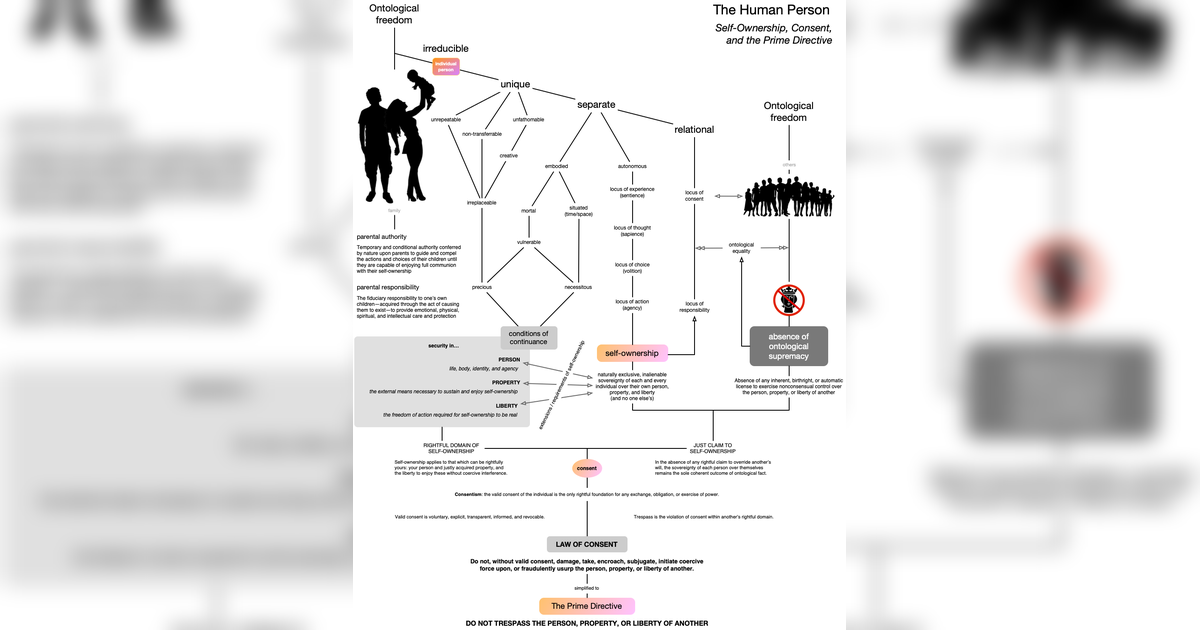
(Follow along in the chart below to see how it all connects.) 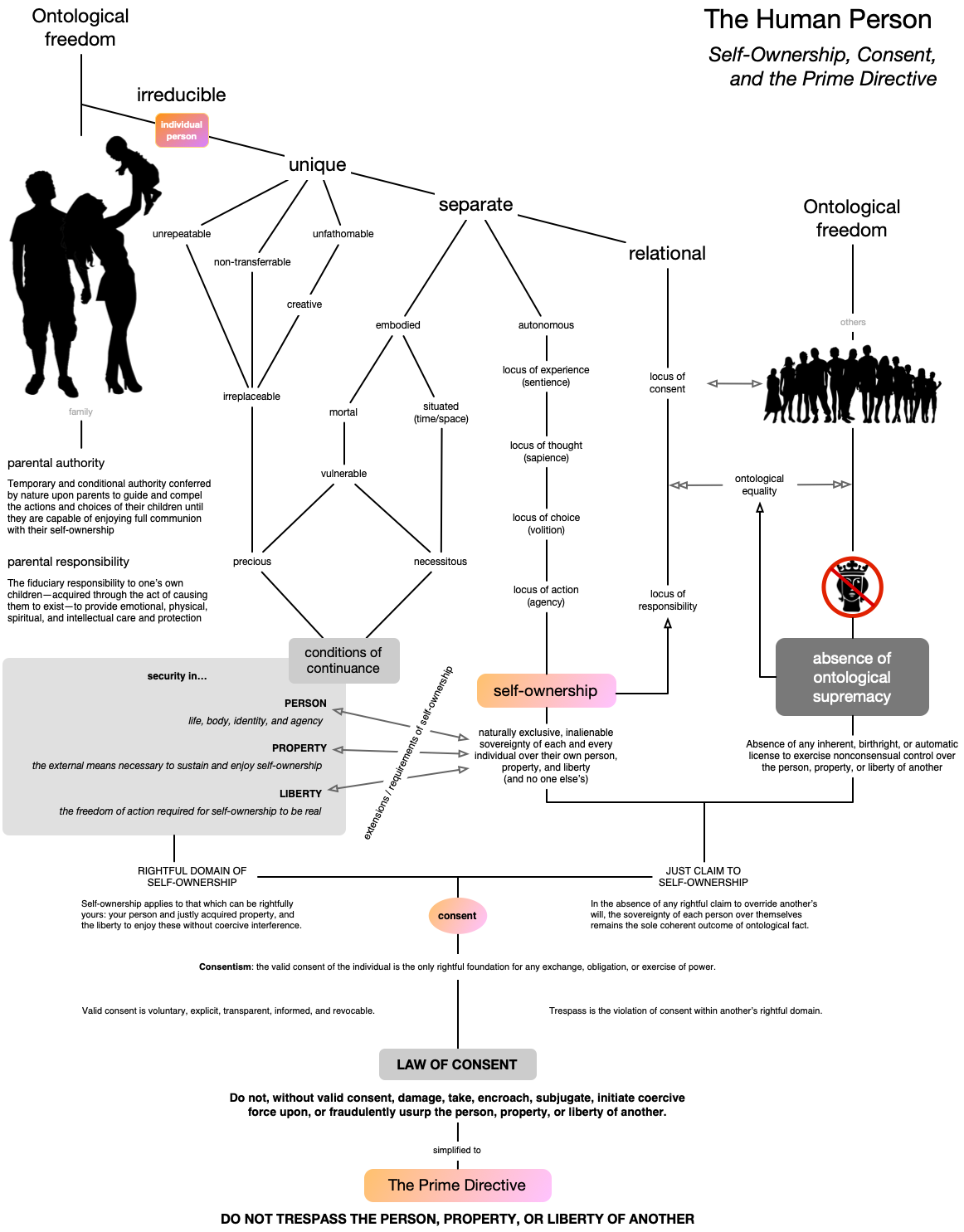
Only you can own you.
You have responsibilities to others. There are people with whom you choose to share your time, your being, and even your body. In some sense, you may "belong" to God, though we will leave that to each individual's personal belief system. Here on Earth, no other person owns you.
This is not a moral preference; it is a natural fact. As the autonomous locus of your own actions and choices, you are the self-governing author of your own life. You have dispositive decision-making authority over yourself as a fact of your existence as a person, and dispositive decision-making authority is the core characteristic of a property right. You quite literally own yourself.
You can, by some act of coercion, be severed from the enjoyment of that self-ownership, but the self-ownership itself cannot be taken away by any force in the world. Your self-ownership is thus naturally exclusive and inalienable. Your personhood itself cannot be usurped or unmade. No one else can own you, and you cannot own anyone else.
The rightful domain of self-ownership
The sovereignty you hold over yourself does not end at the boundary of your skin, however. A self-owning being must act in the world: to move, choose, build, exchange, create. To live. In this activity, your inner agency meets the outer world, and in that meeting arises a rightful domain within which your self-ownership must be free to operate.
Here too, we are not making a mere moral claim; we are stating a hard fact: every living system requires freedom and a secure domain for its continuance. As the self-owning mover of your own life, you are naturally free to pursue this continuance—to do what it takes to survive and to thrive.
To act freely in the world, you must be secure in your person, property, and liberty. These are not mere social conventions but the natural conditions of continuance.
No one is born 'booted and spurred.'
Most people recognize that they have this natural freedom to act in the world, so long as they do not interfere with others' freedom to do the same. We generally refer to this as having rights. Even if there were no government to enumerate or offer legal protections for such rights, we still know, on some deep and primordial level, that we have them, and we know darned well when they are being violated.
But why do we have them? It all begins with another natural fact: no one is the boss of you.
"Ontological" is a big word, but it really just means "relating to or based upon being or existence." No one has any ontological—that is, inherent, automatic, or birthright—authority over you. There is no intrinsic license to rule. Fixed classes of highborn and lowborn are social conventions; they do not exist as an automatic fact of nature.
Humans began to recognize this fact a long time ago. Here is Richard Rumbold, right before his execution in Edinburgh in 1685:
I am sure that there was no man born marked by God above another; for none comes into this world with a saddle on his back, neither any booted and spurred to ride him.
Ten days before his own death, Thomas Jefferson borrowed heavily from Rumbold, saying,
All eyes are opened or opening to the rights of man. The general spread of the light of science has already laid open to every view the palpable truth, that the mass of mankind has not been born with saddles on their backs, nor a favored few, booted and spurred, ready to ride them legitimately by the grace of God.
What they were stating with poetic eloquence, we here assert as a brute fact: Ontological authority does not exist. Some people may have natural abilities that make them good leaders, but no one has an automatic license to rule.
Auctoritas and potestas
Broadly speaking, we can describe license as a permission or warrant to take specific actions, and authority as the license to compel the actions and choices of others. And because one's actions and choices occur within one's rightful domain of self-ownership, we can further expand the definition of authority to the license to exercise control over the person, property, or liberty of another.
Authority comes in two main forms, delineated by the Roman historian Tacitus as auctoritas (authority granted by consent) and potestas (authority imposed by force).
When I studied karate, I granted my sensei a rightful license to guide my actions and choices. I could withdraw that consent whenever I wished, of course, but while I was in his class, he was, in fact, the boss of me. I chose that.
Imposed authority, by contrast, has no rightful license. The perpetrators of imposed authority claim to have license to rule, but that license is simply invented by the authorities and then imposed by force. They grant themselves “permission” and then clobber you if you resist.
Inescapable contradictions
This type of authority—potestas—exists, in that it is an empirical phenomenon in the world. But the rightful license they claim to have does not exist, either in nature or in logic. They made it up.
Princes, potentates, and politicians have been perpetrating this ruse upon the bulk of humanity for thousands of years. If we are ever to escape this cycle, we need to be armed with the facts. Not just moral pleas, but real facts.
This is where the rest of our philosophical calculus comes in.
A performative contradiction occurs when someone attempting to refute an argument must confirm the truth of that which they are trying to deny. (If I assert that you speak English and your attempted refutation is delivered in English, you have committed a performative contradiction.)
We will use this tool to demonstrate that there is no rightful license to impose authority by force.
Performative contradiction #1
We begin with our central claim: Ontological authority does not exist; therefore, all authority must either be granted consensually or imposed by force.
If we do not consent to be ruled, their attempted refutation always ends up looking something like this:
Obey me.
WOULD-BE SUBJECT
No.
WOULD-BE RULER
(draws sword)
OBEY ME.
We don't usually see the sword (or gun, these days), but it's always there. If a would-be ruler insists that he has the rightful authority to rule others and those others do not consent, he has no choice but to impose his rule by force. In doing so, he has proved our claim. Since neither he nor any other ruler can exercise nonconsensual rule by any means other than force, our claim rises to the level of an axiom.
Every act of non-consensual rule is an admission that rightful authority cannot exist without consent—otherwise, force would be unnecessary. Coercion does not confer legitimacy; it confesses its absence.
This contradiction is enough on its own. However, let us further expose the hollowness and hypocrisy with a few more.
Performative contradiction #2
Our claim: Any system that
- grants special rights to some to commit acts that are forbidden to others,
- requires citizens to respect the consent of their fellows but exempts officials from this requirement,
- requires citizens to respect the self-ownership of officials but exempts officials from this requirement,
is a forcible imposition of inequality.
Attempted refutation:
That's not true at all! Everyone is equal!
Now, here's the list of things we're allowed to do that you are not.
In other words…
Sorry, the only way this works is if we grant ourselves special rights and then pretend that you consented.
They never offer any other option. They have no other option. Thus, they cannot refute us without performing the truth of our claim. All involuntary governance is a forcible imposition of inequality.
More contradictions
"Sure, you have self-ownership…we just don't care."
Even if a would-be ruler refuses to argue and simply acts to impose his rule, the contradiction persists in the nature of the action itself:
- To compel another, you must recognize them as a distinct being whose will differs from your own (otherwise compulsion would be unnecessary).
- This recognition implicitly affirms their separate agency—the very agency the compulsion seeks to negate.
- Thus, every act of non-consensual domination carries within it a tacit acknowledgment of the other’s independent sovereignty.
In other words…every act of coercion affirms what it attempts to destroy. They know you have self-ownership, but they assert that theirs supersedes yours. This deepens the contradictions further, especially given their hypocritical noises about "equality"…
"All animals are equal; some are more equal than others."
Jefferson's statement that all people are "created equal" (not equal in abilities, but ontologically) is absolutely true. But let's prove it, just to be rock-solid:
- If ontological inequality exists, some would possess ontological authority (an inherent license to rule others).
- Ontological authority does not exist.
∴ Ontological inequality does not exist; therefore, all persons are ontologically equal.
(For the logic geeks out there, that's modus tollens, right? A → B; ¬B; therefore ¬A)
Those of us who cherish Jefferson's words today are not engaged in hollow moralizing. He was factually correct—people are, quite literally, created (ontologically) equal. Yet government officials give themselves rights that you don't have—to tax, to arrest, to compel behavior without consent. In other words, governments may pretend to believe that all people are equal before the law, but none actually act on it—not even the United States.
Responsibility without agency?
As the exclusive author and instrument of your actions, you are exclusively responsible for those actions. Only a self-owning moral agent can be held morally accountable, and governments do treat you as a self-owner when they hold you responsible for violating their laws. And yet they deny you the status of self-owner when it comes to imposing governance without your consent.
Pretty neat trick, huh? Except it's another major contradiction:
- To hold a person responsible is to recognize them as a self-directing moral agent.
- To coerce a person without their valid consent is to negate them as a self-directing moral agent.
- Therefore, any system or actor that both coerces and holds responsible commits a contradiction in practice—presupposing the very agency it violates.
They cannot coherently claim license to rule while also holding you responsible for your actions. To do so is to treat agency as both real and unreal in the same act.
———
I trust the point has been driven home.
But wait, there's more. This gets even bigger than just authority…
The absence of ontological supremacy
Humanity has languished under the thumb of illegitimate rulers for thousands of years. As such, our revelations tend to focus on the nature of authority. We think in terms of the spurred and the saddled, the rulers and the ruled. But the reality of ontological equality applies not only to would-be rulers, but to everyone.
The government official says, "I am your rightful ruler," and we know he is wrong. But the same goes for criminals or anyone else who claims, or acts upon the belief, that their will rightfully overrides yours. We know that is wrong too. Thus, we will treat ontological authority as a subset of the larger concept of ontological supremacy, and state categorically that Ontological supremacy—that is, any inherent, birthright, or automatic license to exercise control over the person, property, or liberty of another—does not exist.
Our subsets of "ontological" give us a tripartite denial:
-
Inherent → denies metaphysical hierarchy.
Birthright → denies hereditary hierarchy.
Automatic → denies procedural, default, or institutional presumption of hierarchy.
Consensual hierarchy is legitimate, of course, so long as the consent is valid (voluntary, explicit, transparent, informed, and revocable). That, of course, rules out every nation-state on the planet, since none of them ever bother to ask for such consent.
The burden of proof
These truths we have been illuminating have moral implications. And yet, as you may have perceived, we have not been relying on moral claims. Everything we are describing is a fact of being, not a plea for respect.
Self-ownership is a fact. It can no more be alienated from a person than a triangle can be alienated from its three-sidedness. Ontological supremacy is no more real than a number that claims to be both odd and even at the same time. These facts have normative implications, but they are, first and foremost, facts.
We have a just claim—that is, a right—to security in our person, property, and liberty. For centuries, classical liberals have attempted to justify this claim by reference to what we have (a moral right). But the real key, as it turns out, is to look at what the would-be rulers don't have.
- There is no rightful license to supremacy over another. It does not exist.
- Because it does not exist, there can be no epistemic justification for it—it is factually incoherent.
- An idea that is factually incoherent cannot be morally coherent.
The burden of proof isn't on us. It's on them.
And they have nothing.
Self-sovereignty is not something that authorities graciously permit. Self-sovereignty is the default condition of existence. Every claim to the contrary is factually, and thus morally, empty.
Everyone knows.
Morality is a fact of human life.
It is induced from experience and deduced through rational thought. It is observable in nature. It is felt.
Morality exists in brain structures that, when functioning properly, mediate emotions (such as conscience, empathy, and remorse) that produce ethical behavior. (Note: It is precisely these structures that are damaged or under-functioning in the brains of psychopaths.)
Morality is practical. Morality is taught. Morality is shared.
Morality is real.
Philosophy, like statistics, can be manipulated to make anything sound plausible. But that's not philosophy's job. Philosophy's job is to explain why things are the way they are. To figure out what is good. To explore and explain things that everyone knows intuitively…not to use sophistry to talk us out of them.
Everyone knows when their consent is being violated, and no one likes it. No amount of dancing on the head of a pin will ever change that.
Everyone knows that consent is the difference between boxing and assault, sex and rape, borrowing and theft.
Consent is the beating heart of morality and justice.
The just claim of self-ownership
You can search to the ends of the universe, and you will never find any justification for any person to claim supremacy over another. Any such claim—by a criminal or a government official—is dead on arrival, and we are under no moral obligation to submit or obey.
The only burden of proof that falls on us is to explain why the less obvious instances—taxation, for example—fall into the same category. And that is easily done.
The just claim of self-ownership is not a new “ought”; it’s the logical remainder once the possibility of rightful domination is eliminated. Self-ownership, and the secure domain in which it must operate, is not some social dispensation—it is woven into the very fabric of the universe.
CONSENTISM
Consent is the linchpin of all of this.
The only morally legitimate way one person may exercise control within another’s rightful domain is if that other consents. Thus, the consent of the individual human person is the fundamental unit of moral concern. This provides us with a coherent philosophy: Consentism.
Consentism is The moral philosophy, grounded in the facts of nature, that the valid consent of the individual is the only rightful foundation for any exchange, agreement, authority, or encroachment upon the person, property, or liberty of another. Consentism is roughly analogous to anarchism and voluntaryism.
Like anarchism, consentism holds that no one has rightful authority over another’s person, property, or liberty except by that other’s consent. Since all involuntary governance runs afoul of this requirement, consentism, like anarchism, recognizes all involuntary governance as morally impermissible. However, it lacks the terminological baggage of anarchism's association (however erroneous) with "chaos" and "disorder."
Like voluntaryism, consentism holds that all exchanges among persons ought to be voluntary. Here too, it offers a terminological improvement, since voluntaryism is frequently confused with "volunteerism."
The Law of Consent and the Prime Directive
We have to be careful about the size of the brush with which we paint.
I cannot, for example, demand that strangers gain my consent before asking me the time of day or accidentally brushing my shoulder in a crowded room. Nor are the personal activities and consensual exchanges of others my business in any way. Not everything requires consent.
This is why we have so carefully established the rightful domain of self-ownership as only that which can be rightfully yours: your person and justly acquired property, and the liberty to enjoy these without coercive interference.
Ultimately, our goal is peace and social harmony. Thus, it will help us to know what sorts of acts do require consent. We can describe these as trespasses. A trespass is a violation of consent within another's rightful domain.
In Part 3, we developed a list of trespass categories, and as it turns out, they are indeed the sort of acts that everyone knows are wrong. Let us state them formally, as a part of a Law of Consent: Do not, without valid consent, damage, take, encroach, subjugate, initiate coercive force upon, or fraudulently usurp the person, property, or liberty of another.
(Recall that in Part 2, we established that in order for consent to be valid, it must be voluntary, explicit, transparent, informed, and revocable.)
Finally, as we demonstrated in Part 3, we can shorten all of this into a compact and easily understood Prime directive: Do not trespass the person, property, or liberty of another.
A funny thing happened on the way to the Prime Directive…
All we did was prove what you already knew! Consent is non-negotiable.
You already knew that. Every living creature needs freedom to seek out its own continuance and betterment.
You knew that too. All creatures do! It is wrong to trespass the person, property, or liberty of another.
You did not need anyone to tell you that. You. Already. Knew.
Our purpose here has not been to develop some new kind of morality. We have simply explained why things are the way they are. We have clarified the truth. Instead of relying on question-begging or making vague appeals to "right reason," we have shown our work…just so there's no doubt.
For most of recorded history, we have been ruled by tiny factions of overlords. Today, administrators have replaced aristocrats, and the pretense of majority rule has replaced monarchy, but nothing has really changed. We are still ruled, without our consent, by a small minority.
But we are waking up. We were born free—not by decree, but by being. Reclaiming that truth is not rebellion—it is remembering.
Slowly, inexorably, we are remembering who we are. We were not born with saddles on our backs. We are not serfs in need of masters. We are the people who know the truth.
And now, we are going to start building a new world based on this truth.
Questions? Input? Concerns? Feel free to email me at chriscook@theadvocates.org