The Zoom window on my laptop suddenly flickers to life amid light laughter and exchanged hellos..
Michele Steeb, author of Answers Behind the Red Door: Battling the Homelessness Epidemic, leans forward into the screen with a focused, compassionate energy that she’s known for.
Adrianna Granlund, radiant and grounded, sits smiling, embodying what it looks like when redemption is not just a story but a way of life.
I clear my throat, letting them know we’re recording. “The reason I’m capturing this conversation,” I tell them, “is that this isn’t just about policy. It’s about freedom and sovereignty—the kind of deep, personal accountability that allows someone to govern their own life. People don’t talk about that enough.”
Adrianna nods, her voice warm. “Thank you so much for having me, Diamond-Michael. I’m really excited and grateful to be here with Michele, my mentor.”
And with that, we step into the raw and courageous narrative of a life transformed.
The Myth of the “Perfect Victim”
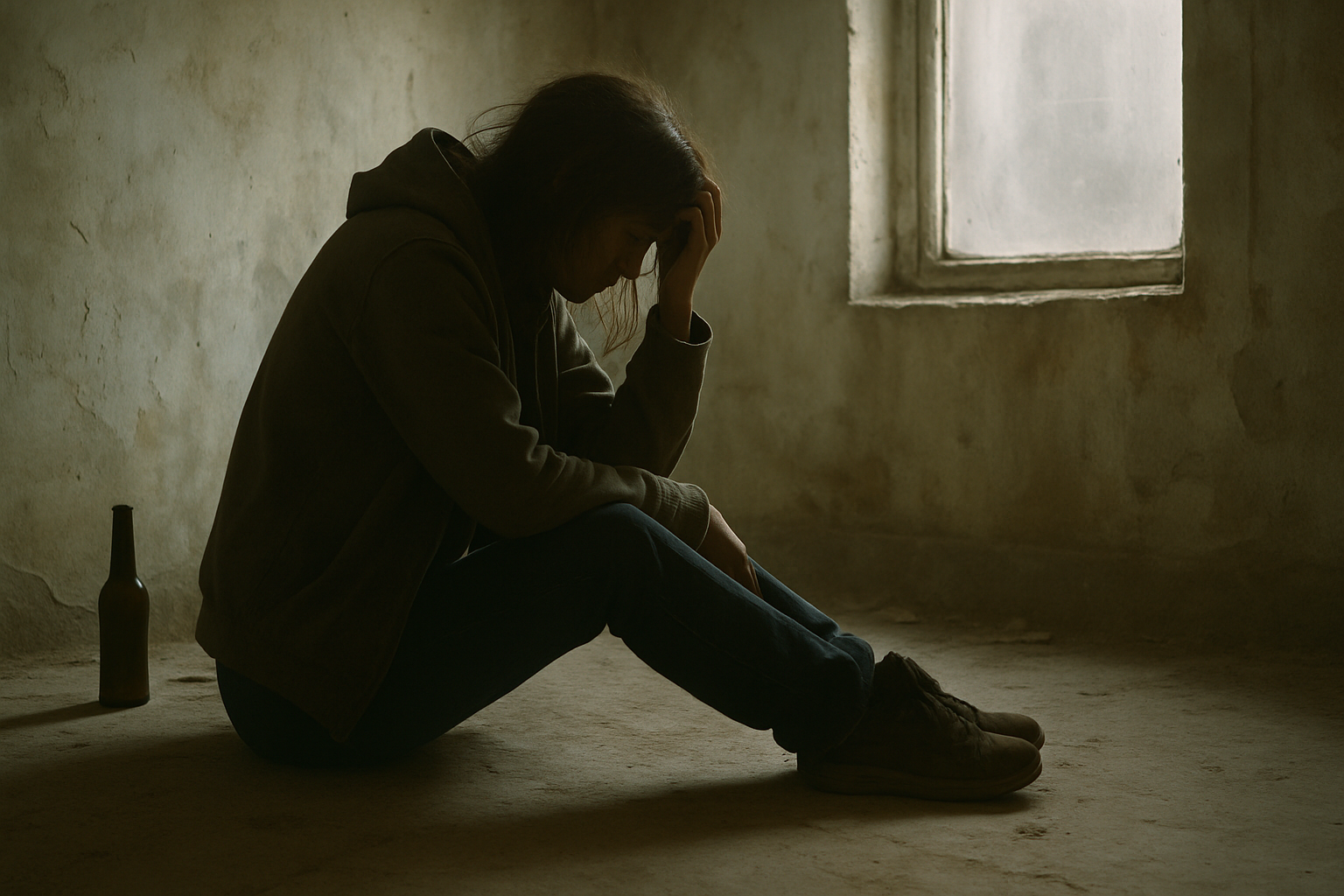
“I had a really great upbringing,” Adrianna begins. “I wasn’t a product of my environment. But I never felt like I quite fit in. So I started using drugs at thirteen. Meth, alcohol, cannabis—the whole nine. It became my way to escape myself.”
For twenty-three years, that escape route became a prison. Through those years, she had three children, lost them to Child Protective Services (CPS), and cycled through rehab after rehab. Each time, she would stabilize, get free housing, get her kids back, and then relapse. The free housing that was meant to be a lifeline became a runway back into chaos.
“I thought I had hit the lottery,” Adrianna recalls. “But as an addict, free housing just meant I had more money to use drugs. I’d spiral out. Relapse. And then I’d know free housing was waiting for me again. It kept me stuck.”
It’s here where Adrianna’s story shatters a common narrative— one that paints every homeless or addicted person as a passive victim of circumstance, waiting only for the right policy or government program to save them. Her life is proof that well-meaning solutions can have unintended consequences, and that the road out of addiction is paved not with subsidies alone but with structure, accountability, and the courage to choose change.
St. John’s and the Power of Self-Accountability
Adrianna’s turning point came when she entered St. John’s Program for Real Change in Sacramento.
“They offered me more than 90 days,” she says, her eyes bright with memory. “They gave me structure. Chores. Therapy. Drug counseling. Three meals a day. They required us to work, to budget, to open bank accounts. They gave me the tools to become the woman I am today.”
Today, Adrianna is a certified drug and alcohol counselor, nearly nine years sober, the proud owner of her second home, and the author of a memoir titled Beautifully Broken and Wonderfully Put Back Together. Her story is not just one of recovery but of radical re-parenting—of herself, of her children, of her own sense of worth.
Michele speaks as Adrianna listens. “She represents 80% of the homeless population,” she adds, “people struggling with addiction, mental illness, trauma, and joblessness. Housing First, which is the federal policy that has dominated since 2013, doesn’t address these underlying issues. It isolates people. It removes accountability. It assumes a key to a door is the solution.”
And that is where the conversation shifts from one woman’s transformation to a larger question that every reader must grapple with: What is the role of accountability in restoring a life?
The Crisis of Compassion Without Clarity
In 2013, the U.S. Department of Housing and Urban Development (HUD) adopted a policy called Housing First, shifting billions of dollars away from shelters, transitional housing, and treatment programs, and directing those funds almost exclusively toward permanent housing subsidies. The promise was bold: end homelessness within a decade.
But twelve years later, homelessness has risen by nearly 35%, the highest level in American history.
“This is not just about policy failure,” Michele says. “When we give people keys without community, accountability, or treatment, we are essentially abandoning them to their diseases. It’s laissez-faire neglect.”
Her words land heavily. I think about the tents I see lining streets in cities across the country, the lives playing out in the shadows of overpasses, the silent epidemic of overdose deaths. Compassion without clarity is not compassion—it is abdication.
Adrianna jumps in. “Isolation was the worst thing for me. St. John’s put me in community. They made sure I couldn’t hide. And that saved me.”
Self-Accountability as a Daily Practice
For Adrianna, freedom is not just about owning a home or being free of substances. It is about living intentionally, showing up for herself and her children, and contributing to society in ways she never imagined possible.
“I have great relationships with my kids now,” she says. “I have a new car I bought myself. I’ve lost 211 pounds. I’m on spiritual retreats with my recovery community. And I keep setting goals and meeting them.”
What’s your political type?
Find out right now by taking The World’s Smallest Political Quiz.
Take the Political QuizShe smiles, almost in disbelief at her own trajectory. “I never thought past the next day when I was using. Today, I have a future. And more importantly, I have a purpose.”
Michele sees this as the ripple effect of a life reclaimed. “Her children and grandchildren will grow up seeing this example,” she says. “That’s generational transformation. And it happened because Adrianna was given the gift of structure and chose to do the work.”
This is where sovereignty comes alive, not as a political slogan, but as a lived reality. It is the process of becoming the kind of person who can be trusted with freedom.
The Call to Build Something Different
As our conversation winds down, Michele grows serious. “We have witnessed twelve years of failed policy,” she says. “This administration, through a recent executive order, is finally saying enough is enough. They are saying that we must prioritize treatment and recovery again. But the work ahead is enormous.”
And that’s where the rest of us come in. Because this story is not just about Adrianna or Michele or me—it is about all of us. It asks us to consider what we believe about compassion, about justice, about the kind of society we want to build.
Do we want to create a world that simply hands out keys and leaves people to languish? Or do we want to build systems and communities that require something of us all? Systems that ask for accountability but also offer hope, dignity, and a path back to purpose?
A Personal Reflection
I share with Adrianna and Michele that I once had eight months in 2019 where I lived without a home of my own, drifting between 24-hour coffeehouses and borrowed couches. I was not homeless in the same way Adrianna was, but I got a glimpse of what it feels like to be unmoored, to lack a place to stand.
“This work is personal to me,” I say. “Because I know what it’s like to lose footing, and I know what it takes to fight your way back.”
And that, perhaps, is why this conversation matters. Because every person who reads this has a choice to either look away or to lean in, to ignore the encampments on our streets or to ask what it would take to bring those lives back into community, back into accountability, back into hope.
Choosing to Bet on Ourselves
Adrianna ends with a sentence that stays with me long after the call ends: “The life I have today is beyond my wildest dreams. And I wouldn’t have any of it if I hadn’t chosen to bet on myself.”
That is the invitation to bet on ourselves. To build systems that invite others to do the same. To create a culture where freedom is not merely the absence of restraint, but the presence of purpose.
Because when one life is reclaimed, the ripple effects stretch far beyond that single person. They touch children, grandchildren, neighbors, clients, whole communities. They remind us that sovereignty is not given by governments. It is cultivated one choice, one day, one act of courage at a time.