The Nolan Chart · Since 1969

Comparing Political Types

Most political quizzes force you to pick a side on a single line. The Nolan Chart uses two dimensions to reveal the political type that actually matches your views: libertarian, conservative, progressive, moderate, or authoritarian.

The Nolan Chart showing five political types mapped by economic and personal freedom
The Framework

What Is The Nolan Chart?

For most of the twentieth century, political views were sorted along a single line running from "left" to "right." That model worked well enough when the loudest disagreements were about how to manage the economy. It works poorly today, when many of the most important political questions are about personal freedom, civil liberties, and the proper limits of state power.

In 1969, libertarian David Nolan proposed a simple fix: stop forcing every political position onto one axis, and start measuring two things separately. How much economic freedom should people have? And how much personal freedom should they have? Plot the two scores against each other, and a richer political map appears.

The Nolan Chart is a basic mapping of political types that is more detailed than any simple left/right axis. The chart's five types are determined by the degree of one's support for two intersecting dimensions of freedom: economic freedom and personal freedom.

LIBERTARIAN High both PROGRESSIVE High personal CONSERVATIVE High economic AUTHORITARIAN Low both MODERATE ECONOMIC FREEDOM → PERSONAL FREEDOM → Two Dimensions, Five Types
The Two Axes

What "Freedom" Actually Means in This Framework

The Nolan Chart breaks freedom into two questions and lets your answers fall where they may. Both matter. Neither one collapses into the other.

Economic Freedom

Economic freedom is defined as the degree to which individuals can protect their business, property, or earnings from aggression by others and the degree to which they can produce or exchange goods and services without interference.

Touches questions like
  • Taxation
  • Free trade
  • Regulation
  • Property rights
  • Labor markets

Personal Freedom

Personal freedom is defined as the degree to which one may engage in certain behaviors unmolested. Such includes the practice of religion, the exercise of free speech, and the freedom to move around and/or associate with others.

Touches questions like
  • Free speech
  • Religion
  • Drug policy
  • Privacy
  • Personal lifestyle
Meet The Five

The Five Political Types

Each type represents a coherent answer to the two questions of freedom. None is a caricature; each captures a real way that millions of people think about politics. Click any card to read the full profile.

High Personal · High Economic

Libertarian

Libertarians score high on both economic and personal freedom. In other words, libertarians value entrepreneurship and enterprise, often because they think these are the bases of a prosperous society. Libertarians are also keen to protect the individual in his or her pursuit of happiness, however different that pursuit might look to others.

Read more

Because libertarians value both economic and personal freedom highly, they think governments should be limited or eliminated entirely. Government, after all, has a monopoly on the initiation of violence in a jurisdiction. Libertarians view this monopoly power with skepticism and as a potential source of injustice.

Because government authorities use the threat of violence to privilege or oppress certain persons or groups, libertarians tend to support the rule of law and equality before the law. While the most consistent libertarians are anarchists, all libertarians think there should be rules and laws. The difference is, libertarian anarchists think any system of rules should be based on consent rather than compulsion.

Libertarian anarchists should therefore not be confused with self-styled "anarchists" who stir mob violence.
Because libertarians believe governance should be based on consent, some libertarians are willing to accept rules and restrictions on their behavior so long as they consent in advance and retain a right of exit. (See, for example, homeowners associations.)

Read the full profile
High Economic · Lower Personal

Conservative

Conservatives score higher on economic freedom but lower on personal freedom. For example, conservatives generally support honest entrepreneurship and free enterprise but think that too much personal freedom breeds widespread immorality. Conservatives thus worry that excesses in personal freedom can lead to cultural or civilizational decline.

Read more

Because conservatives value law and order, they also tend to support broader police powers. While some conservatives are uncomfortable with showy displays of wealth, they support individuals working hard and amassing wealth for themselves and their families. (In more recent times, some conservatives have come to embrace protectionist measures, which moves them in the direction of populism. See, for example, Trumpism.)

Conservatives also tend to embrace some form of religion or at least a shared moral system that they believe holds the social order together. Such includes family, tradition, honesty, and hard work. Indeed, most emphasize family as the basic ordering unit of society.

Read the full profile
High Personal · Lower Economic

Progressive

Progressives (sometimes referred to as "liberals") score lower on economic freedom but higher on personal freedom. That means progressives are quicker to embrace values of personal choice but place a comparatively lower value on private property rights or investment, production, and exchange. Many progressives think capitalism is a system that allows the strong to prey upon the vulnerable.

Read more

Most progressives are committed to the administrative ordering of society along economic lines. Because progressives view themselves as advocates for those they consider dispossessed or disenfranchised, progressives favor wealth redistribution. Such redistributive policies include high taxes and revenues to fund centralized social programs or welfare schemes.

In recent decades, many progressives have moved away from supporting civil liberties such as free speech, and legal doctrines such as equal treatment under the law. Instead, more progressives think that social justice requires abandoning civil rights in favor of "equity," which means equality of outcome. More contemporary progressives are willing to curtail the freedoms of certain groups — such as the wealthy — whom they view as oppressors operating in an unfair system.

Read the full profile
Mixed · Pragmatic

Moderate

Moderates (sometimes referred to as "centrists") score neither particularly high nor particularly low on either economic or personal freedom. That's because moderates tend to be pragmatists or otherwise think about issues on a case-by-case basis. As with any other type, moderates can 'lean' progressive, conservative, libertarian, or authoritarian — it's just that those leanings aren't extreme.

Read more

Other forces shape moderates' views, so they are, in many ways, the most difficult type to understand. For example, political moderates sometimes support centrist views not on any principle but on the grounds of political expediency. Instead of asking What does my ideal society look like? They might instead ask What can we possibly get done here? In this way, it's no wonder that moderates sometimes have a populist streak.

Moderates can also be difficult to type because they can have extreme views on one issue but not on another. So while some moderates just don't have strong views about anything, other moderates have strong feelings on this issue or that, which seems inconsistent to those with more comprehensive ideological views. In any case, the core of being a moderate is sometimes simply to view a given matter with greater circumspection and less extremism.

Read the full profile
Low Personal · Low Economic

Authoritarian

Authoritarians generally score low on both economic freedom and personal freedom. That means authoritarians are not only hostile to free enterprise, but they also believe authorities ought to regulate people's personal behaviors to maintain social order. Authoritarians want the state to control more aspects of economic and personal life because they think such control is more likely to bring about an ideal society.

Read more

To the extent authoritarians do tolerate private enterprise, it's because some believe companies can be forced into serving their ends. In other words, it behooves authorities to direct companies to serve the good of society as a whole. Such a system is referred to as corporatism or fascism. By contrast, authoritarians who tolerate no private enterprise believe the state should control all means of production. This authoritarian form is referred to as socialism. Thus, both fascism and socialism are authoritarian forms.

With regard to personal liberties, authoritarians think autonomous individuals are a threat to the overall order. Ideal societies have to be planned. As such, society's planners cannot tolerate excessive diversity of opinion or any expression that challenges or questions its authority or expertise. People have an urge to control or to submit to control in times of crisis. Authoritarians understand this dynamic well and are willing to use it to realize their conception of the good, even if such requires the threat of state violence.

Read the full profile
Side By Side

Compare Any Two Political Types

Pick any two of the five types and read a full comparison of where they agree, where they disagree, and how to tell them apart in practice. Or use the matrix below to jump directly to any pairwise comparison.

I Want To Understand The Difference Between
vs.
Or jump straight to any of the ten comparisons
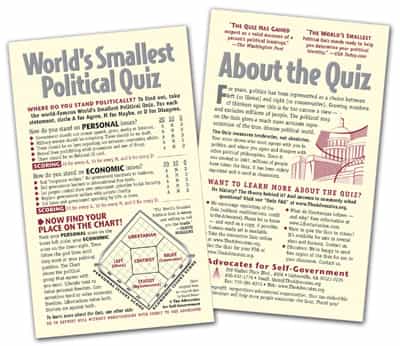
The World's Smallest Political Quiz

In Two Minutes,
Find Out Which One You Are.

Ten questions. Five on personal issues, five on economic issues. Your answers plot directly onto the Nolan Chart. The original online political quiz, taken by more than thirty million people since the 1990s.

10
Questions
2 min
To Complete
30M+
Have Taken It
Question 1 of 10
Personal Issues

"Adults should be free to make their own personal choices, as long as they harm no one else."

Common Questions

Frequently Asked

What are the five political types?
The five types defined by the Nolan Chart are libertarian (high economic and personal freedom), conservative (high economic, lower personal), progressive (high personal, lower economic), moderate (mixed positions and pragmatic temperament), and authoritarian (low on both). Each represents a coherent way of answering the two questions of how much state control should govern economic and personal life.
Is libertarian left-wing or right-wing?
Neither, and this is the entire point of the Nolan Chart. The traditional left-right spectrum forces every political position onto a single line, which obscures the fact that libertarians hold positions that look "right-wing" on economic questions (low taxes, free markets, minimal regulation) and positions that look "left-wing" on personal questions (drug legalization, civil liberties, non-interventionist foreign policy). On the Nolan Chart, libertarianism appears at the top — high on both axes — rather than at either end of a single line.
Is the Nolan Chart the same as the Political Compass?
The Political Compass uses the same two dimensions David Nolan identified in 1969: an economic axis and a personal-or-social axis. It launched in 2001 — three decades after Nolan published the chart, and a decade after the Advocates for Self-Government had already distributed the framework globally through the World's Smallest Political Quiz. The Political Compass relabels the axes and presents the result as a square instead of a diamond, but the underlying model is the same. Nolan's chart is the original; everything since has been a variation on it.
How accurate is the World's Smallest Political Quiz?
The Quiz is designed to give a fast, accurate placement on the Nolan Chart in about two minutes — not to capture every nuance of a person's political views. Ten questions cannot match the depth of a sixty-question survey, but the Quiz's questions were chosen specifically to discriminate well between the five types. After more than thirty million completions, the Quiz reliably places people in the type that matches their other political indicators. For more depth on any specific issue, ASG also offers Single Issue Surveys that explore individual topics in more detail.
What's the difference between conservative and progressive?
Conservatives generally favor economic freedom and traditional moral institutions; progressives generally favor active government in the economy and expanded civil liberties. The two camps disagree about whether inherited institutions embody accumulated wisdom (the conservative view) or accumulated injustice (the progressive view), and that disagreement shapes most of their specific policy differences. For a full comparison of the two, see our dedicated comparison page.
Where do most Americans actually fall on the Nolan Chart?
Polling that uses Nolan-style two-axis questions consistently finds that Americans are spread across all five types, with significant numbers in each. A 2011 Reason-Rupe poll found roughly 28% conservative, 24% libertarian, 20% communitarian (closer to authoritarian on this chart), and 28% liberal/progressive. This is one of the strongest arguments for using two dimensions instead of one: the traditional left-right line treats nearly half the country as not really fitting either side, when in fact those people often hold coherent libertarian or moderate views that the one-dimensional model cannot represent.
Who created the Nolan Chart?
The Nolan Chart was created by David Nolan, a libertarian activist and one of the founders of the Libertarian Party, in 1969. He first published the chart in an article called "Classifying and Analyzing Politico-Economic Systems" in the January 1971 issue of The Individualist. The Advocates for Self-Government has popularized the framework since 1985 through the World's Smallest Political Quiz and educational materials used in classrooms around the world.