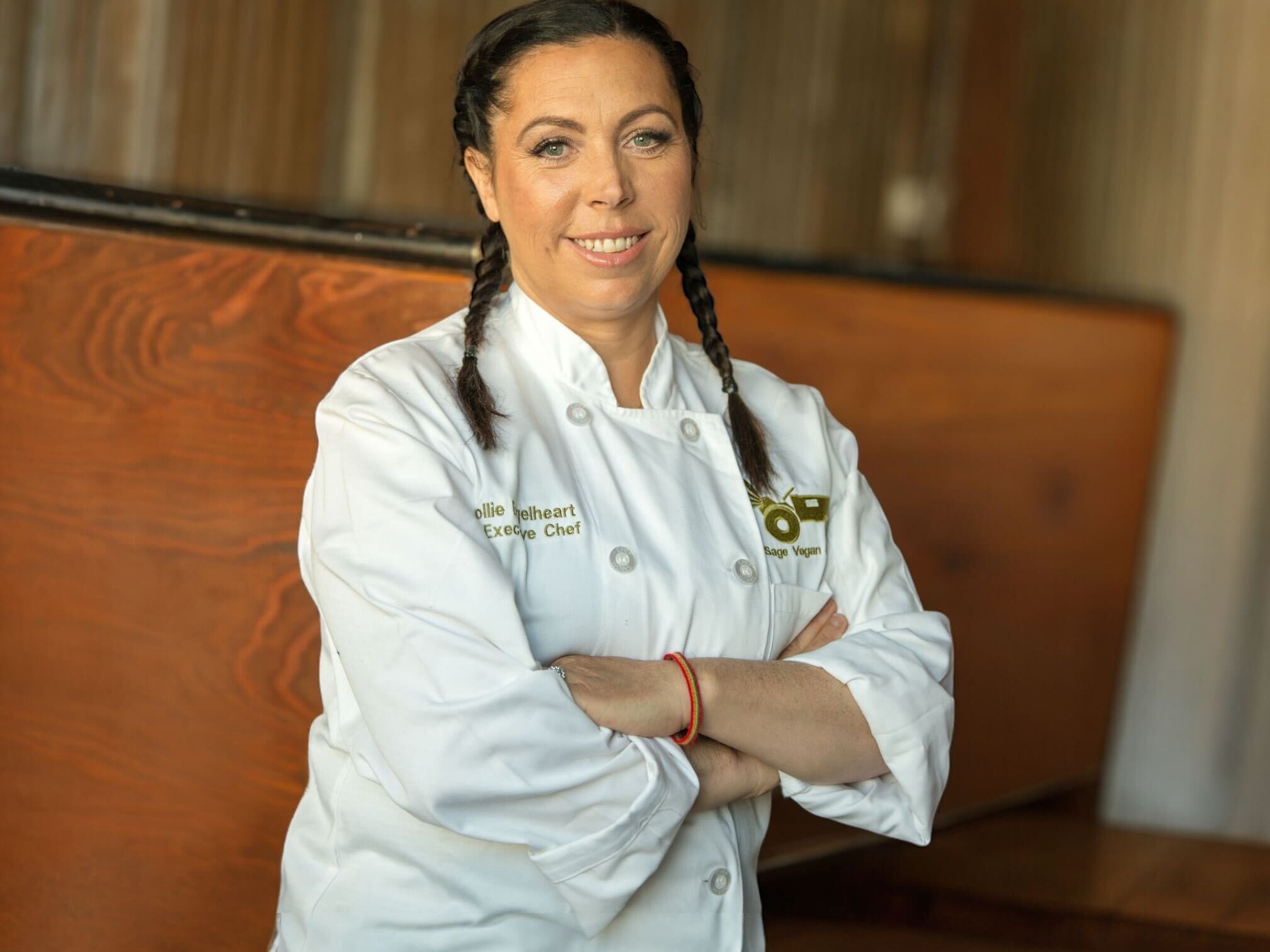
Mollie Engelhart is a leader in the regenerative-agriculture movement with two-hundred acres at Sovereignty Ranch in the Texas Hill Country, where she and her husband Elias now serve organic and regenerative ingredients at their restaurant, The Barn.
Her mission: produce healthy food from healthy soil for her communities. A mother of five, film producer, poet, and thought-leader, Mollie examines the connections of humanity, family, soil, food and culture — constantly questioning, “Where do we go from here?”
During the pandemic, she faced a state bureaucracy that destroyed her once-thriving Los Angeles restaurants, Sage Regenerative Kitchen.
In our interview on Free the People’s Food is Freedom series, we explore her journey from California to Texas, how she started a food forest, and what gardening advice she offers novice growers. We also discuss the soil-gut-mental health connection and the question: Would the natural world be better off without people?
The Roots of Regeneration
“When we eat sterile food from sterile environments, we become sterile — physically and spiritually.”
Q (Sienna): As a leader in regenerative agriculture, you’ve uplifted the importance of regenerating topsoil and biodiversity. How does this align with your philosophy about humanity’s connection to nature? A (Mollie): I spent much of my life as a vegan chef in Los Angeles, but I was raised on a small farm in upstate New York. Over time I realized food waste was a massive, overlooked issue that led me to start my own farm. Then I discovered there’s no such thing as vegan food. Everything in nature is interconnected.
Regenerative agriculture became my way of stepping back into our rightful role as caretakers of creation. Nature, to me, is an expression of God. When we eat sterile food from sterile environments, we become sterile — physically and spiritually. Reconnecting with soil, with life itself, is how we hear God’s whisper again.
Learning from the Soil
“Nature teaches us balance, not ideology.”
Q (Sienna): You’ve spoken about the interconnectedness between plants, microbes, and people. In practice, you grow comfrey, which supplies the soil with nitrogen and microbes through its roots, a good example of natural fertilizer, allowing less dependence on commercial fertilizer. Or oregano, for example, can be grown as a groundcover rather than relying on weed mats. In your food forest, you planted companions: corn to shade young avocado and lemon trees with kale nearby to aspirate moisture under the trees. What lessons can we take from the way companion plants and soil work together? A (Mollie): Plants share water, nutrients, even information through a vast underground web of microbes. If one plant is struggling, another can literally send it help. That’s cooperation over competition.
Nature never lies. If an idea doesn’t make sense in nature, it doesn’t make sense for us either. For example, veganism doesn’t pass what I call the “nature sniff test.” Most people couldn’t grow or sustain themselves on vegan food without industrial inputs. Nature teaches us balance, not ideology — and that same balance that heals soil also heals our bodies.
When your gut is alive with good bacteria, you’re participating in the same living web that runs beneath your feet.
Loss and Resilience in Los Angeles
“We’ve become obsessed with safety — a safety that doesn’t actually exist.”
Q (Sienna): You faced major challenges in California, especially closing your restaurants during the pandemic. What was that like for you? A (Mollie): I lost millions of dollars. Every week the rules changed: “At midnight you can’t eat indoors, at midnight you can’t sit at the bar, at midnight outdoor dining is too dangerous.” I was pregnant or breastfeeding the entire time, and my employees even called OSHA because I wasn’t checking vaccine cards.
That broke something in me. I realized we’d become obsessed with safety — a safety that doesn’t actually exist. One day I heard a clear voice say, “Stop being afraid.” From that moment on, I chose resilience over fear.
The Meaning of Sovereignty
“After losing everything in California, I wanted to build something they couldn’t take away.”
Q (Sienna): Your ranch is called Sovereign Ranch. Why that name? A (Mollie): After losing everything in California, I wanted to build something they couldn’t take away. The name came out of an event we hosted called Sowing Sovereignty — it was about gathering freely and sharing truths during the lockdowns.
“Sovereign” represents freedom from government overreach and the systems that strip us of joy and independence. I don’t want a massive bureaucracy controlling our food or our lives. I want people to have dominion over their own existence — the way the Constitution intended.
Faith, Freedom, and Food Policy
“I don’t want to connect my brain to a computer; I want to stay connected through prayer and creation.”
Q (Sienna): We’re seeing movements to remove fluoride from water and artificial dyes from food. Do you find these shifts promising? A (Mollie): I’m cautiously optimistic. It’s encouraging to see people question the systems that have made us sick. But I don’t trust government or tech billionaires who want to merge humans with machines.
What’s your political type?
Find out right now by taking The World’s Smallest Political Quiz.
Take the QuizWhat I pray for most is divine intervention… I don’t want to connect my brain to a computer.
The Carbon Footprint Debate
“It’s propaganda meant to discourage food independence.”
Q (Sienna): According to Climate Depot, the carbon footprint of homegrown food is five times greater than conventional food. What do you make of that? A (Mollie): It’s nonsense — propaganda meant to discourage food independence. Even if you buy soil in bags and drive to Home Depot, any step toward growing your own food is a net positive for the planet.
Industrial agriculture runs on fossil fuels and chemicals. The idea that homegrown food harms the Earth more? That’s part of a broader attack on food sovereignty — the notion that you shouldn’t or can’t feed yourself. We belong here. We’re part of nature’s design, not a plague upon it.
Advice for New Gardeners
“When your hands are in the soil, you’re in conversation with creation itself.”
Q (Sienna): While the beauty and abundance is nourishing above ground, the roots run riotous under the soil and the soil itself is such a crucial foundation. What advice would you give to a novice gardener for them to begin to build topsoil, and why? A (Mollie): Start simple. Grow crops that give back to the soil. Examples of this are legumes, kale, herbs, and perennials. Companion planting is key: let your plants support one another. Build compost, save seeds, and remember, this isn’t just about food. It’s about freedom, resilience, and belonging.
When your hands are in the soil, you’re in conversation with creation itself.
Listen to the Full Podcast with Mollie & Sienna
Shifting focus toward human health, there is a curious connection between healthy soil, healthy gut, and mental health, essentially between the microbiology of the earth and of the human body.
With the global push toward highly processed, corporatized foods and the demonization of local farms, grass-fed beef, and localized systems, we desperately need to uplift our health and our happiness from the grassroots. Free the People brings you Food is Freedom with Sienna Mae Heath.
Explore food as medicine and natural remedies free from Big Pharma, and find advice for novice growers, permaculture practices that nourish natural beauty, experiential learning activities, and ways to accomplish the divine art of homesteading.
Check out the short trailer here. Sienna Mae Heath is a gardening consultant, companion gardener, local tea vendor, writer, and artist. She is the host of the Food is Freedom and Real Unity podcasts on Free the People, where she explores agriculture, food as medicine, natural remedies, and human connection.