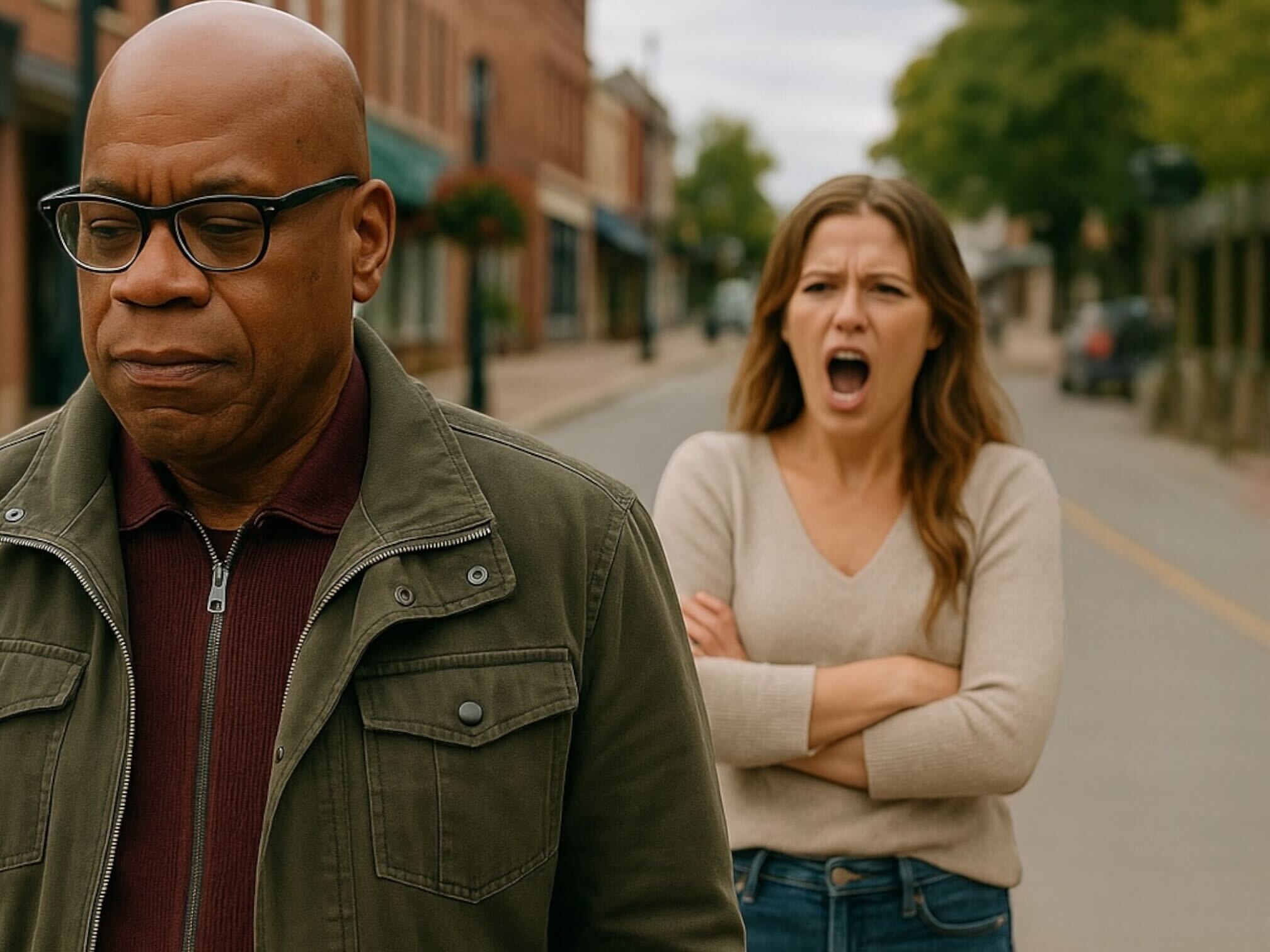
The insult hit me like a slap I wasn’t expecting.
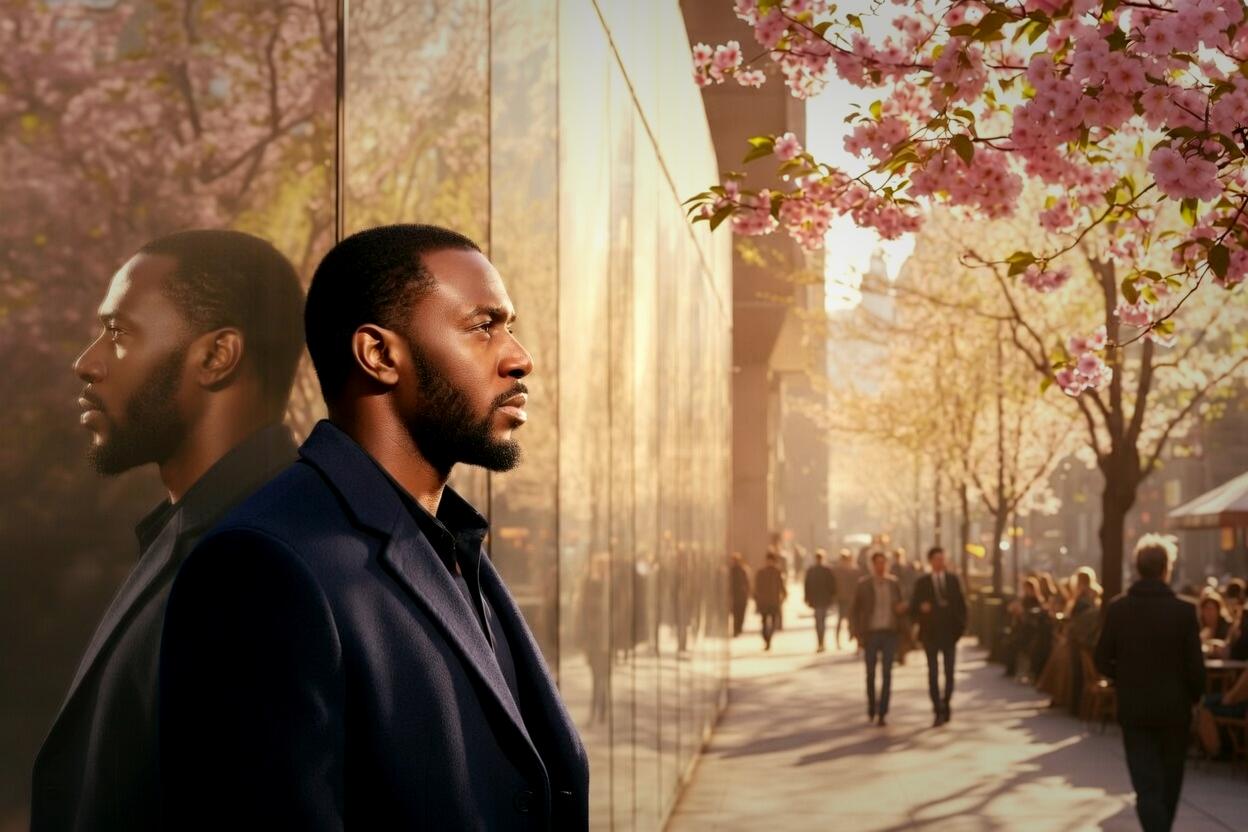
A racial slur that was ugly, sharp, and venomous—cutting through the crisp Colorado air while I was walking to a local coffeehouse.
It came from a woman who locked eyes with me, her face twisted in contempt.
For a moment, time slowed. My whole body stiffened. My instinct, the primal one, wanted to shout back, to reclaim my dignity through words.
But I didn’t.
I simply walked away.
And that walk—quiet, deliberate, painfully calm—was not cowardice.
It was an act of sovereign power.
When Words Become Weapons
People often talk about sticks and stones, but words, particularly racial slurs, carry energy that can pierce the spirit. They sting not because of the syllables, but because of the history behind them—the centuries of degradation, exclusion, and dehumanization baked into the American soil.
That day, the word hurled at me carried the weight of that history. Yet instead of letting it own me, I chose to let it pass through me.
There was a moment, standing there, when I felt the tension between two freedoms—a person’s freedom to speak, and my freedom to be unmoved.
That’s where the debate about free speech really lives—not in courtrooms or constitutional text, but in our daily encounters with other people’s shadows.
What Is Really Free?
The First Amendment guarantees that the government cannot silence her words.
But no constitution guarantees that words won’t wound.
That’s the paradox of freedom: the same liberty that protects my right to speak truth also protects her right to spit hatred.
In America, hate speech is protected speech. That may feel morally wrong, but legally, it’s part of our compact with liberty. We decided long ago that the government shouldn’t be the arbiter of what’s acceptable to say. That’s a heavy responsibility and a kind of dangerous freedom.
So if the government can’t restrict her tongue, who governs the use of that freedom?
We do. Individually. Internally.
That’s where self-government comes in. Self-government requires neither permission nor punishment.
The Tao of Restraint
When Lao Tzu wrote, “He who conquers others is strong; he who conquers himself is mighty,” he wasn’t speaking of warlords or politicians. He was talking about the quiet mastery of the inner landscape.
Walking away that day wasn’t weakness but wu wei in action: the Taoist art of effortless response. I wasn’t suppressing rage; I was allowing it to dissolve in the greater current of awareness.
The I Ching’s Hexagram 6, Conflict, teaches that when contention arises, the wise one retreats to higher ground, not out of fear but out of vision. The battle you avoid isn’t always the battle you lose. Rather, it’s often the one you transcend.
In that moment, I wasn’t trying to win. I was trying to stay whole.
Howard Thurman’s Quiet Power
The theologian Howard Thurman, whose writings nourished both Martin Luther King Jr. and countless freedom workers, wrote about the need to “center down”—to find that still place within where hatred cannot reach.
He believed true power arises from inner composure, from refusing to let external chaos dictate internal order.
When I think of that woman now, I realize she wasn’t free.
She was possessed by fear, by projection, by something unexamined in her own story.
I, on the other hand, had the power to choose presence over reaction.
What’s your political type?
Find out right now by taking The World’s Smallest Political Quiz.
Take the Political QuizThat’s real freedom: sovereignty over your own nervous system.
The Politics of Permission
We live in an era where political tribes weaponize speech itself. On one side, you hear “cancel culture”; on the other, “hate speech.” Both are symptoms of the same anxiety tied to the fear of losing control over the narrative.
But freedom isn’t tidy. It’s not polite. And it certainly isn’t safe.
The Founders didn’t design the First Amendment to protect agreeable conversation; they wrote it to protect confrontation. Speech, even hateful speech, tests our commitment to liberty.
As a Black man, I know the gut-level cost of that commitment. But if we start carving exceptions based on offense, the slope toward censorship becomes steep and slick. Today it’s the bigot we silence; tomorrow it’s the dissident.
The Marketplace of Pain and Ideas
Free speech is often described as a marketplace of ideas, but let’s be honest: the market is messy. Some sellers peddle poison. Others sell truth at a loss.
Yet, as in any market, the consumer bears responsibility. We can’t control what others sell, but we can control what we buy into.
That woman offered me hate that day.
I declined the purchase.
That, too, is an act of sovereignty.
The Tao reminds us that “what you resist, persists.” Fighting her hatred on her level would have only amplified it. My silence, paradoxically, was the louder statement.
Jung and the Shadow of Speech
Carl Jung would call what I witnessed that day “the shadow made visible.” The slur wasn’t about me but a projection of the part of herself she couldn’t accept.
In that sense, America itself is a nation in shadow. We project, deny, suppress, and repeat. We legislate free speech yet struggle with free hearts.
Jung taught that integration, not repression, is the path to wholeness. If free speech exposes the ugliness we’d rather not see, maybe that’s the first step toward collective therapy. The wound has to bleed before it can heal.
But exposure alone isn’t enough. We need the consciousness to meet darkness without becoming it.
The Paradox of Tolerance
The philosopher Karl Popper warned that “unlimited tolerance must lead to the disappearance of tolerance.” If we tolerate the intolerant, do we risk self-destruction?
Taoism would counter: every extreme invites its opposite. Trying to crush hatred through censorship often breeds more hatred underground. Trying to legislate civility often creates hypocrisy instead of healing.
The challenge, then, is to build a culture of voluntary restraint—a world where people choose decency not because it’s mandated, but because it’s wise.
That’s the essence of self-government: being your own law.
The Self-Governed Soul
Self-governance begins with emotional discipline. It’s the ability to stand in the storm of someone else’s ignorance and remain centered.
Most political debate on free speech revolves around what the government should allow. I think the deeper question is: What will I allow to live rent-free inside my consciousness?
If I let her words define me, she wins.
If I meet them with awareness and walk on, I stay sovereign.
That’s the Taoist version of freedom—not from opposition, but within it.
The Fragile Beauty of an Open Society
America’s experiment with free speech is both noble and excruciating. It demands that we hold space for the best and worst of human expression. It assumes that truth, given enough light, will eventually prevail.
That assumption is tested every day on our streets, campuses, and screens. Yet the alternative—a society where speech is policed for purity—is far more dangerous.
I don’t want to live in a nation where the state decides what offends me. I’d rather live in one where I can decide what moves me and where I can practice the discipline to rise above what doesn’t.
A Personal Reckoning
In the hours after the slur, I sat with a strange calm. The Tao teaches that “soft overcomes hard, the slow overcomes the fast.” Maybe walking away was the soft way of winning.
It didn’t feel triumphant. It felt human.
I thought about my ancestors, those who endured far worse and yet held their dignity.
I realized that walking away wasn’t retreat; it was inheritance. It was the quiet rebellion of staying free inside.
Freedom, I’ve learned, is not granted by a constitution. Instead, it is practiced in moments like these.
An Invitation to Dialogue
So here’s the question I leave you with:
If freedom of speech means the freedom to offend, how do we cultivate the inner maturity not to become offended by everything?
And conversely, if we cherish freedom, how do we use our own speech in ways that enlarge, rather than diminish, the human spirit?
Maybe the real work of liberty isn’t in fighting speech we hate, but in expanding our own capacity to respond wisely when we hear it.
Because in that pause between insult and reaction lies the space where civilization is built or broken.
That day, I chose to walk through that space quietly. And in that silence, I discovered something rare:
Freedom doesn’t always roar. Sometimes it simply walks away.