
Let’s take a look back at 2014 and a conversation that I almost walked away from too quickly. It was late afternoon in a conference ballroom amid a cacophony of voices and polite applause.
The day had been long and the coffee mediocre, and the ideas coming from the speaker sessions were ranging from genuinely provocative to aggressively self-congratulatory. I had been taking notes all day, half-engaged, wondering whether I would leave with anything worth carrying home.
Then Peter Schiff walked to the podium.
He had arrived to deliver a presentation on his book “The Real Crash.” Half the audience was leaning forward, energized, the way people look when someone is articulating something they have felt but could not name. The other half had the tight-lipped expression of folks who have decided not to be persuaded before the speaker even reaches the microphone.
I was somewhere in the middle, genuinely curious, making my way toward him later at the cocktail reception with an open notebook and an inquiring mind.
Within the first few minutes of our very brief conversation, I concluded that he was one of the most uncompromising individuals I had met in a very long time. I do not mean that as a criticism. I mean it as an observation.
Peter had predicted the 2008 housing collapse with the kind of specificity that serious analysts dream of and almost never achieve. He had been dismissed on national television, laughed off panels, and treated like a man selling maps to a continent that did not exist.
And then the continent appeared, exactly where he said it would be, and everything on it burned, exactly the way he said it would burn. Needless to say, Schiff did not emerge from that experience particularly interested in softening his certainty for the comfort of people who had been wrong.
I walked away from that conversation with a feeling that took me a few years to properly identify. I respected his mind enormously and found his manner challenging. Yet I was not entirely sure those two things were separable.
Fast forward to 2026. I’m now revisiting Schiff’s book “The Real Crash: America's Coming Bankruptcy, How to Save Yourself and Your Country,” and I am doing something I almost never do—especially with the work of someone who unsettled me so much on our first meeting. Namely, I am underlining paragraphs from almost every page.
A Taoist Argument in Libertarian Clothing?
Strip The Real Crash down to its philosophical core, and what you find is essentially a Taoist argument dressed in the language of Austrian economics. The central claim is that nature, including economic nature, corrects itself. Not gradually. Not politely. Not through carefully managed press conferences and bipartisan compromise legislation. It corrects itself through the sudden, irreversible logic of accumulated imbalance, the way a river that has been dammed too long does not negotiate its release but simply finds the lowest point and takes everything with it.
Schiff argues that the 2008 financial crisis was not resolved but relocated. In other words, the debt that should have been liquidated through genuine market correction was absorbed by the federal government through stimulus packages, bailouts, and the Federal Reserve's extraordinary monetary interventions. In this true scenario, private sector losses became sovereign liabilities. And these bubbles, when they finally give way, do not produce recessions. They fuel civilizational disruptions.
The Tao Te Ching puts it this way in chapter seventeen: governing a large country is like frying a small fish. You spoil it with too much poking.
American fiscal policy for the last four decades has been nothing but poking. Stimulus here. Quantitative easing there. Zero interest rate policy sustained for years beyond any reasonable justification. Each intervention creating the precise conditions that demanded the next intervention. The fish is not merely overcooked. It has been cremated, and someone has been calling it a five-course meal.
The libertarian tradition, from Hayek and Mises to Murray Rothbard, has been making a version of this argument for a very long time. Spontaneous order is not chaos. It is the natural result of millions of voluntary exchanges conducted by people who have skin in the game.
When institutions disrupt spontaneous order through centralized manipulation of prices, interest rates, and credit supply, they do not eliminate the underlying imbalance. They defer it, amplify it, and distribute its consequences onto people who had no part in creating it.
The Wolf Has Redecorated
When The Real Crash first appeared in print, critics called it alarmist. Mainstream economists treated it with the particular brand of condescension reserved for people who are inconveniently correct about things that are expensive to acknowledge.
The bubble Schiff said would destroy us kept inflating, which made it easy to dismiss him as someone who had gotten lucky once and was riding the same thesis past its expiration date.
Here is the inconvenient reality of 2026. His truths have moved in, redecorated the economic rooms, and are currently renegotiating the lease.
The United States’ national debt has crossed into territory that would have looked like dystopian science fiction a decade ago. Inflation, whatever the official indices say, has structurally reorganized the lives of working and middle-class Americans in ways that no revised CPI calculation can honestly paper over.
The dollar's role as the undisputed global reserve currency is being actively contested in ways that would have earned you a tinfoil hat at any Washington think tank just ten years ago.
The BRICS coalition's expansion and its persistent push toward de-dollarization are not theoretical anymore. Central banks from Moscow to Beijing to Mumbai are accumulating gold at rates not seen in decades.
Bilateral currency agreements are proliferating, quietly routing around dollar dependence. The tariff wars and economic nationalism reshaping global supply chains are not temporary disruptions; they are structural shifts in the architecture of international commerce.
The average everyday person, whether in Manila, Lagos, Peoria, or Sao Paulo, is absorbing the cost through higher prices, currency volatility, and the slow erosion of purchasing power that nobody in power wants to call by its true name.
Schiff's framework makes all of this legible in a way that mainstream economic commentary consistently fails to do, because in too many cases, it is structurally incentivized to make it illegible.
What a Critical Thinker Must Hold Onto
Here is where I want to step away from Schiff for a moment and speak directly to you as a reader and as someone who takes the responsibility of thinking seriously.
The critical thinker's most important practice in an age of institutional failure is not skepticism as a reflex but discernment as a discipline. There is a difference between the person who distrusts everything and the person who has developed the internal equipment to evaluate competing claims against evidence, incentive structures, and historical patterns.
Self-governance begins in the mind before it ever reaches the wallet. The person who cannot govern their own information diet—who cannot distinguish between analysis and advocacy, between a framework that describes reality and one that merely confirms what its author wanted to find—is not prepared for the economic and political complexity of this moment, regardless of how well-positioned their portfolio may be.
From a personal sovereignty perspective, a few principles are worth holding onto firmly. First: Understand who benefits from your dependence. Every institution that encourages you to outsource your thinking, your economic decisions, or your sense of security to itself has a structural interest in maintaining that dependence. That is not a conspiracy. It is just an incentive.
Second: Distinguish between voluntary community and compelled participation. The libertarian philosophical tradition, at its best, is not anti-community. It is pro-consent. The distinction between voluntary mutual aid and coerced redistribution is not merely ideological. It is the difference between arrangements that build genuine trust and those that breed resentment.
Third: Know the difference between money and wealth. Schiff makes this point insistently, and it bears repeating. Money is a social agreement about the representation of value. Wealth is productive capacity, genuine skill, real relationships, and the knowledge to navigate complexity. Agreements can be renegotiated. Wealth, properly understood, cannot be printed away.
The Stoics, to whom I frequently return alongside the Taoist texts as navigational instruments, would add one more thing: Focus on what is within your control. Not because the external world is unimportant, but because the only lever you can actually pull with any reliability is your own prepared mind and disciplined will.
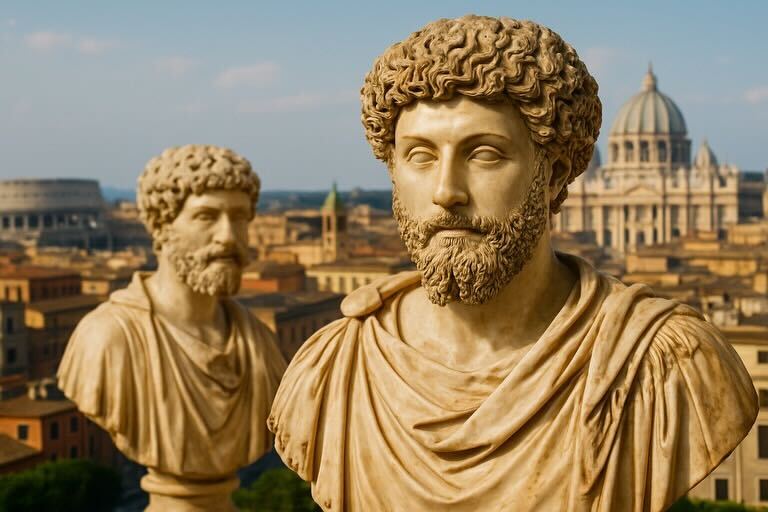
The great Stoic emperor Marcus Aurelius managed an empire under continuous external pressure by refusing to allow that pressure to colonize his interior world. That is not passivity. That is the highest form of self-governance there is.
Voluntary Solutions and the Taoist Case for Decentralization
The Taoists were, at their philosophical heart, radical decentralists. They did not believe that human beings required elaborate institutional machinery to live well and in right relationship with one another. Instead, they believed that most of what large governments do is introduce friction, imbalance, and artificial complexity into systems that would, left to themselves, find their own elegant equilibrium. The sage, in Taoist thought, leads without commanding. Things get done. Lives get lived. The river flows.
What’s your political type?
Find out right now by taking The World’s Smallest Political Quiz.
Take the QuizSchiff's prescriptions in The Real Crash are, in this light, genuinely interesting beyond their political surface. He is not merely proposing policy adjustments. He is articulating a vision of voluntary order: the elimination of agencies that create dependency, the end of monetary manipulation that transfers wealth invisibly from savers to debtors, and the honest reckoning with what government has promised and what the mathematics has already decided it cannot realistically deliver.
His argument for sound money, adopted voluntarily through gold, foreign currencies, or other stores of value before governments mandate a broken alternative, is not nostalgia. It is preparation.
His argument for rebuilding local productive capacity, hollowed out by forty years of financialized globalization, is not nationalism. It is the Taoist recognition that resilience lives in rootedness, in the community that knows how to feed itself, skill itself, and sustain itself through disruption.
The concept in Taoist thought most relevant here is ziran, usually translated as self-so-ness or naturalness. It is the quality of acting in accordance with one's own nature rather than in conformity with external demands.
In economic terms, ziran looks like living below your actual means when every cultural incentive pushes you toward debt. It looks like building income from multiple genuine sources rather than a single employer or government program. It looks like developing the literacy to read a balance sheet, understand a currency, and evaluate an asset because those are, in 2026, simply the minimum equipment for navigating the world Schiff describes.
The Future of Money Is Already Being Decided
One of the most underappreciated arguments in The Real Crash is Schiff's observation that the dollar's decline will function as a kind of global equalizer. Devastating for American living standards, yes. But potentially clarifying, even liberating, for nations that have subsidized American consumption for generations through cheap exports and recycled dollar reserves.
The global working class has been paying an invisible tax to sustain American deficit spending for a very long time. Every time the Federal Reserve prints money, purchasing power is diluted globally. Every time the United States issues debt that the world absorbs, a hidden subsidy is extracted from nations that can afford it least. The unwinding of that arrangement is genuinely painful and disorienting. But it is, in some respects, overdue.
You are not being asked to vote on the restructuring underway in the global monetary architecture. It is simply happening. The response that makes the most sense, both practically and philosophically, is not panic and not paralysis but preparation. The clarion call here should be to build real skills, deep community and real knowledge. Hold assets that are not dependent on the continued competence and good faith of institutions that have demonstrated a limited supply of both.
Self-Governance Is Not an Ideology; It’s a Survival Skill
I want to be direct about something that most economic and political commentary refuses to name plainly. The era of outsourced selfhood is ending. That closure will be difficult for people who were never given the tools to govern themselves and genuinely brutal for those who were given the tools and chose not to use them.
I believe that self-governance is a daily practice. It is the discipline of living within your actual means along with the willingness to develop skills that have real-world value. It is the courage to think independently about money, power, and your position in a shifting world when every institution that was supposed to guide you has a structural interest in your continued dependence. It is the commitment to building genuine community rather than consuming curated community, to show up for people in your actual life with actual presence rather than performing social media calisthenics on platforms optimized for your distraction.
This is why reading matters— not as intellectual ornamentation but as a practice of building the frameworks that allow you to see clearly. Reading Schiff alongside Piketty. Reading Hayek alongside Keynes. Reading Zhuangzi alongside Marcus Aurelius. Building the intellectual range to move between frameworks rather than becoming imprisoned in any single one.
The person who can hold multiple genuine perspectives and reason between them, who has done the hard work of building a real worldview rather than renting one from a media ecosystem, has a decisive advantage over the person who has outsourced their understanding of reality to whoever shouts loudest.
The Arrogant Oracle and the Honest Text
I want to close where I began, in that conference hotel in 2017, with a man I found genuinely challenging on first meeting.
I have thought about that brief conversation over the years, and I have revised my initial impression somewhat. The certainty that I found abrasive was not, I think, arrogance in the pejorative sense. It was the particular bearing of someone who had watched his most unpopular predictions come true in full public view, repeatedly, while being mocked by credentialed professionals who were wrong, and who had decided that the social tax of intellectual honesty was worth paying regardless of the reception. That is not a temperament I always find comfortable to be around. But it is one I have come to respect.
The Tao Te Ching tells us that true words are not beautiful and beautiful words are not true. Schiff's words are rarely beautiful. They are blunt, sometimes graceless, and entirely uninterested in managing your emotional response to their content. But in the economic shifts of 2026, they are proving, again and again, to be true.
Read this book. Argue with it honestly. Underline the parts that make you uncomfortable. Sit with the parts that genuinely frighten you. Then do the harder work of deciding what your response will be—not as a passive subject of forces beyond your control, but as a person who has chosen to govern themselves, to build something real, and to meet whatever is coming with preparation, clear eyes, and the dignity that comes from having done the work.
The river is going to flow. It always does. The Tao moves whether we are ready or not. The only question worth asking is whether you will move with it.