
Dinner at Delmonico‘s Steak House was lovely—all the more so because it was paid for with a stack of gift certificates. My wife (unsurprisingly, if you know her) got the filet mignon with a shrimp add-on. I don’t normally get pasta, but I decided to try their lasagna. We split a meatball appetizer, and we each had one well-crafted old-fashioned. We jawed with the waitress, checked out the funny caricatures on the wall, and then we left—full and happy.
This was the Delmonico’s in Rochester, NY, not the one in New York City. This means that our route home took us up the 390 North. And about five minutes into our homeward journey, we hit a pothole.
Pothole is not really the right word. Hellhole is more appropriate. It was deep and fiendishly dark. There was no avoiding it, and we hit it not with the typical thud but with an awful crash.
The car‘s motion immediately felt strange, and it wasn’t long before we heard the telltale sound of a flat tire … even through windows closed tight against the frigid rain. I rolled us off the nearest exit.
Fortunately, there was a gas station right off the exit, and it had air. Unfortunately (as one would expect from an impact that hard), the tire was completely blown out, and the air immediately hissed out of the gaping wound, which I otherwise could not see in the gloom.
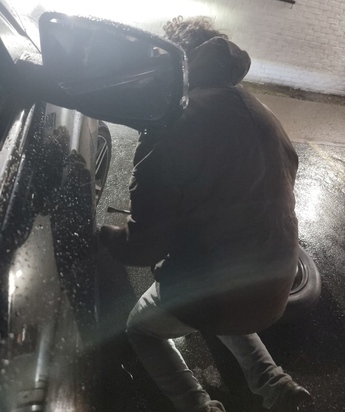
We carefully rolled out of the cramped gas station and into the parking lot of the liquor store next door, so I would have more room to jack up the car and put on the spare.
Until this time, we hadn’t given any thought to where we were. It was Friday night, and we were at a liquor store on the edge of the reddest section on this crime heat map of Rochester (Rochester is a very violent city. In 2023 and 2024, its per capita murder rate was comparable to that of Compton, California, and more than four times higher than that of New York City.)
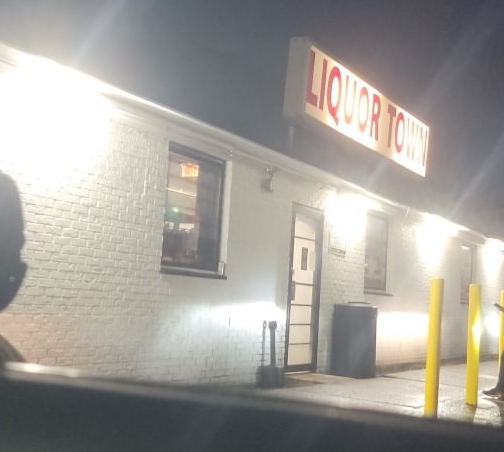
Does that mean that we were automatically going to get shot or stabbed just for changing a tire in a rough part of town? Obviously not. But the chances do go up.
As it happens, our only interactions were quite pleasant. One woman asked if we were okay. Another lovely man offered to help (though his wife did not seem to appreciate his generosity). Everyone else just ignored us.
In spite of the dark and the freezing rain (early March in this part of the world is almost never pleasant), I got the job done, and we were on our way.
On the way home, the first subject of conversation was not the nasty weather or the rough neighborhood. Instead, it began with me saying, with all the sarcastic vitriol I could muster…
‘But … but … but … without government, who will build the roads?’
Libertarians—especially those of the anarcho-libertarian persuasion—know exactly what I am talking about. Who will build the roads? has become a proxy for all the arguments we regularly hear for why humans cannot possibly get by without the state.
We need a government, we are told. But not just any government. It must be, the statist apologist insists, a government that rules over us without our valid consent, and that takes our property at the point of a gun. Nothing else will work, they declare.
Because bad people.
Because free riders.
Because roads.
As it happens, however, there are quite a few ways in which humans can create common thoroughfares without the need for involuntary governance.
As John Hasnas notes in The Myth of the Rule of Law, it is not possible to envision, from our current vantage point, all the different ways in which the free market would meet the need for roads. As Hasnas cleverly points out, if one person could envision all the ways, that would be an argument for central planning. But no one can.
However, all we really need to do is envision a few. To that end, here are just some of the ways in which private entities could own, maintain, and profit from roads.
Roads corporations
The most likely scenario is one in which large, well-capitalized firms buy, build, own, and maintain many miles of roadways. Call them roads corporations, for easy shorthand.
Such corporations could make money by charging usage fees. Transponder technology makes this very easy. Charges could be by the mile or by subscription for unlimited use. They could take into account vehicle weight (heavier vehicles cause more damage to roadways), adjust prices based on traffic flow, or do anything else dictated by market forces.
A common objection goes something like this: You might be able to pull this off with controlled-access freeways, but it’d be impossible with local, general-access roads. You cannot exclude people from such roads, and there will be free riders. General access roads are, therefore, a ‘public good.’
Transponders entirely solve this problem. Just as there is reciprocity in the EZ-Pass system from state to state, so too would the market develop a mechanism by which drivers need only one transponder, even though various stretches of road are owned by different companies. (There is always someone with the wit and imagination to find a way. That is the magic of the market.)
What’s your political type?
Find out right now by taking The World’s Smallest Political Quiz.
Take the QuizThe next objection immediately follows: But that means private businesses would control your access to travel. This is the fallacy of argument from the brochure. In essence, it ignores the realities of governments, which also control who is allowed and forbidden to travel upon their roadways. The only difference is the incentives. Governments have political incentives. Roads corporations would face the incentives of the market.
(The free-rider argument is another example of an argument not from reality, but from the government’s own gauzy brochure. Large swaths of Americans pay little to no taxes and are thus free riders right now. We can hardly do worse than that.)
Roads corporations could also fund roads in other ways…
They could lease highly valuable roadside real estate to private businesses. They could charge fees for access or easements. They could sell roadside property and use the proceeds to create financial endowments that generate long-term income. They could sell advertising space along the road.
The next objection is easily anticipated: The profit motive will incentivize the creation of roadsides littered with businesses and billboards. Beautiful vistas will be obscured by crass commercialism.
Will they?
A business still needs customers. Long stretches of scenic rural roadways don’t have the same volume of traffic as areas of higher population density, and thus cannot support as many businesses. Go for a drive in the country, and you will see more than one shuttered restaurant and failed gas station. The market corrects.
It is more likely that scenic portions of roadways would be funded by transponders. There would be the occasional rest stop or commercial hub, rather than an endless string of businesses that could not possibly be supported by the traffic flow. People also don’t want a beautiful view desecrated, and they will make that preference known. The market listens.
Indeed, customer preferences play a big role in all of this. In a competitive market, some roads corporations will do a better job than others. If people have a choice of routes, they will pick the ones that are more pleasant, convenient, safe, clean, beautiful, or well-maintained, based on what they value. Motivated by a desire for profit, roads corporations will try to attract and retain customers by producing a better product. The market responds.
Innovators and good stewards will get more business; poor performers will suffer. Better approaches will produce better results, which will then be emulated. Competition continues. The market rewards and punishes, but always to the benefit of customers.
Other road owners
Roads corporations are by no means the only ones who can or would own and maintain roads in a free society.
Commercial entities—shopping malls, consortia of local businesses, and other associations—might own and maintain sections of road around their operations. Contracts would spell out assets and responsibilities.
Some property associations, housing developments, and apartment complexes would build and maintain their own roads and charge residents subscription or usage fees. Property developers might invest the money they make from building and selling the roadways in and around a development. Other property-based associations might outsource the roads to a third party. Consensual polities, free cities, and other private-law jurisdictions would similarly choose a variety of ways to own, finance, and maintain their own thoroughfares.
We simply cannot envision all the creative ways in which private interests and free peoples would facilitate the human need and right to travel. The market is infinite.
Road maintenance
The next likely objection is common, but all too tragic: But Chris, potholes are just a fact of life. It’s not government’s fault that you got a flat.
Wrong. It is absolutely government’s fault.
I won’t hide behind the trope of Roman roads. It is true that many have lasted for 2,000 years, but it is also true that they haven’t had 60,000-pound semi trucks driving on them that whole time.
Yet the point still has merit. Crappy, pothole-ridden roads are not a force of nature. We have been using the same basic methods and materials for over a century. There have been changes, of course, but only on the margins. There are other ways, and market incentives make their discovery and implementation a lot more likely.
In order to maximize profits, private businesses must continually find new ways to reduce costs and improve services, or they will lose business to other firms. They must innovate.
A business’s goal is also to maximize value for its owners or shareholders. This means the business must preserve and expand its capital stock. This requires both short- and long-term thinking.
Similarly, a king must consider the capital stock of his kingdom. He cares about the realm he will leave to his prince. He is thinking about his family and their dynasty. His concerns stretch forward into the future.
A democratically elected politician has none of these incentives. He is playing with other people’s money. He just needs to get the roads built as cheaply as possible in the short term. The long term does not matter to him, because none of it is his.
A consortium of private businesses wants to maximize access and ease of use and maintain their roads in good condition to attract customers and keep them happy. Why would I shop at a place where the parking lot is rubble if there is another mall at the other end of town with clean, safe roadways and parking lots? The same competitive pressure applies to roads corporations or any other entity that needs to attract and retain business.
Property associations and private law polities are somewhat better shielded from competitive pressure, in that it is easier to move from one shopping mall to another than it is to move to a new home. But these too are still at least subject to some such pressure.
Governments, by contrast, are a monopoly imposed by force. They have zero competition. And if you think voting makes a difference, I invite you to check the condition of the infrastructure in and around your area.
By way of example, here is just one portion of just one intersection in my town. The holes are much deeper than they look in these images (there was too much traffic for me to take pictures at ground level). And I have 13 more images just like these.
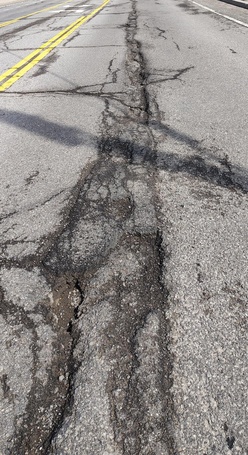
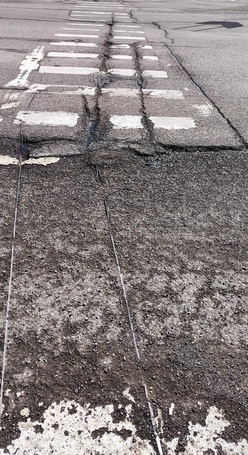
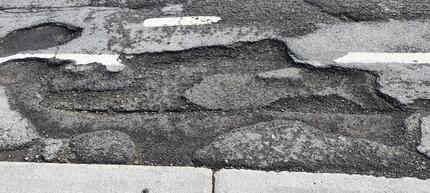
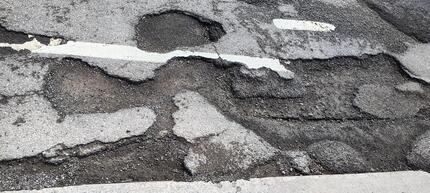
This is a small university town in a county with the second-highest property taxes in the nation, in a state with the highest overall tax burden.
The town is not fighting off invading Russians, space aliens, or a pandemic. We pay an appalling amount of taxes for the ‘privilege‘ of living here. There is no excuse. These roads should be perfect. They should sing a pretty song as we drive on them. They should be built to last 100 years, not 100 weeks.
And if they were built by any entity that faced competition and cared about its capital stock, they would.
Government is, for all intents and purposes, a racket: a monopoly of force whose primary incentive is to solidify its dominance and expand its forcible extractions from productive people. It will continue those extractions no matter what the condition of its roads. Because it can.
Road safety
Government is also a deadly racket.
There are tens of thousands of deaths on America’s government-owned roads every year. Are these too an unavoidable fact of nature? Are you sure?
I have seen plenty of analyses of alternative road designs and traffic patterns that mitigate driving risks. Roundels instead of red lights. Chains between lanes of traffic. Separating cars from much more dangerous trucks.
Market forces would impel private roads owners to innovate and do so quickly, before the other guy beats them to it. Meanwhile, the words “innovate” and “quickly” do not exist in any government’s vocabulary.
Besides market forces and competition, guess what else private enterprises are subject to that governments are not…
Liability.
If 40,000 people were dying and many thousands more were being maimed every year on private roads, the lawyers would be feasting like piranhas. Faced with astronomical losses, you can be darned sure that businesses would be looking for ways to make their roads safer as fast as they could.
Now try suing a government or politician for an injury or death on their roads. While such suits are technically possible, government officials are protected by sovereign immunity, and the bar to bringing such suits is incredibly high. And who knows, maybe the police would start finding ways to make your life hell if you do. After all, government is, for all practical purposes, a kind of mafia: a protection racket for which you are forced to pay, and which you’d better not make angry.
——
The bottom line: Potholes, flat tires, and endless road carnage are not a fact of life. They are a fact of government roads.
We can do better.