Put your faith in the two inches of humus
that will build under the trees
every thousand years.
Listen to carrion – put your ear
close, and hear the faint chattering
of the songs that are to come.
Expect the end of the world. Laugh.
Laughter is immeasurable. Be joyful
though you have considered all the facts.
—Wendell Berry, “Manifesto: The Mad Farmer Liberation Front”
· · ·
Quotes featured in this article are from a speech, and are herein presented without editing.
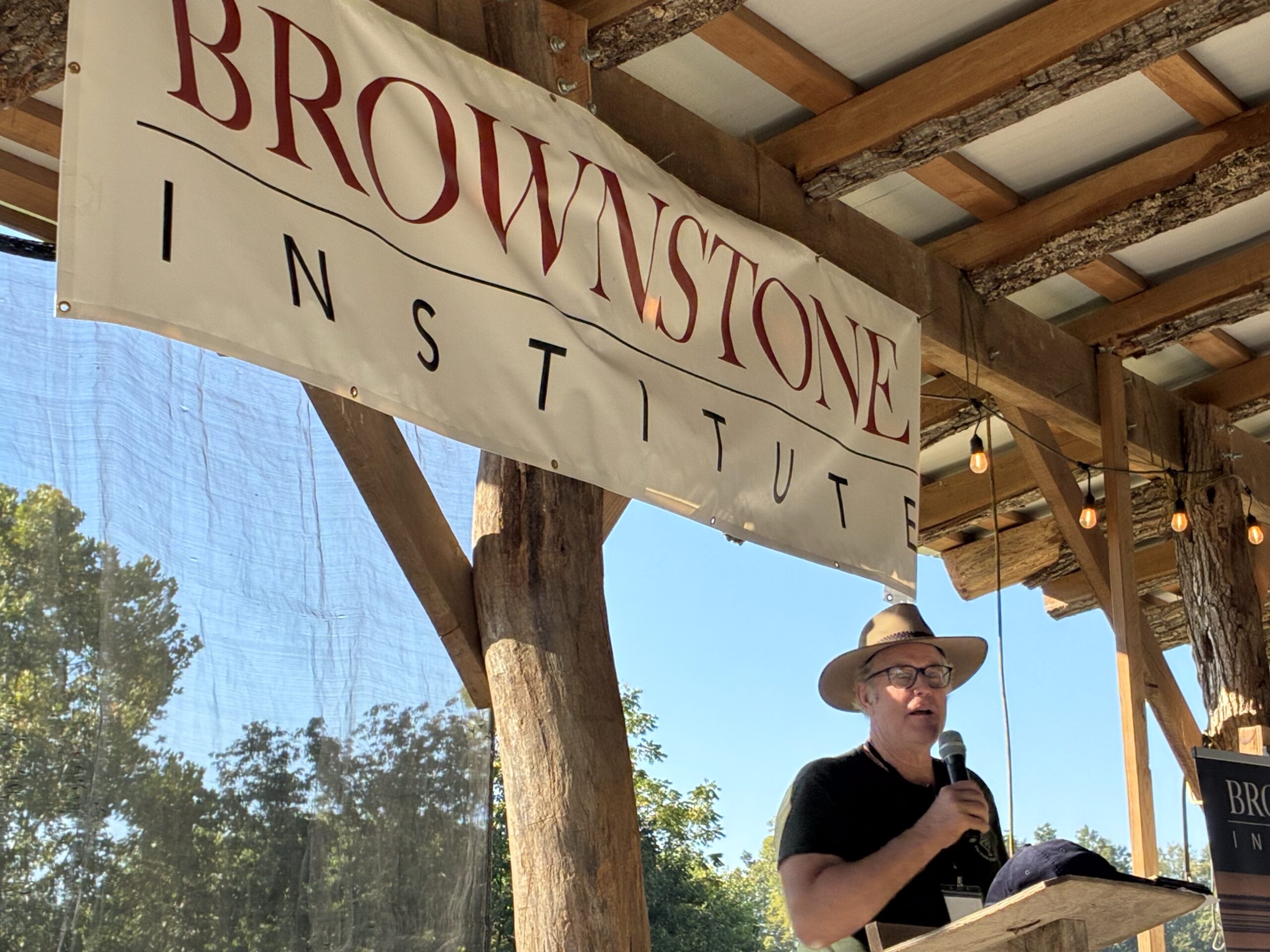
“Nobody’s going to have to go home today and check for ticks,” Joel Salatin announces from the back of a small truck in the middle of a field dotted with rectangular movable chicken runs. He then explains that the chickens clucking away at our feet in their mobile runs are responsible for keeping the bloodsucking bugs away.
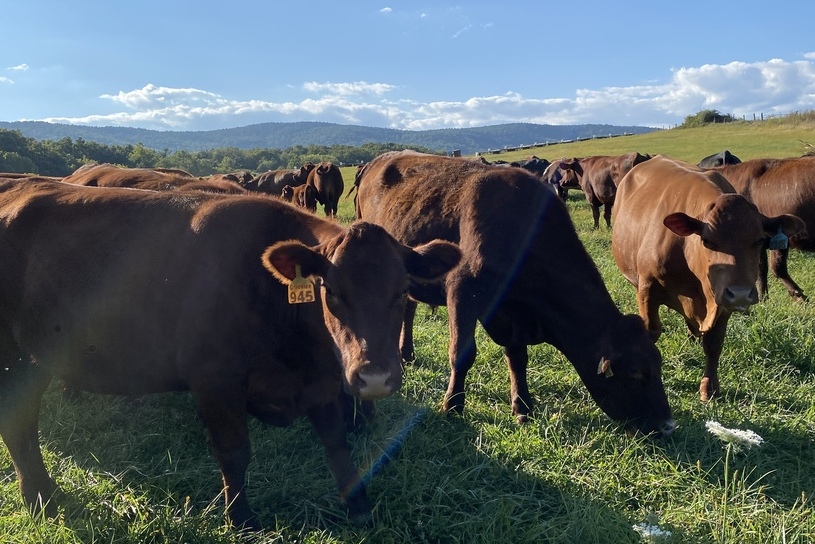
They also form an important part of the farm’s ecosystem, taking turns fertilizing the earth with the cows on the other side of the fence in regular rotations. Salatin’s grazing methods—employed by his parents beginning in 1961—are what have transformed what was then a barren, eroded, rocky stretch of land into verdant and productive pastures. All without ever planting a single seed of grass.
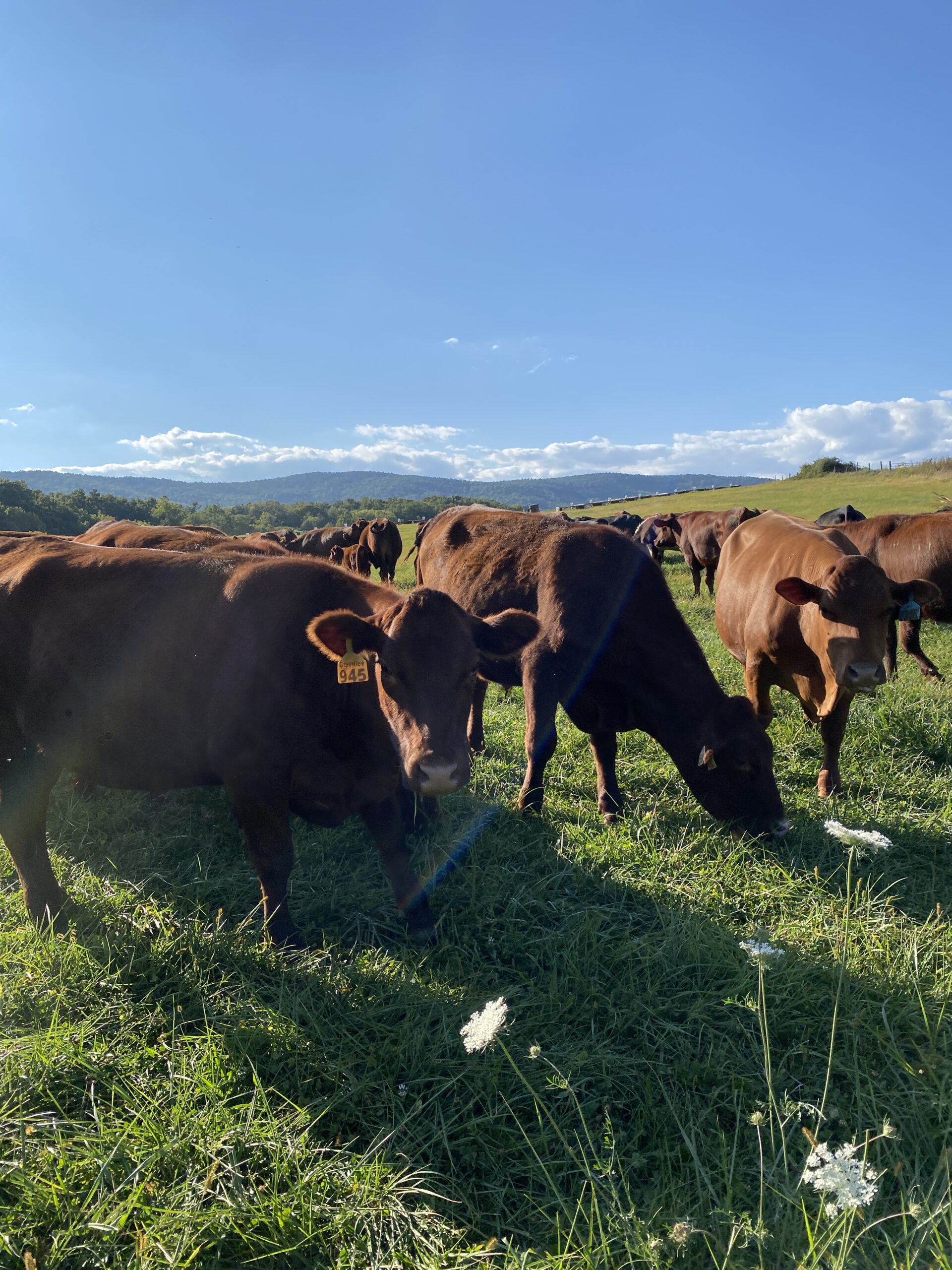
I’ve visited enough farms to recognize that Salatin’s Polyface Farms is exceptional. It is early September, sunny and very warm. But there is no lingering smell of manure, nor thick swarms of flies. The rolling pastureland is fresh and green, the cattle seem contented in their wide-open space, and the pigs are free to roam in their large woodland enclosures. It is idyllic.
It is also on the verge of becoming even more rare.
Over the next fifteen years, Salatin tells us, 50 percent of the country’s agricultural equity (land, buildings, machinery) will be changing hands. (While other estimates put this number a little lower, the USDA and other observers predict that an astonishing 70% of American farmland will change hands over the next 20 years.) Such an enormous transfer, he says, is without precedent in peacetime.
The problem?
More than a century of government regulation of food and agriculture has made small-scale farming increasingly difficult and largely unprofitable. Bigger, industrial-scale farms receive immense government subsidies, and are better able to bear the costs of complying with onerous—and, in Salatin’s view, unnecessary—regulations.
“So how do we disentangle from the industrial food farm complex?” asks Salatin. “We grow it ourselves or we buy it outside the system. But here’s the problem. If we start down that path, we realize that the ability to exchange food is so heavily regulated, we have very little choice. If one of you wanted to come to me and say, wow, that chicken was great yesterday. Could you sell me one of those barbecued halves of chicken? I can’t legally sell it to you because that’s a cooked product and it can only come from an inspected kitchen.
“…In order for me to offer you a chicken pot pie, I have to have an inspected kitchen, a HACCP (Hazard Analysis and Critical Control Plan)… I have to have a licensed bathroom, not a composting toilet, and it doesn’t matter that our kitchen is a hundred yards from two in our house, two in mom’s house. It has to be on site, a licensed leach field for that bathroom and a certified cold chain with 24/7 thermometer, computer microchip reading.”
These kinds of restrictions make farming an unattractive proposition for young people and other independent investors, and have served to further consolidate the agricultural industry.
“Upton Sinclair thought it was a monopoly in 1906 when seven companies controlled 50 percent in the meat supply,” writes Salatin. “Today, after the government’s intervention to protect us in the food system, four companies control 85%.” (Note: These numbers are for the beef supply only. The percentages for pork and poultry are a little lower.)
The solution?
Joel Salatin has a few ideas, including tenant-farmer arrangements with landowners and setting up business as a private membership association (PMA). But ultimately, he proposes attacking the problem at its root: government regulation of food and agriculture. To that end, he proposes the “Food Emancipation Proclamation.”
Says Salatin:
“hat concerns me is that the current agenda from MAHA doesn’t address any of this. The current agenda from MAHA is, ‘Well, let’s transfer the money from commodity subsidies to farmers that are trying to transition to organic.’ So we’ll take money from this pot and we’ll put that money in that pot. I’m sure we can trust the administrators to do that perfectly.
“Another big one is let’s outlaw Topamine. Glyphosate factory farming. Name your demon. Let’s outlaw that.
“We’re still asking for salvation by legislation. We basically either trade money or we outlaw something. That’s basically the agenda.
“How about we try liberty instead of regulation so that consenting adults, exercising freedom of choice… should not have to ask the government’s permission to engage in a food transaction.
“I suggest the solution is a food emancipation proclamation so that we can engage in the direct exchange of food neighbor to neighbor without government permission.”
Among the many benefits this kind of reform would produce, says Salatin, is the fact that “production would never leave the farm for processing. This would create a 30 to 40% price savings of local food. People always ook how expensive your price is. Well, it’s largely because we’re trying to squeeze an artisanal product through an industrial commodity paradigm and it doesn’t work.”
Other nearly immediate benefits include integrating waste streams with other farm enterprises, making organically produced food much more affordable for buyers, and the elimination of urban “food deserts.”
Salatin’s proposal would also create “an economic on-ramp for new entrepreneurial farmers by being able to access the retail dollar. I meet thousands and thousands of homesteaders and small farmers around this country who could easily make a full-time living on a 10-acre place if they could sell retail.”
What’s your political type?
Find out right now by taking The World’s Smallest Political Quiz.
Take the Quiz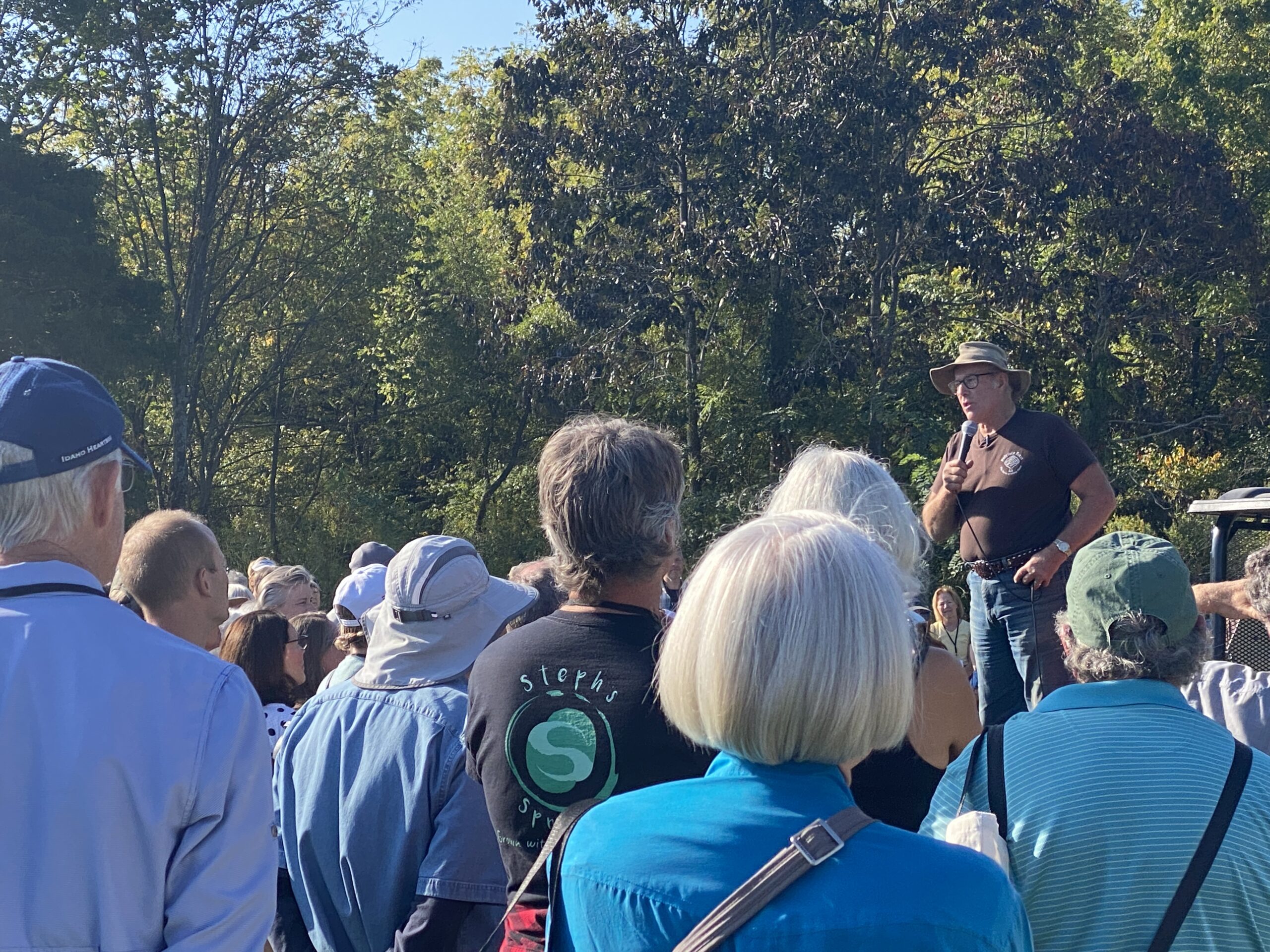
How to make it happen?
“What’s my dream goal?” asks Salatin. “I’ll tell you, my dream goal is: I want 30 minutes with Trump. I believe that if I made this pitch to Trump, he would be all over it.”
Maybe he would. And maybe he would even find a way to beat down the inevitable resistance from industry and the monolithic regulatory structure that serves their interests.
But appealing to Trump is not the only way to make Salatin’s food-freedom dreams a reality. The power of states to nullify federal laws that violate the rights of their citizens is enshrined in the Constitution, and there are many examples of states making use of this power.
Most recently, the State of Florida acted to remove all vaccine mandates in that state. Meanwhile, at the other end of the spectrum, politicians in California are working to defy the latest CDC/ACIP vaccine recommendations and issue their own (more stringent) guidelines.
And then there’s just plain old non-compliance.
In 1930, Mahatma Gandhi led a mass act of civil disobedience against the then-occupying British government. The British had established a monopoly on the production of salt, and had levied a heavy tax on it. They prohibited Indians from producing or selling salt on their own.
In the spring of 1930, Gandhi led a 240-mile march to the sea, through the state of Gujarat. He was joined by thousands of followers. When they arrived at the beach, Gandhi picked up a handful of salt, and others followed him. Across the country, people began to make and sell salt on their own, in defiance of the British government’s prohibition.
Gandhi’s “Salt Satyagraha” (Satyagraha means “non-violent resistance”) was a pivotal event in the Indian resistance to British rule, which ultimately resulted in the empire’s departure from that country.
Maybe it’s time for our own Food Satyagraha.