


When respondents are given a Conservative answer, a Libertarian answer, and a Progressive answer to the same question, the results don’t collapse into two opposing sides with a middle. They break into three distinct patterns, each reflecting a different way of thinking about the issue.
Every question in our Immigration Enforcement survey offered three distinct answers, each based on a political philosophy: Conservative, Libertarian, or Progressive.
Respondents chose the answer that best reflected their view. Based on their choices across all ten questions, we scored and plotted them on a Nolan-style chart. The results don't look like a left-right spectrum with a moderate middle. They look like three distinct clusters, because the three philosophical frameworks produce genuinely different answers — and on several questions, directly opposing ones.
The tensions between them reveal something that standard left-right polling is structurally incapable of capturing.
The Big Picture: 1,233 Responses
Advocates for Self-Government collected responses between January 14 and March 8, 2026, with 1,233 unique respondents. Each respondent answered 10 questions about current immigration enforcement topics, ranging from sanctuary cities to the use of force by federal agents. Based on their answers, we scored and plotted respondents on a Nolan-style chart.
Here's how the results broke down:
Conservative: 55.2% (681 respondents)
Progressive: 19.2% (237 respondents)
Libertarian: 17.8% (219 respondents)
Moderate: 7.8% (96 respondents)
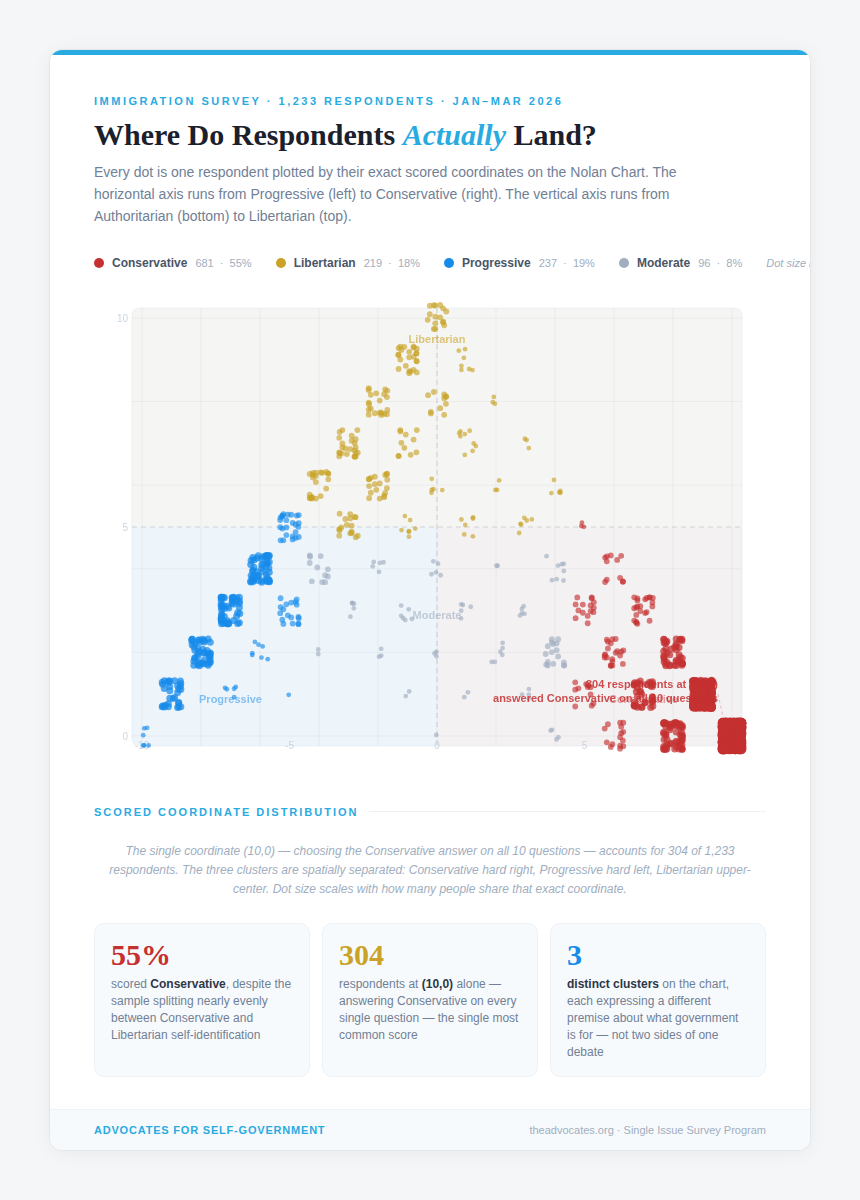
Surprisingly, the Conservative result dominates. This is a sample drawn largely from our audience, a community with significant libertarian representation.
Self-reported political identity split almost evenly between Libertarian (26%) and Conservative (25%). Yet the survey scored 55% of respondents as Conservative. That gap between how people identify and how they answer specific policy questions runs through everything that follows.
What the Three Positions Actually Mean
Before looking at the data, it's worth being precise about what each answer represents. These are distinct philosophical traditions that often land in directly opposing places, not points on a spectrum.
The Conservative answers in this survey consistently argue for robust federal enforcement authority: the border is a security crisis requiring strong action; military assets are appropriate tools for border enforcement; no location should be off-limits for ICE; and federal law must be enforced regardless of local preferences or community resistance. Federal government has both the authority and the obligation to enforce immigration law aggressively.
The Libertarian answers share a single organizing principle: opposition to federal power, applied consistently regardless of the policy outcome. The question is never "is this the right immigration result?" but "is this the right use of government authority?"
On sanctuary cities, the Libertarian answer defends local governments from federal compulsion (a federalism argument, not a pro-sanctuary one). On military deployment, it objects to domestic use of the military against civilians (a civil-military boundaries argument that has nothing to do with border security per se). On sensitive locations, it defers access decisions to property owners, producing no categorical outcome either way: a church that wants to serve as a sanctuary can; a hospital that doesn't object to ICE can allow entry. On self-deportation programs, it rejects government payments to encourage departure in favor of eliminating welfare incentives (an anti-management position that declines to take a side on who should stay or go).
The framework is consistently anti-statist. Whether the target is immigrants, citizens, or government programs, the objection is the same: federal power shouldn't be doing this.
The Progressive answers prioritize the protection of individuals and communities from enforcement: crisis framing dehumanizes immigrants, military deployment targets vulnerable people, sensitive locations should be protected spaces, and comprehensive reform with pathways to legal status is the preferred solution. Where the Libertarian objects to federal power on principle, the Progressive objects to enforcement on humanitarian grounds.
This distinction matters for reading the data correctly. When a Libertarian respondent and a Conservative respondent choose different answers, they're expressing different premises about the proper role of government, not a difference of degree.
Conservative Answers Dominate. The Libertarian Position Largely Opposes Them.
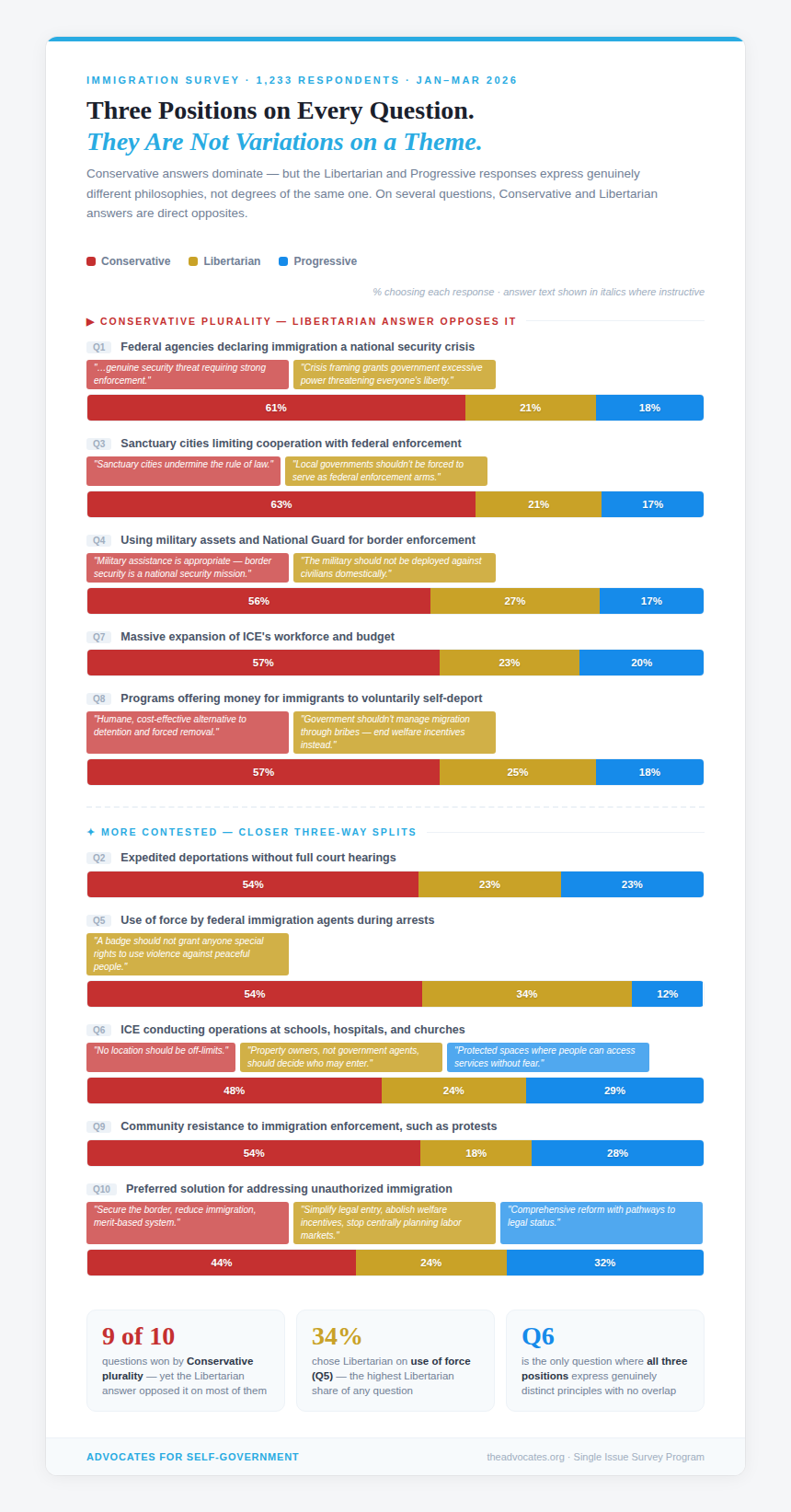
Conservative answers captured the plurality on 9 of the 10 questions in this survey. This sample, despite its substantial libertarian self-identification, answered most questions in ways that tracked closest to the Conservative framework.
But look at what the Libertarian answers were actually saying on those same questions:
On Q1 (national security crisis framing), 61% chose Conservative, endorsing the crisis framing and the enforcement response it justifies. The Libertarian answer chosen by 21% explicitly rejected that framing: "Crisis framing grants the federal government excessive power that threatens everyone's liberty." These are opposing positions.
On Q3 (sanctuary cities), 63% chose Conservative, wanting federal authority to override local non-cooperation. The Libertarian answer chosen by 21% defended local governments against federal compulsion: "Local governments should not be forced to serve as enforcement arms of the federal government." The Libertarian respondent is effectively answering a different question than the Conservative one. The Conservative is taking a position on immigration policy. The Libertarian is taking a position on federalism, which functionally allows sanctuary cities to exist as a downstream effect.
On Q4 (military deployment), 56% chose Conservative, supporting military assets at the border as a national security mission. The Libertarian answer chosen by 27% opposed military deployment categorically: "The military should defend against foreign threats, not be deployed against civilians domestically." These are opposing positions.
On Q8 (voluntary self-deportation programs), 57% chose Conservative, endorsing these programs as a humane, cost-effective alternative to forced removal. The Libertarian answer chosen by 25% rejected them: "Government shouldn't manage migration through bribes or force — end welfare incentives instead." The Conservative respondent thinks voluntary self-deportation is good policy. The Libertarian respondent thinks the government shouldn't be in the business of paying people to leave.
The full distribution across all ten questions:
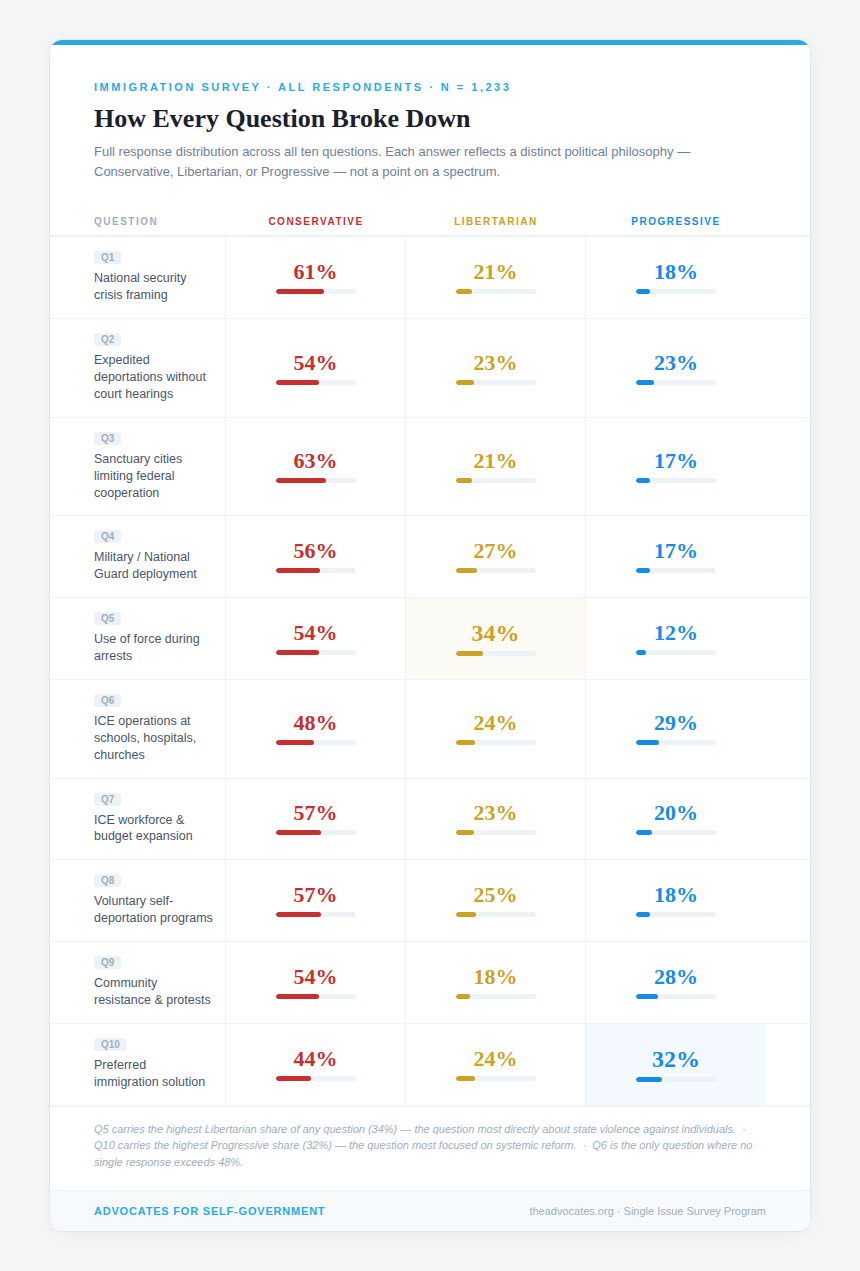
The Libertarian answer never wins a plurality in the full sample. Its highest share is 34% on Q5 (use of force during arrests), the question most directly about state violence against individuals.
The Progressive answer wins its highest share on Q10 (preferred solution) at 32%, the question most removed from specific enforcement mechanisms and most focused on systemic reform.
The Q9 Problem
On community resistance to immigration enforcement, 54% chose Conservative — the highest Conservative share of any question in the survey. Another 28% chose Progressive, while only 18% chose Libertarian, the lowest Libertarian share of any question. In other words, even in a group that broadly identifies as libertarian, this question produced a clear lean toward enforcement compliance.
Q9 is also a clean illustration of why the three-way breakdown matters. If you collapsed these responses into a single left-right average, you would have to assign the Libertarian responses a position on that scale, typically somewhere in the middle. That move makes the overall result appear more balanced than it actually is. The actual distribution shows something clearer: a 54% Conservative plurality is the dominant signal, while the Progressive share remains a distinct minority, not a moderating influence on a shared view. Averaging a three-way split into one number hides who chose what, and obscures the reasoning behind those choices. That is exactly the signal standard polling is structurally incapable of capturing, and exactly what the Single Issue Survey format is built to surface.
The Libertarian answer on this question is also the most philosophically indirect of any in the survey. Rather than addressing whether community resistance is legitimate, it shifts the focus: “Peaceful assembly is a right, but the real problem is laws that criminalize peaceful people.” That framing redirects attention to the underlying laws rather than the enforcement response, without taking a position on the specific situation being asked about. It may be that self-identified Libertarians sensed the same ambiguity. They split more evenly on Q9 than on any other question (38% Conservative, 33% Libertarian, 29% Progressive), suggesting the answer left many of them uncertain about how their principles applied in this case.
Where Libertarian Instincts Hold, and Where They Bend
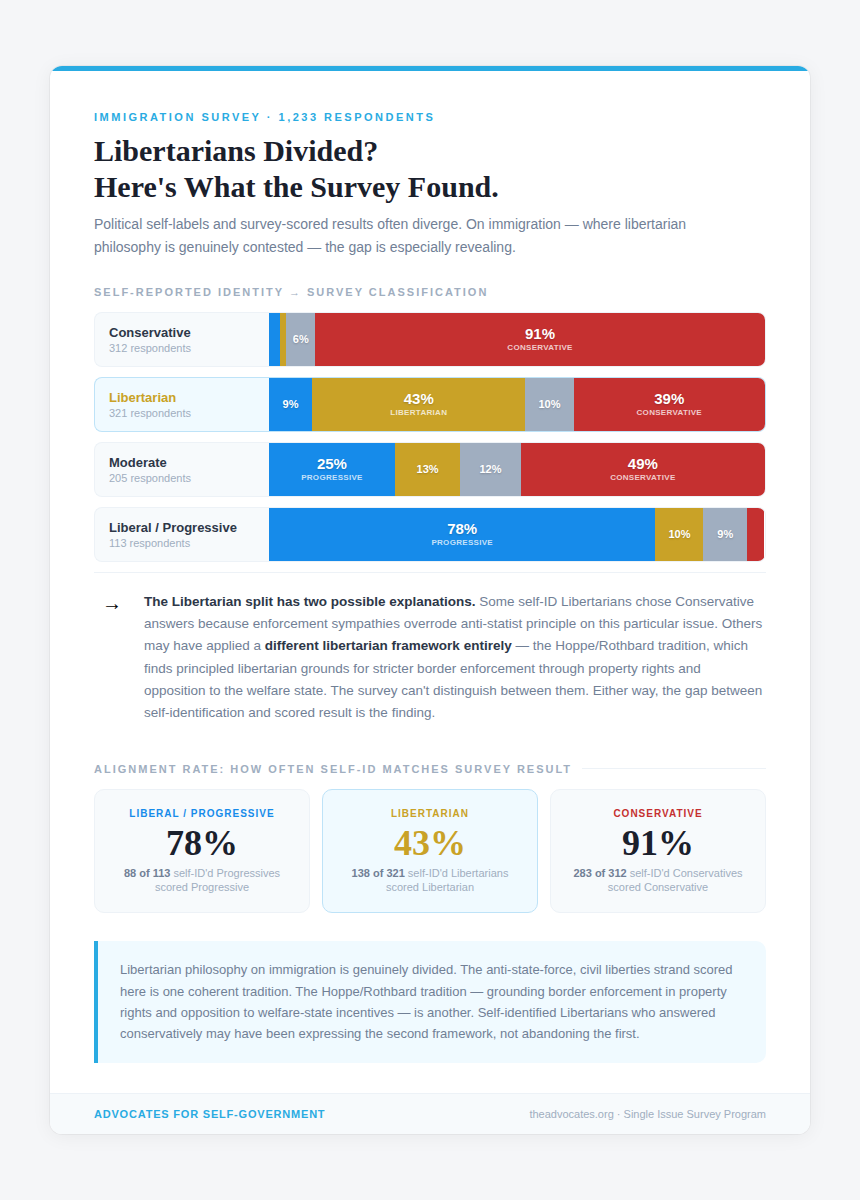
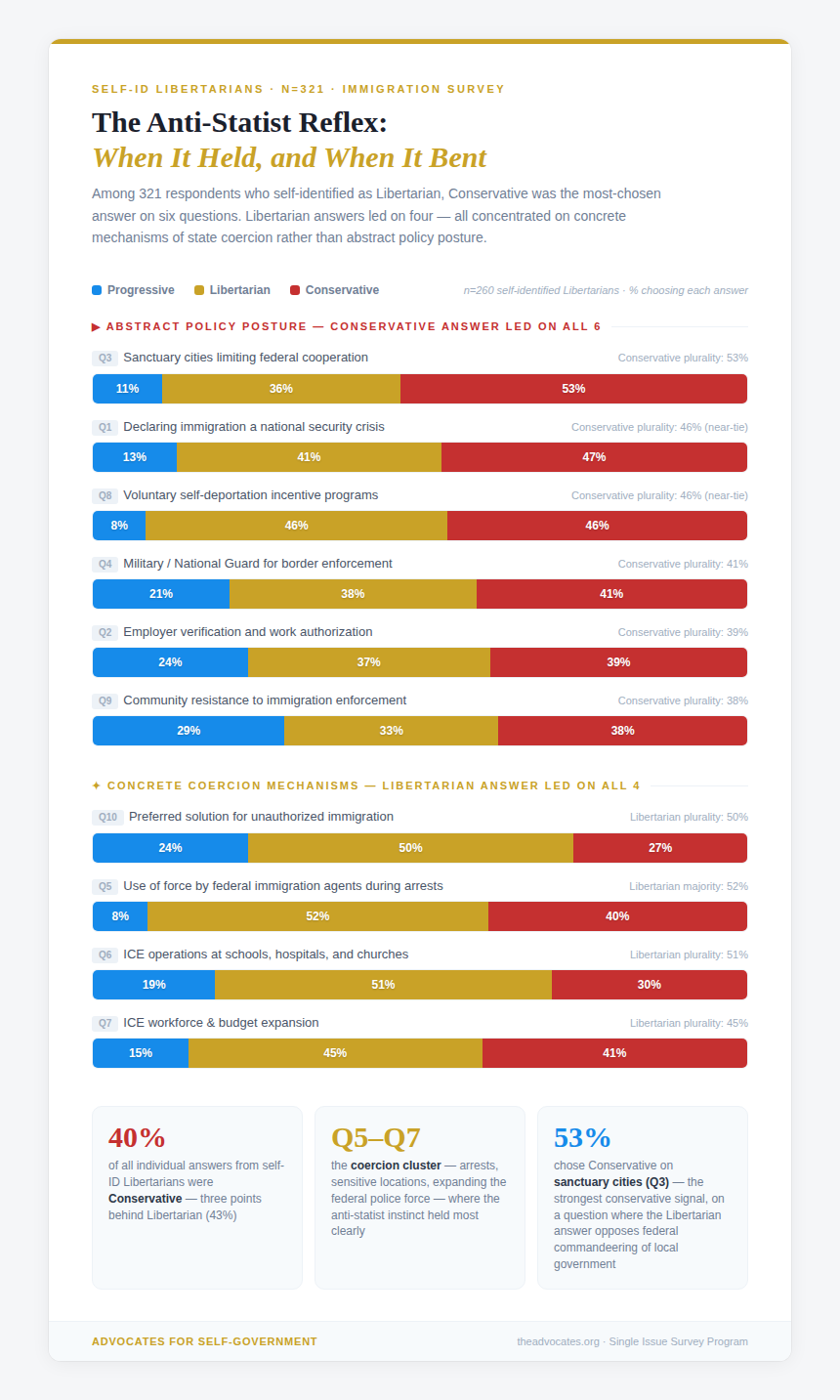
Among the 321 respondents who self-identified as Libertarian, only 43% received a Libertarian classification from the survey. Nearly 39% classified as Conservative. The question is why.
The conventional explanation is that self-ID Libertarians agree with Conservatives on enforcement but diverge on the scope of government power. That doesn't hold up against what the answers actually say. On Q1, Q3, Q4, and Q8, the Libertarian answer was an explicit rejection of the Conservative position, not a softer version of it. When 47% of self-ID Libertarians chose the Conservative answer on Q1, endorsing crisis framing and strong enforcement, they weren't expressing a libertarian position on government power. They were choosing the enforcement outcome over the anti-statist principle.
The question-by-question data shows a more specific pattern. On questions framed around policy outcomes and enforcement posture (is this a crisis? should we deploy the military? should employers verify immigration status?), self-ID Libertarians chose Conservative answers at rates between 39% and 53%. On questions where the specific mechanism of state coercion was front and center, the libertarian instinct reasserted more clearly.
On use of force during arrests, among self-ID Libertarians, (Q5): 52% Libertarian, 40% Conservative. On ICE operations at schools, hospitals, and churches (Q6): 51% Libertarian, 30% Conservative. On ICE workforce and budget expansion (Q7): 45% Libertarian, 41% Conservative. On preferred immigration solution (Q10): 50% Libertarian, 27% Conservative, with the Libertarian answer calling for deregulated legal entry and elimination of welfare incentives rather than either restriction or amnesty.
The split comes down to what triggers the anti-statist reflex. Abstract policy questions about crisis framing and military deployment didn't reliably trigger it. Concrete questions about arrest procedures, access to specific locations, and expanding the federal police apparatus did.
Across all individual answers from self-ID Libertarians, 43% were Libertarian and 40% were Conservative, a three-point gap. That near-tie within a group that explicitly identifies with libertarianism is a serious finding. Immigration is the issue where libertarian principles face the most pressure from enforcement sympathies, and this survey shows that pressure winning more often than not.
A note on methodology. The scoring in this survey reflects the anti-state-force, civil liberties strand of libertarian thought. It is not the only coherent libertarian framework.
Right-libertarians in the Hoppe or Rothbard tradition would argue that private property rights and opposition to the welfare state provide equally principled libertarian grounds for stricter border enforcement — and would dispute some of our answer designations accordingly.
That division matters for reading the results honestly. The near-equal Conservative/Libertarian answer split among self-ID Libertarians may reflect genuine philosophical disagreement within libertarianism as much as it reflects enforcement sympathies overriding principle. The survey can't distinguish between someone who chose the Conservative answer because they wanted strong enforcement and someone who chose it because a different libertarian framework pointed them there.
The Most Contested Questions
Two questions stand out as genuinely three-way contests rather than Conservative pluralities with smaller opposition camps.
Q6 (ICE operations at schools, hospitals, and churches) produced the closest result in the survey: 48% Conservative, 29% Progressive, 24% Libertarian. The three answers express three genuinely different principles. The Conservative position removes location as a constraint on enforcement. The Progressive position creates categorical protected spaces regardless of owner preference. The Libertarian position is the most structurally distinct: it defers entirely to property owners. A church that wants to serve as a sanctuary can. A hospital that doesn't object to ICE can allow entry. Government decides neither way. No other question in the survey produced this kind of philosophical triangulation among the three positions.
Q10 (preferred immigration solution) shows the Libertarian answer at its most distinct from both alternatives. Conservative: secure the border, reduce overall immigration, merit-based selection. Progressive: comprehensive reform with pathways to legal status. Libertarian: drastically simplify legal entry, abolish welfare incentives, stop centrally planning labor markets.
The Conservative and Progressive answers are both, in different ways, about managing immigration as a policy problem. The Libertarian answer rejects the premise of management entirely, calling for deregulation in both directions rather than tilting the system one way or the other. This answer drew only 24% of all respondents and 50% of self-ID Libertarians, suggesting that even in this community, the fully deregulated immigration position is a minority view.
Who Took the Survey
A few notes on our sample.
64% of respondents identified as White, with 20% declining to state their race. 62% were male and 25% female. That split matters: women in our sample scored Progressive at nearly twice the rate of men (28% versus 16%), a statistically significant difference that likely reflects both the sample's composition and genuine differences in how men and women approach immigration enforcement questions.
On age, 48% of respondents were 60 or older, with only 16% under 30. The youngest cohort skewed notably toward Progressive and Moderate results relative to older age groups, a pattern worth watching as we collect more data across surveys.
Self-reported political identity split almost evenly between Libertarian (26%) and Conservative (25%), with Moderate at 17% and Liberal or Progressive at 9%.
This is a deep sample of a specific ideological community, not a nationally representative poll. That's precisely what makes the internal distinctions visible. National surveys blend libertarian-leaning and conservative respondents into a single right-of-center category and lose exactly the signal we're capturing here. The gap between how people self-identify and how they actually answer specific policy questions doesn't show up in standard polling because standard polling isn't designed to measure it.
What This Means
The immigration debate is usually presented as a binary: enforcement or reform, closed or open, for or against. Our data shows that framing obscures more than it reveals.
Three philosophically distinct traditions are operating in this space. Conservatives argue that the federal government has both the authority and the obligation to enforce immigration law aggressively, and that expanding that capacity is a legitimate use of state power. Progressives argue that enforcement harms vulnerable people and communities, and that the system needs structural reform rather than stronger enforcement. Libertarians argue that federal power is dangerous regardless of its target: the same government apparatus being expanded to enforce immigration law today can be turned on anyone tomorrow. The answer to a broken immigration system, in this view, is less government management of migration, not more.
These are different premises about what government is for, not variations on a shared one.
The fact that 55% of this sample scored Conservative while 26% self-identified as Libertarian points to something libertarians have confronted before. During the Covid-19 pandemic, a notable number of self-identified libertarians supported lockdowns, mask mandates, and in some cases mandatory vaccination — positions that would have been unrecognizable as libertarian by any prior definition of the philosophy. The reasoning in each case was similar: the stakes felt too high, the threat too urgent, the policy outcome too important to let principle get in the way. Immigration produces the same dynamic from the other direction. The threat feels real. The enforcement outcome feels necessary. And so the same philosophical framework that would normally object to federal agencies operating without judicial review, deploying military assets domestically, or expanding a federal police force without constraint gets set aside — not abandoned, exactly, but suspended for this issue, on these facts, given how much is at stake.
This is the central tension in libertarian political philosophy, and it has never been fully resolved: when, if ever, is government coercion justified? The non-aggression principle — the idea that the initiation of force is never legitimate — points toward a clean answer. But most people who identify as libertarian in practice apply something softer: a strong presumption against coercion that can be overcome when the threat is sufficiently serious or the target sufficiently culpable. The question is where that threshold sits, and who gets to set it.
On immigration, this survey suggests the threshold shifts significantly depending on what is being asked. Abstract questions about policy posture — is this a national security crisis? should we deploy the military? — produced conservative-leaning answers from self-identified Libertarians. The enforcement framing triggered the enforcement instinct. But concrete questions about specific coercive mechanisms — the force an agent can use during an arrest, whether a federal agency can operate on private property without the owner's consent, whether a federal police force should be expanded — triggered the anti-statist instinct instead.
The implication is that libertarian political identity is more durable as a constraint on state power than as a guide to policy outcomes. When the question is "should the government be able to do this specific thing to this specific person," the libertarian answer holds. When the question is "what should our immigration policy be," the answer looks a lot more conservative. That gap is philosophically significant. It suggests that for many self-identified libertarians, the anti-statist principle functions as a check on excess rather than as a foundation for policy — activated by visible abuses of power, less visible when the abuses are still hypothetical or the enforcement machinery is aimed at people who are seen as having violated the rules.
The Nolan Chart exists to make these distinctions visible. Standard polling makes them disappear.
Haven't Taken the Survey Yet?
Take the Immigration Enforcement and Federal Authority Survey →
It takes about 5 minutes, and you'll see how your views compare to the 1,233 people who've already responded. We'll plot your results on a Nolan-style chart and show you where you land.
And if you've already taken it, share it. The more responses we get, the richer the picture becomes.
This analysis is part of the Advocates for Self-Government's Single Issue Survey program, which uses current policy debates to help people understand their political orientation beyond the traditional left-right spectrum.