We like to tell ourselves that we’re the most informed generation in human history.
All of us with our mobile phones carry the world in our pockets. We summon breaking news, live footage, commentary, and moral verdicts with a swipe of a thumb. We see events unfold in real time, often from multiple angles, often before professional journalists even arrive.
And yet, for all this access, I would argue we are also among the most misinformed, emotionally manipulated, and epistemically confused world to ever exist.
This is not an accident. It is not simply the cost of progress. It is the predictable outcome of a media ecosystem that has been hollowed out, accelerated, and gamified, at the very moment when press freedom itself is retreating around the world.
The most frightening thing about our media moment is not that lies exist. Because they always have. What is new is how easily they spread, how quickly they can harden into truth, and how rarely anyone is held accountable for pushing them.
We are no longer drowning in misinformation. We are swimming in it, often mistaking motion for depth.
When Media Stopped Reporting and Started Performing
Traditional media did not collapse because it was virtuous or incorruptible. It collapsed because its economic and ethical foundations eroded. Advertising dollars vanished. Subscriptions thinned. Newsrooms shrank. Time disappeared.
Speed replaced verification. Emotion replaced clarity. Being first mattered more than being right.
Into that vacuum stepped an entirely new class of media actor: the citizen correspondent. Armed with a camera phone, editing software, a social account, and a belief that attention equals authority, anyone could publish. No editor required. No standards enforced. No corrections demanded.
Platforms that once promised democratization now reward outrage, certainty, and spectacle. Instagram, Reddit, TikTok, and X are no longer neutral platforms. They are newsrooms without walls, driven by algorithms that prioritize engagement over accuracy.
This is the new journalistic narrative. And it is being orchestrated with real-world consequences.
What ‘Trust Me, I’m Lying’ Saw Coming
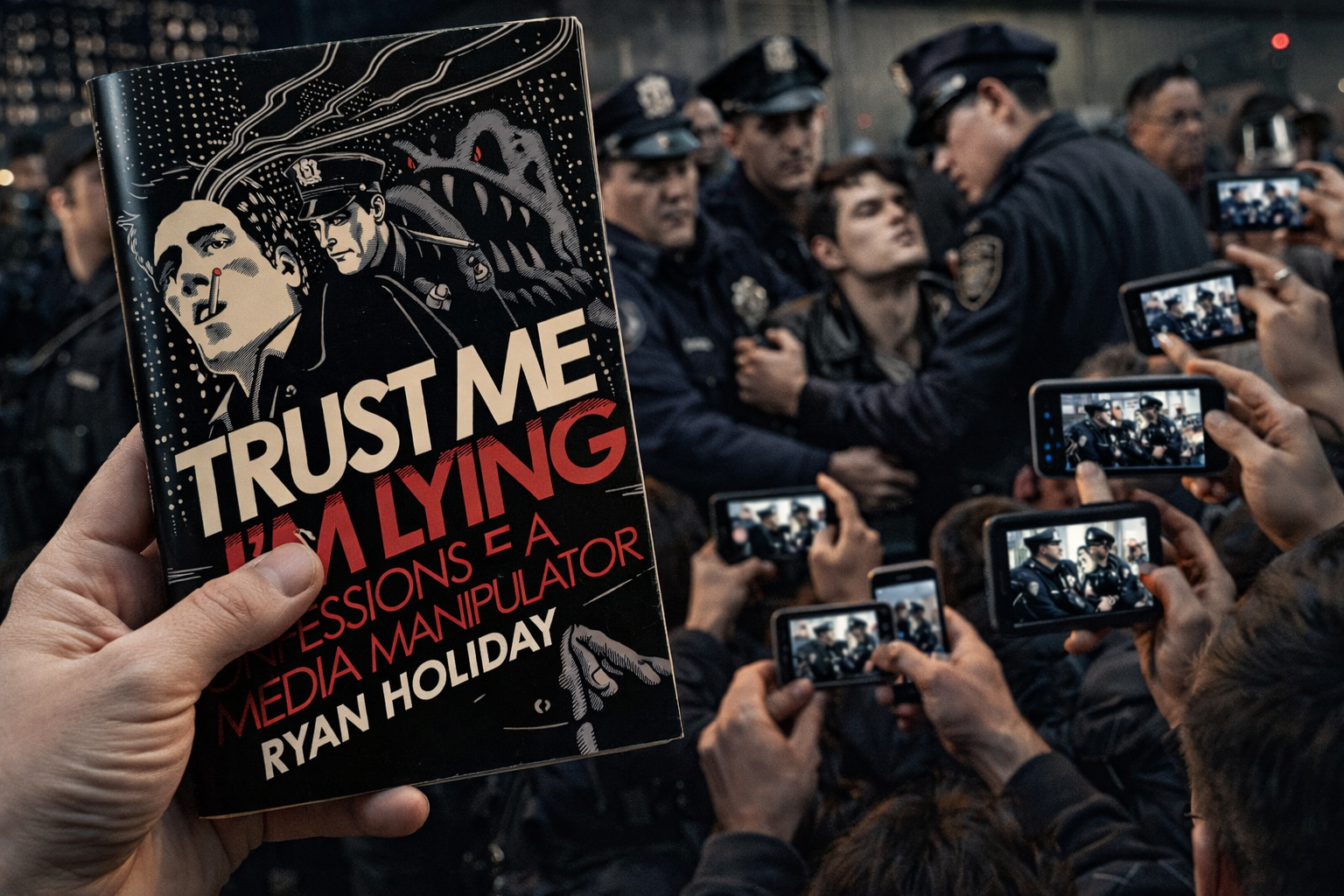
When Ryan Holiday published his book Trust Me, I’m Lying in 2013, many readers treated it as a scandalous exposé or a clever takedown of blogs. They missed the deeper warning.
Holiday was not describing a temporary glitch. He was documenting a structural vulnerability. A system that quietly rewarded manipulation.
Drawing on his background as a media strategist and marketer, Holiday explained how rumors are planted, how outrage is manufactured, and how lies are “traded up” through the media ecosystem until they become headlines, and eventually, history.
The most disturbing insight was not that bad actors exist. It was that no one had to be malicious. They only had to be fast, hungry, and unaccountable.
That logic did not disappear. It metastasized.
The Trade-Up Machine in Everyone’s Pocket
Holiday described how misinformation rarely begins at the top. It starts where standards are lowest and incentives are sharpest. A small outlet publishes a rumor. Another cites it. A larger outlet reports on the “buzz” rather than the truth.
What’s your political type?
Find out right now by taking The World’s Smallest Political Quiz.
Take the Political QuizToday, that process unfolds in minutes.
Replace blogs with viral clips. Replace anonymous sources with shaky bystander footage. Add captions, filters, selective cropping, slowed frames, and algorithmic amplification.
The trade-up machine is no longer centralized. It is distributed among millions of people who believe they are simply sharing what they see.
Seeing, however, is no longer believing.
Press Freedom in Retreat
While this performative media culture explodes, something far more serious is happening in parallel: press freedom is collapsing worldwide.
According to an index compiled by Reporters Without Borders, the global environment for journalism has been steadily deteriorating since 2014. Countries once considered relatively safe for reporters now resemble states where intimidation, violence, and financial coercion are routine.
In Serbia, journalists covering anti-corruption protests have been beaten by police. In country after country, investigative outlets find themselves economically strangled. It’s here where tax audits, frivolous lawsuits, and regulatory harassment have often become tools of suppression.
Even in supposedly democratic nations, individual journalists are being targeted. Some have even been prosecuted for charges unrelated to their journalistic work in an attempt to silence them. By way of example, journalist Frenchie-Mae Cumpio, a frequent critic of security force abuses in the Philippines, was sentenced to 12 to 18 years in prison on charges of “financing terrorism.”
This is not theoretical. This is happening now.
Democracy Without a Shared Reality
A free-thinking world doesn't require perfect information but some level of consensus around what we deem important as citizens.
With that, we must be able to distinguish reporting from commentary, evidence from interpretation, documentation from hastily pulled together opinions. Because when those distinctions become disjointed, humanity becomes nothing but theater.
In today’s evolving media environment, elections can turn into emotional referendums. Policy debates can dissolve into tribal spectacle. Nuance disappears first. Then trust. Then legitimacy.
Now comes the elephant in the room — What is truth? What is legitimacy? Who decides? How can we possibly know if what is deemed"legitimate" is actually the truth?
In the end, when this narrative takes place, the loudest voice wins, not the most accurate one.
Free Speech Is Not the Same as Journalism
None of this is an argument against free speech. The ability to document and publish matters. It always has.
But freedom without some agreed upon ethos creates noise, not knowledge.
Journalism is a craft. It requires verification, skepticism, context, and restraint. When everyone becomes a correspondent but no one is accountable, the signal disappears beneath the static.
Holiday’s central insight was never that the media is evil. It was that incentives shape behavior.
Systems reward what they measure. Right now, they are measuring speed, outrage, and certainty.
Why This Demands Informed, Critical Thinking
I don’t believe that today’s citizen based media ecosystem is going back to what it was. There is no reset button. No savior platform. No perfect algorithm. And maybe that’s OK.
What remains is responsibility.
Being an informed citizen now requires effort. It requires slowing down, resisting immediacy, and holding uncertainty longer than feels comfortable. It requires asking who benefits from this narrative, what is missing, and what might still be unknown.
That discomfort is not a flaw. It’s the point.
The Real Fear
The greatest danger is not that we are being lied to.
It’s how comfortable we have become living inside the lie, mistaking immediacy for insight, footage for fact, and outrage for understanding.
Holiday warned us where this road led. Taking a critical thinking, informed approach is ultimately the answer.