Something strange has happened to the American economy. Ask people whether life has become less affordable, and you’ll probably hear the same story.
The middle class is disappearing.
Wages can’t keep up.
Our parents had it better.
Everything costs too much.
Slivers of that story are true. But then you encounter a chart like this one from the Master of Killer Charts, Mark Perry.
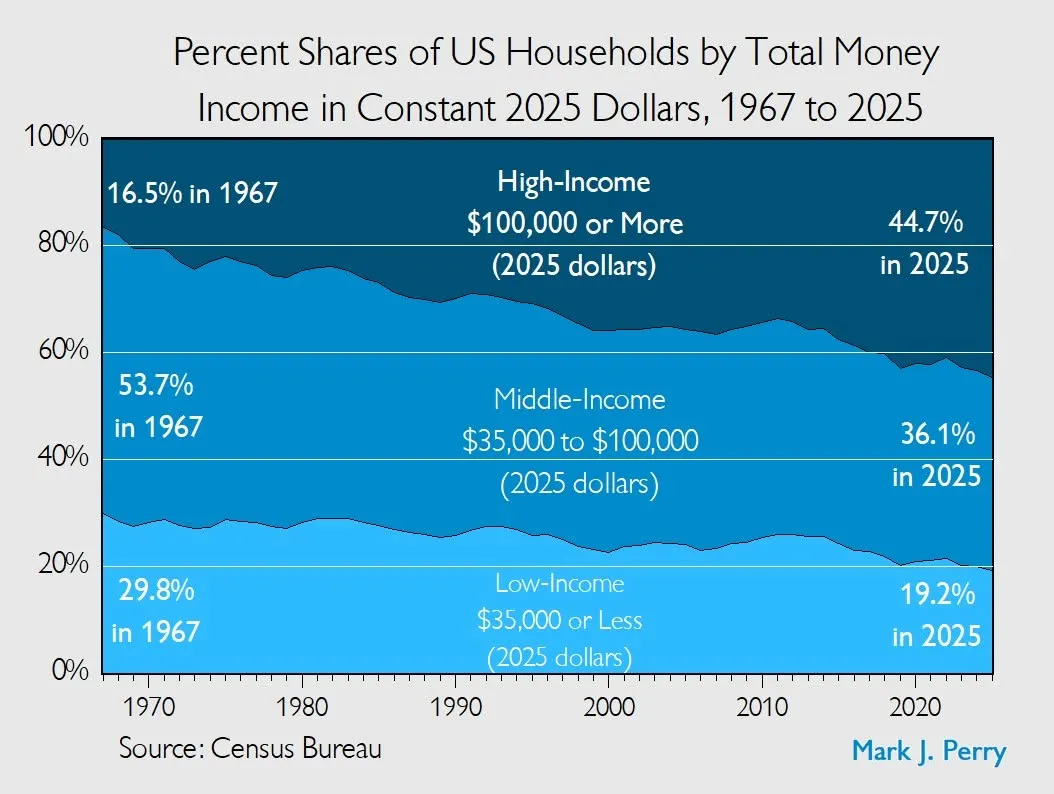
In 1967, adjusted for inflation, about 30 percent of American households earned less than $35,000. Today it’s about 19 percent.
Okay. So where did everybody go?
They got richer.
In 1967, only 16.5 percent of households earned the equivalent of $100,000 or more in today’s dollars. Today? Nearly 45 percent. The middle-income group really has shrunk—from 54 percent of households to 36 percent.
But look where it went… Up.
The disappearing middle class didn’t simply tumble into poverty. Millions of households graduated into higher real incomes, despite persistent inflation. And the percentage at the bottom fell, too.
So America has this weird problem: we’re still getting richer, but we don’t feel richer.
The Great Divergence in American Affordability
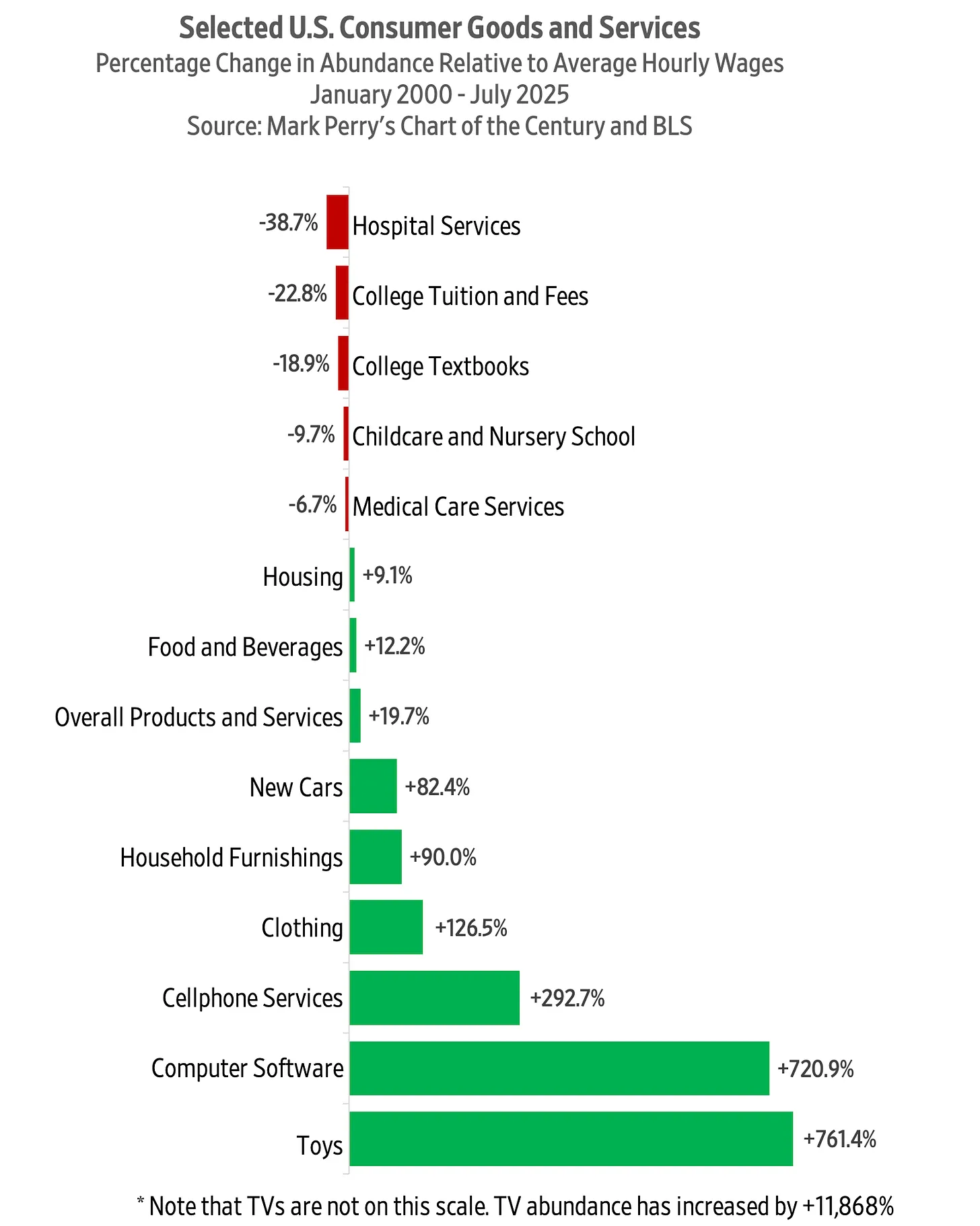
Another Mark Perry chart helps explain why. Look at what happened to prices between 2000 and 2025.
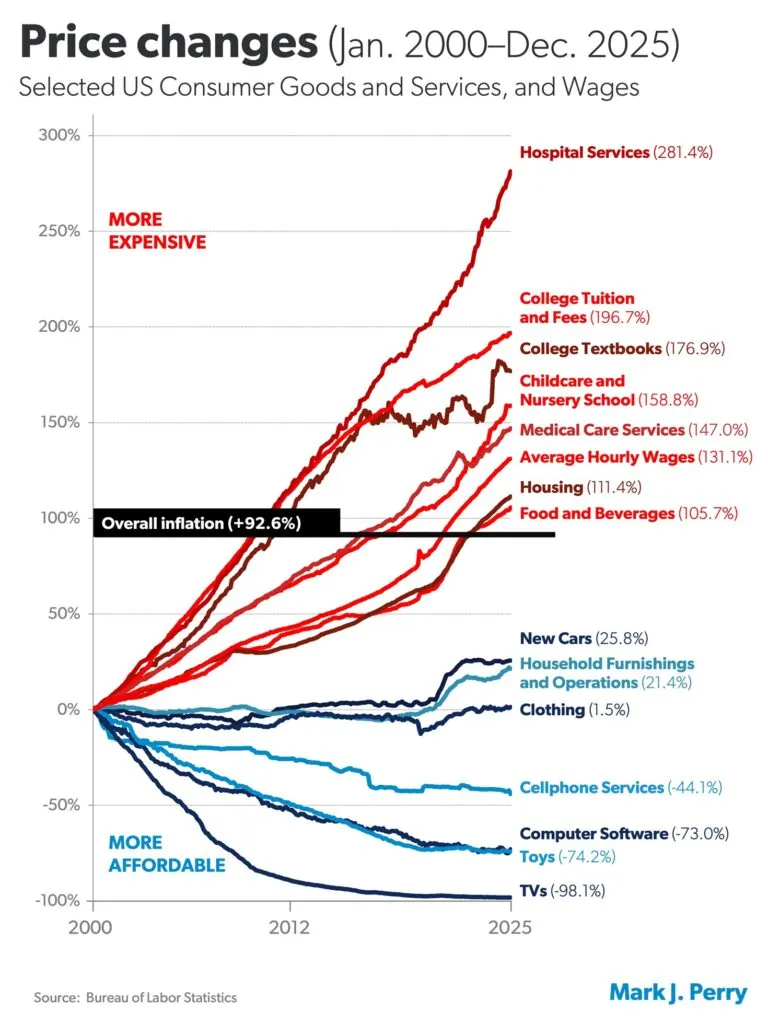
TVs became almost unbelievably cheaper. Computer software plunged in price. So did cellphone services and toys. Clothing barely budged. Household furnishings and new cars increased far less than wages.
These are sectors in which competition, technology, globalization, automation, and scale have been allowed to perform their strange magic. Companies figure out how to make more with less. Competitors copy them. New entrants undercut them. Technology improves. And consumers benefit.
Now look at the other end of the chart.
Hospital services: up 281 percent
College tuition and fees: up 197 percent
Childcare: up 159 percent
Medical services: up 147 percent
Housing: up 111 percent
What’s your political type?
Find out right now by taking The World’s Smallest Political Quiz.
Take the Quiz
Something very different is happening in these industries. And unfortunately, these aren’t trivial.
You can postpone buying a new flat screen, but you can’t postpone appendicitis.
You can keep using your old laptop, but you still need a place to live. And if your kid needs childcare while you work, Amazon can’t ship you a cheaper substitute tomorrow morning.
Such is the paradox of American prosperity. We’re richer. Many of the things we buy have become dramatically better and cheaper. But some of the things we cannot easily do without have become painfully expensive.
So instead of asking “Why is everything unaffordable?” we should ask: What’s different about the things that are?
Follow the Red Lines: Where Prices Are Rising Fastest
Start with housing. Why don’t developers just build more homes where people want them? Often because it’s illegal.
Zoning restrictions and building codes are costly. Minimum lot sizes consume land. Parking requirements increase costs. Permitting adds delays. NIMBY opposition prevents construction. Then we all express shock that restricting the supply of something makes it more expensive.
Or consider health care.
Whatever else American health care is, it is not some laissez-faire free-for-all. It’s a labyrinth of government subsidies, third-party payments, occupational licensing, insurance regulation, patent protections, insurance mandates, in-state monopolies, and restrictions on competition.
Some states even maintain Certificate-of-Need laws, which can require government permission before a provider builds or expands a medical facility. The Federal Trade Commission and Justice Department have criticized such laws for restricting competition.
And then there’s college.
For decades, our solution to expensive higher education has been to give people more money with which to buy increasingly expensive higher education.
This has created a tuition spiral: Loans. Grants. Subsidies.
But subsidizing demand without proportionately increasing supply almost never makes something cheaper. Some of our increased purchasing power becomes higher tuition. Meanwhile, universities compete with amenities, facilities, administration, and prestige — costs that don’t necessarily translate into more learning.
Baumol’s Cost Disease and the Price of Essential Services
There is another force at work here, too. Economists call it Baumol’s cost disease.
Some industries become dramatically more productive. One farmer can feed vastly more people than his ancestor could. One factory worker can produce vastly more goods.
But a string quartet still requires four musicians. A nurse practitioner still needs a certain amount of time with a patient. A teacher still needs time with students. A caregiver can only watch so many children.
As wages rise in productive sectors, these labor-intensive sectors have to raise wages too, even though they can’t increase output at anything like the same rate.
So not every red line on this chart is caused by government. But officials can make an intrinsically expensive problem considerably worse.
The Wrong Diagnosis of America’s Affordability Crisis
This is why the standard story matters.
If your diagnosis is that “capitalism” has made ordinary life unaffordable, your solution will probably be more subsidies, more controls, and more regulation.
But what if the diagnosis is backward?
What if competitive markets are actually doing remarkably well in much of the economy—and our worst affordability crises are concentrated in sectors where competition, supply, and productivity are tightly regulated and unusually constrained?
If that’s true, the prescription changes.
For housing: Let people build.
For health care: Create transparent prices and remove barriers to entry and competition.
For higher education: Never assume subsidizing students will discipline prices.
When Baumol’s cost disease is the real culprit, recognize the trade-off instead of pretending there’s a regulatory magic wand that makes labor-intensive services cheaper and more widely available.
This isn’t an argument that every regulation is bad. It isn’t an argument that every subsidy is useless. And it certainly isn’t an argument that Americans who feel squeezed are imagining things.
It’s an argument that we need to identify where the squeeze is actually coming from.
The Affluence Paradox: Richer Americans, Higher Essential Costs
America isn’t a country steadily sinking into poverty — though it risks it by sinking into ever more debt.
In inflation-adjusted terms, far more households earn six-figure incomes than did two generations ago. Far fewer live at the bottom. And technological progress has delivered goods our grandparents could scarcely imagine at prices they could hardly believe.
Yet we’ve constructed bottlenecks to accessing some of the most important things in life. Housing. Health care. Education. Childcare.
Because those expenses loom so large in a household budget, they can sap all the gains in prosperity.
A 70-inch television for $400 doesn’t help much when your rent just went up another $400 a month.
So maybe the great economic question of our time isn’t “Why doesn’t capitalism work anymore?”
The question is: why do the things exposed to vigorous entrepreneurial competition keep getting better and cheaper — while so many of the things we’ve insulated from it keep getting more expensive?
We need to follow the red lines. They’re trying to tell us something.
---
I’m Max Borders. Let’s criticize by creating.
UPDATE: Check out this excellent analysis of Perry’s chart on time pricing—from doomslayer Gale Pooley.