Who are you?
When you introduce yourself to someone, you tell them your name. Often enough, you tell them something about what you do for work, or who you are in relation to others: husband, wife, parent, Bob’s friend, Jenny’s cousin.
Is that who you are?
If you dig a little deeper, perhaps you tell them something about your likes and dislikes. Your thoughts about this or that. Your hopes and your dreams.
Are those who you are?
Those of us who are concerned with human freedom often emphasize the centrality of the individual human person in moral and political questions. Yet we seldom delve deep into who and what the individual is.
Are we defined by our roles? By our similarities and relations with others? By what makes us unique? By fathomless depths that no one can truly plumb? Or perhaps some mystical combination of all of these, and more?
style="width:3.5rem;border:0;border-top:2px solid currentColor;margin:1rem auto;">I am not writing you an article today—I am singing you a song.
It is a song about you. About me. About each one of us.
It doesn't exactly rhyme, and it doesn't exactly have meter, but it has an underlying music.
YOU are that music.
You are the lyrics. You are the song. You are the radiant spark from which all moral meaning flows.
You are the individual human person, and this is an ode to you.
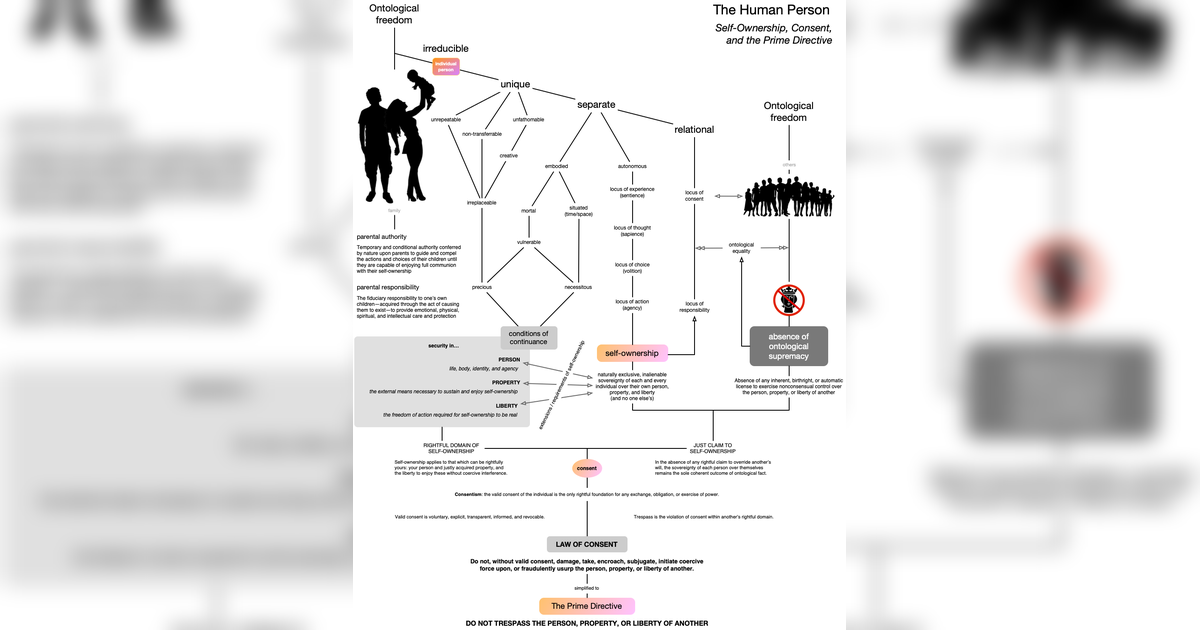
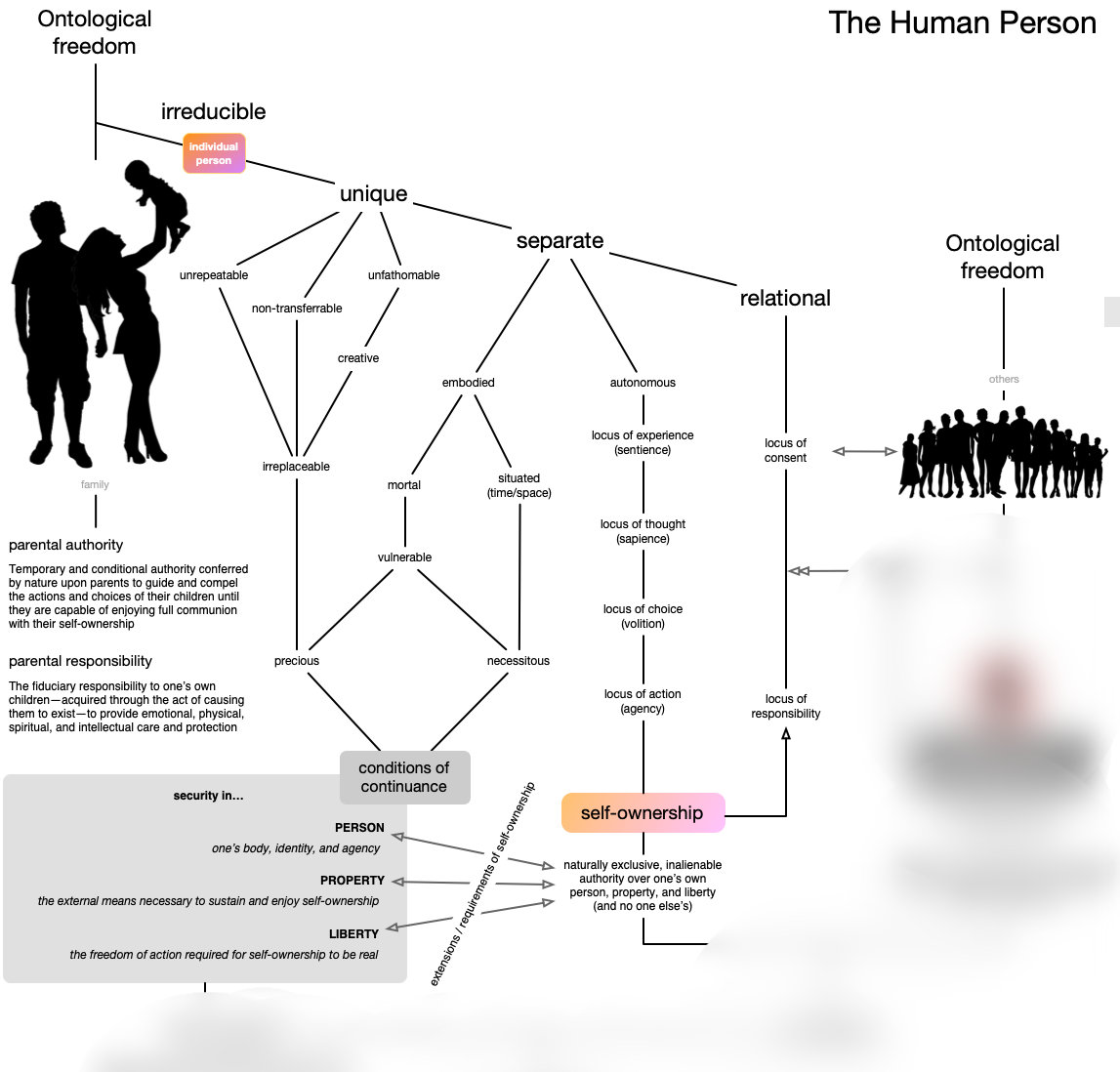
(I have also 'painted' you a picture—a picture about you. As we sing our song, please follow along in the chart below.)
You Are Irreducible
We begin with the magical act of reproduction. A man and a woman join to contribute to the ongoing creation of the universe. They create a person.
A person has life. A person has identity. A person has agency.
And, very importantly, a person is irreducible.
Groups are made of separate units. A nation or region is composed of communities, a community is composed of families and social relationships, and all of these are composed of individuals. But only the individual cannot be further reduced.
A group can lose an individual and still be a group. An individual, by contrast, is indivisible. You see—it's right there in the name.
The implications here are profound. Individuals cannot justly be relegated to the status of a cog in a machine or a cell in a larger body. We cannot be reduced to a function or a classification.
The individual human person is the fundamental unit of moral concern—the beating heart at the base of everything.
You Are Unique
There is only one of me. There is only one of thee.
No two human beings are the same. Similar, sometimes, but never the same.
What’s your political type?
Find out right now by taking The World’s Smallest Political Quiz.
Take the QuizThere is only one of each of us. Unrepeatable
Your existence and identity are a one-time thing. You cannot be replicated. You cannot be duplicated. Your moments, once gone, cannot be redone—even by you. You are unique not just in the here and now, but in the whole universe, for all time. Non-transferrable
You can tell people what it is like to be you, but no one else can ever be you. Others can attempt to impersonate you, but they cannot inhabit your being. Each person's "I" is wholly non-transferrable. Unfathomable
You can never be fully comprehended, inventoried, or described. You cannot be reduced to your biology. You cannot be reduced to anyone else's assessment. You are a well of inexhaustible depth. A locus of infinite mystery. Creative
You have the existential capacity to bring new realities into existence—to reach down into the ineffable depths of your own mysterious being and bring forth the new. You can also create new life. Irreplaceable
You are not fungible. You cannot be swapped out for another of like kind, for there is no other of like kind. You are not an interchangeable part. Once you are lost, you are lost. Precious
You are not merely scarce, like a resource or some rare thing. You are not a thing at all. You are an irreducible, unrepeatable, one-of-a-kind locus of ineffable personhood. You are irreplaceable, for all time.
You are also physically vulnerable. You can be harmed. Your life can be taken. If you are lost, the world has not lost a mere object—the world has lost an infinitely precious (dare we say sacred?) human being.
You Are a Separate Being
I am me; I am not thee.
You are your own being. You are not a mere subunit of any group. You are not someone else's appendage. You can form bonds with others, but you are not those others. You are distinct. You are you. You Are Embodied
Right here, right now, you have a body. It is distinct and separate from all the other bodies in the world. It is yours alone. Mortal
Your body is finite. There is only a limited time during which your body functions as a living thing. Vulnerable
Your body can be harmed. External forces can cause your body to cease to function as a living thing. Situated
Your existence in this body takes place in time and space. No one exists as a mere abstraction; we have a here and a now. Your embodied existence has a context. Necessitous
Your continuance as an embodied being entails physical needs. You require sustenance: food, water, and air. You must occupy a physical space. You must have property: tools for labor and a place to shelter. You must have the freedom of action required to pursue the things you need to survive and thrive. You Are Autonomous
Your existence as an autonomous being is not a mere philosophical construct. You are, by ontological fact, the only one in the universe who can execute your own will in your own body. You are the self-governing locus of your own being. Locus of experience
You are a sentient being. You feel your own sensations and experience your own experiences. No one can do it for you, and you cannot do it for anyone else. Locus of thought
You are a sapient being. Others can influence your thoughts, but they cannot think your thoughts for you. Locus of choice
You are a volitional being. External forces may seek to constrain your choices, but no one—absolutely no one in the universe—can make your choices for you. Locus of action
You are a being with agency. You are the sole origin and instrument of your own actions.
All of these miraculous natural facts are paired with two fundamental conclusions: 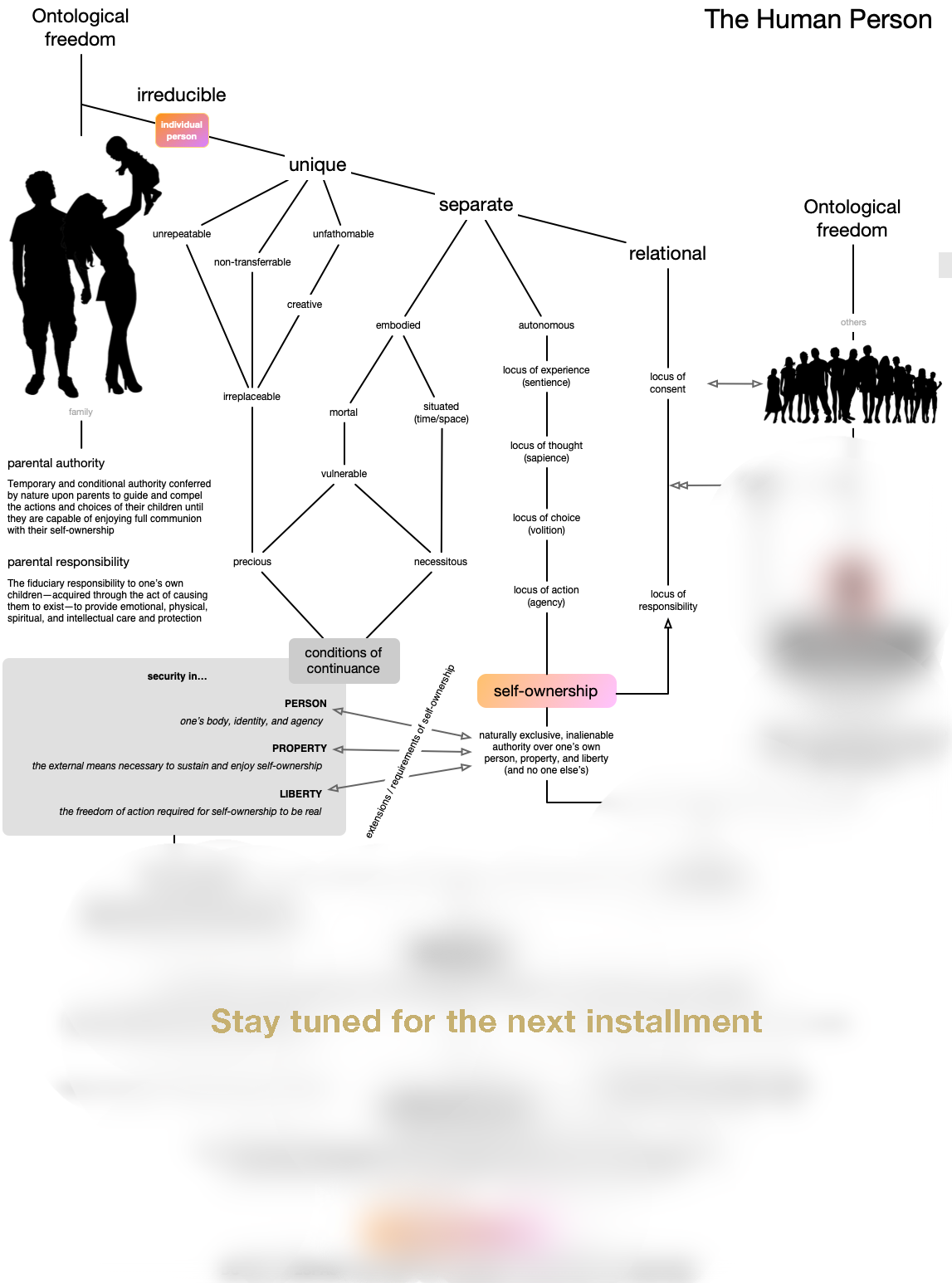
#1
You Have Exclusive, Inalienable Self-Ownership
As the autonomous locus of your own experiences, thoughts, actions, and choices, you are the self-governing author of your own being. You have dispositive decision-making authority over yourself as an ineluctable fact of your personhood.
Dispositive decision-making authority is the primary characteristic of a property right. You own yourself. Not as a purely moral abstraction, but quite literally.
Others can influence or forcibly coerce you, but no one can assume the authorship that you and you alone possess. Your self-ownership is thus naturally exclusive.
You can be severed from the rightful enjoyment of your natural rights as a human person, but your personhood cannot be unmade by any force on Earth. Your self-ownership is thus naturally inalienable.
#2
You Have Requirements for Continuance
As the self-owning mover of your own life, you are naturally free to pursue your own continuance—to survive and to thrive. And yet, as a vulnerable, necessitous being, your continuance is not assured. You must act in pursuit of your own betterment.
This pursuit requires that you be secure in your own person—in your body, identity, and personal agency.
You must be free to create and acquire property—the external means necessary to sustain and enjoy your life.
And you must be free to exercise your own agency—to make choices and take actions in furtherance of your own existence and improvement.
Because you are an infinitely precious being, these requirements are worthy of respect by others.
style="width:3.5rem;border:0;border-top:2px solid currentColor;margin:1rem auto;">Self-ownership and continuance are contingent upon, and extensions of, one another. As a naturally free being, you extend your thoughts, choices, and actions out into the world. You have the natural authority to do this for yourself (and for no one else). To pursue your own betterment—for your self-ownership to be real—you must be free to act without external restraint upon your person, property, or agency.
Yet no one is an island alone. You are part of a world, surrounded by your fellows. And that is how you would want it, for indeed,
You Are a Relational Being
I am me; I am not thee; yet we can choose to be we.
You are a unique, separate, autonomous, self-owning being, but you are also a member of an ultra-social species. We pair-bond and raise our young together. We form families, bands, clans, and communities. We cooperate like no other species on the planet—by biological imperative, but also by choice. We are relational creatures. Locus of responsibility
As the exclusive owner, author, and instrument of your actions, you are exclusively responsible for those actions and may rightly be held accountable for any trespasses. You are a self-owning moral agent.
You cannot rightly be held responsible for the actions of any others, however, nor may any others be held responsible for yours. Your credits and demerits are yours alone. Locus of Consent
Only a responsible, self-owning being is capable of consent. You and you alone can consent for yourself: to enter into relations with others, to engage in transactions, and to share your person, property, time, and being with another. You cannot consent for anyone else, nor can anyone else consent for you. Nor is your consent the business of anyone else.
All of these things are organic facts of your existence. And all of them are grounded in the reality that
You Are Ontologically Free
Your existence is contingent upon the actions of your parents and ultimately upon the Source of all things, and there is a period during which your parents exercise a temporary and conditional authority, protecting you and serving as trustees of your future adult self. Beyond this, no one has any natural authority over you. No one.
You exist as the kind of being you are, within a universe that is itself free to unfold according to its nature. Freedom is your natural state. Any other imposition of authority is an artificial intrusion upon your natural state.
Freedom is the primordial ground of being.
And you—the individual person—are the sacred fire of meaning.
style="width:3.5rem;border:0;border-top:2px solid currentColor;margin:1rem auto;">Did you hear the music? Did you feel the song?
Do you realize what a miracle you are?
I don’t know if you noticed, but there aren’t a lot of moral claims in our song. We have delighted in the beauty of it all, but we haven’t needed to make many normative statements, because these things are just the facts of nature.
There are moral implications from these facts, but the facts are just the facts. You are all these things not because we say so, or because we wish it so, but because you are.
You ARE.
style="width:3.5rem;border:0;border-top:2px solid currentColor;margin:1rem auto;">Stay tuned for the next installment, in which we demonstrate how these facts render the consent of the individual human person to be the fundamental unit of moral concern in society.
Questions? Input? Concerns? Feel free to email me at [email protected]