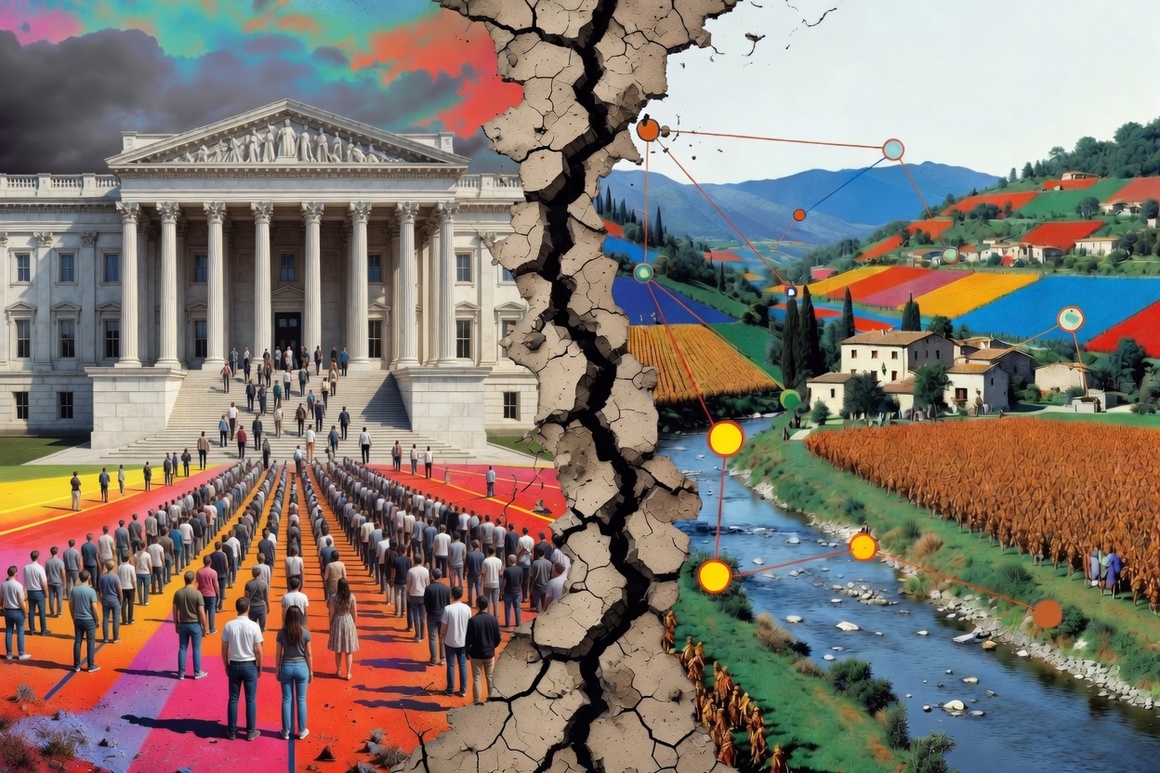

In a neighborhood near me, the HOA board voted to cut down an 80-year-old willow tree, not because it was diseased, but because the tree was actually alive and healthy. It was well known that the property owner had chosen that house partly because of its beauty.
When the board raised concerns about falling leaves and the possibility of the tree splitting apart, she offered to handle all the maintenance herself. When they raised the issue of cost, she offered to cover it all. Then, in what appeared to be a knee-jerk attempt to assert their power and control, they responded: “If she paid for it, they’d sue her.”
Neighbors wrote letters and made phone calls. They showed up to meetings. Yet the four-member board was unmoved. The morning after the HOA deliberation – with no notice – she woke to find a tree crew outside. Today, a gap exists where the 40-foot tree once stood.
Sortition is the practice of choosing decision-makers by lottery rather than by election, the same way juries are formed. Supporters say it produces more representative, less corruptible government, because citizens picked at random have no campaign to win and no donors to repay. Ireland, Iceland, and France have all tested it through citizens’ assemblies.
Why power corrupts representation (the neuroscience)
The neuroscience is consistent on this: power is addictive. Studies show that arbitrarily assigning authority causes even reluctant “bosses” to rapidly become miniature authoritarians. That randomly attained power can inflate self-importance, distort judgment, breed a sense of superiority, and dull empathy for others.
Winning or gaining power triggers a dopamine release, a neurological reward hit. The brain adapts, gets hooked, and demands bigger and bigger doses.
There is abundant data showing that case outcomes worsen when a judge rules before lunch, that doctors misdiagnose based on whether they like the patient, that detectives can lock onto an early theory at the expense of the truth.
The cognitive shortcuts our brains rely on, necessary in a complicated, overwhelming world, carry serious costs for others. The human brain was never designed to bear the weight of millions of lives. We’re not talking about a moral failing here, but a limitation of the human mind.
Throughout history, narratives like this have played out at a civilizational scale. China saw cycle after cycle of dynastic power accumulation, replete with centralization, corruption, and collapse, only to reset under a different banner. Rome died a death of a thousand cuts through extended term limits, prolonged military tenure, the slow drift from elected magistrates to centralized authority, and the transition from republic to empire.
More recently, we’ve watched this unfold in America. The Founders explicitly built limits on federal reach into the Constitution, limits that eroded through congressional exemptions, broad readings of the General Welfare clause, and fiscal federalism. From the Whiskey Rebellion to the Patriot Act to the quiet reversal of the STOCK Act, this historical pattern in America tends to repeat itself.
What is a citizens’ assembly? Ireland, Iceland, France
For years, Irish politicians were deadlocked on the country’s hardest questions: abortion, fixed parliamentary terms, an aging population, climate change. In 2018, a social experiment changed that. Ninety-nine randomly selected members of the public came together to discuss these issues and essentially resolved them.
This was a revival of sortition: the practice of selecting decision-makers by lottery rather than election, specifically to prevent vested interests from taking hold.
In Ireland’s citizens’ assembly, those 99 citizens, guided by a single steward, heard from subject-matter experts on all sides of each issue. The result was roughly 80% consensus across the major questions, and an Irish public that overwhelmingly accepted the findings because it felt representative of actual beliefs, not ideological positioning.
Ireland wasn’t alone. Iceland used sortition to draft constitutional reforms after the 2008 financial collapse. France convened a citizens’ assembly on climate change in 2019. Belgium’s German-speaking region established a permanent citizens’ council that same year.
Here in the United States, we are living through a period in which partisan politics often wields more influence than critical thinking, evidence, or the broader public interest do. Much of this dynamic is driven by a narrow demographic of ambitious, well-funded candidates who are typically upper or middle class, media-polished, and highly focused on winning office. Once elected, their attention frequently shifts away from solving meaningful problems and toward a single overriding objective: securing reelection.
What’s your political type?
Find out right now by taking The World’s Smallest Political Quiz.
Take the QuizGiven this narrative, the next stage of social and political evolution may need to move toward something far more pluralistic, decentralized, and deeply human. As James Bridle writes in Ways of Being, diversity often outperforms raw ability. In other words, the strongest solutions to complex problems tend to emerge not from small circles of credentialed elites conditioned toward conformity, but from a wide range of lived experiences and perspectives.
So what happens when we bring the nurse, the immigrant, the formerly unhoused person, the tradesperson, the professor, the librarian, and the data scientist into the decision-making process together? Wouldn’t ninety-nine varied perspectives, shaped by real life rather than political ambition, offer more nuance, wisdom, and grounded truth than sixty senators operating inside the same institutional bubble?
How many people does one U.S. senator represent?
Each U.S. senator currently represents, on average, 3.4 million people. That one person is supposed to speak for your values on the economy, education, national defense, civil liberties, environmental protection, technological regulation, infrastructure, and dozens of other issues. That may have been plausible in 1776. At today’s scale and diversity, it borders on absurd.
Compound this with the perverse incentives built into governance systems in the U.S., Japan, the UK, and the EU. These are systems centered on lawmaking, where the incentive is always to add more laws. In the average two-year congressional term, more than 10,000 bills are introduced with a roughly 4% passage rate, many obscuring special interests buried in omnibus legislation.
In 2024, the watchdog group Citizens Against Government Waste counted 8,222 individual earmarks costing taxpayers $22.7 billion. The average American has little idea what their representatives are actually voting on, what hidden agendas shaped the vote, or whether the legislation was worth passing in the first place.
This isn’t about villainizing politicians. As the thinker Max Borders puts it: “It is not the official, it is the office that corrupts.” The office is harder to corrupt when 98 other community members have their eyes on every line of legislation.
Lobbying is a long game. It requires building relationships with the same people sitting in the same chairs over time. Rotate those chairs every few months, and there’s no one left to lobby.
How sortition would actually work
Linus’ Law, paraphrased: with enough eyes on a problem, there is no more problem. We have the ability to see from different angles and arrive at solutions that wouldn’t have been found alone.
I once attended an event built on the conviction that designing the societies of the future requires all kinds of voices at the table, not just innovative technologists and economists, but dancers, artists, makers, parents, and homemakers. With many diverse perspectives focused on laws that carry real consequences for real people, we get greater transparency, greater trust, more accurate representation, and more genuine agency.
The honest limits of sortition
That said, this is no panacea. People don’t always act rationally. Individuals carry bias. Plumbers and painters may lack the context that comes with years in the policy realm.
The obvious structural challenge is who selects the stewards, since that role could quickly devolve into the same concentration of power we’re trying to dismantle.
So who gets chosen, for how long, and with what constraints?
The simplest answer is that people should be chosen for short, fixed, and rotating terms. They should be involved long enough to learn the issue but short enough that no one gets entrenched.
Two stewards from meaningfully different viewpoints might provide enough counterbalance without a pretense of neutrality. Visible advocacy by the stewards is preferable, similar to a university debate structure where bias is openly named and built around rather than hidden.
There are likely half a dozen other objections worth working through: accountability, expertise, scalability, the protection of minority views within a randomly drawn majority. These are the right kinds of disagreements to be having.
They require something from all of us — our imagination, our problem-solving, our willingness to sit across from someone who sees things differently so we can build something together. This is discourse we undertake through community, rather than from the sidelines.
Practices like sortition will never be singular solutions. Ancient Athens employed it and still collapsed under over-centralization. The human brain’s appetite for power, conscious or not, will keep reasserting itself. Rather than watch it slowly degrade our communities, we can acknowledge that tendency as a known variable and design accordingly. And when the structure fails, we can build it back better.
Decentralization is not an endpoint. History has proven that the slide back toward concentrated power is always creeping. Decentralization is a practice, one of many tools we can reach for when designing governance around human neurology rather than pretending humans are above it.
The willow tree is gone. The goal was never to find better board members. It was to redesign the room. Four entrenched people did not represent the neighborhood, which was their entire mandate. Two people cannot represent my entire state. We are still using a table built in another era, by people of a particular kind, serving only a limited few.
The good news is we have plenty of material to build more chairs, create new tables, and invite each other in.