
Problems with Revolution, Part 1
I am about to say something edgy—especially for people in the freedom movement. But I promise I can explain. It begins with a look into our cherished history…
In hindsight, the past starts to look ever more black and white. Major figures become heroes or villains. Their acts or pronouncements become all good or all bad. Nuance is lost.
We forget that humans are complicated and imperfect. We forget that each of us is, in part, a product of the time in which we lived.
So, when I make a statement like…
Thomas Jefferson got something wrong in the Declaration of Independence
…some people will react with anger.
How dare I?
I hope it will mitigate that reaction somewhat to note that Jefferson is one of my favorite figures and the Declaration of Independence is one of the greatest documents ever written. But that does not make him infallible, nor does it make the document holy writ.
Do ‘We the People’ Have a Right of Revolution?
The problem lies in statements of the right of revolution. Let’s see if we can spot the errors.
First, the Declaration:
That whenever any Form of Government becomes destructive of these ends, it is the Right of the People to alter or to abolish it, and to institute new Government, laying its foundation on such principles and organizing its powers in such form, as to them shall seem most likely to effect their Safety and Happiness.
Did you catch it? No?
Let’s try John Locke, the Enlightenment-era pioneer in whose footsteps Jefferson walked, from his Two Treatises:
The people have a right to act as supreme, and continue the legislative in themselves; or erect a new form, or under the old form place it in new hands, as they think good.
How about now? It’s just two little words.
We can all be forgiven if the problem isn’t obvious right away. We’ve been trained our whole lives to accept an assigned meaning of these two words without question.
“THE PEOPLE.”
There’s the problem, right there.
What people?
Everyone? A voting majority? The victors in a war? Everyone except Bob?
Revolutionaries’ complaint is always some variant of this:
“We don’t like the system you’re imposing upon all of us.”
So they fight a war and, if victorious, the revolutionaries impose their own system on everyone.
How is that any better?
Who’s the ‘We’ in ‘We the People’?
It is fashionable to believe that “the people” always agree with the revolutionaries.
They don’t.
The most widely cited estimates hold that only three percent of Colonials actively participated in the American Revolution. The rest were split equally among Patriots, Loyalists, and the indifferent. In hindsight, we mention that three percent with reverence. Ultimately, their efforts led to the creation of the most limited government of the modern world, and that was a good thing.
What’s your political type?
Find out right now by taking The World’s Smallest Political Quiz.
Take the Political QuizBut try looking at it another way, for just a moment. Three percent of a population plunged a continent into a war that only another 30-ish percent agreed with. Then they proceeded to impose their idea of a solution on everyone. (And in the end, it wasn’t even really “their” solution; it was mostly Hamilton’s, with Madison in tow.)
What about the people who didn’t want the war? What about the people who didn’t like the solution? What about the people who don’t like the solution now?
A revolutionary’s grievance, boiled down to its essence, is that they are being subjected to a system to which they do not consent. What gives that revolutionary the right to do the same to others after he wins?
Is the ‘Consent of the Governed’ Real Consent?
Humankind has been straining toward this understanding for a long time.
King Arthur taught us that might does not make right. And yet here we are, 1500 years later, still deeming the victors of a war to have legitimate authority. (Yes, I know Arthur is semi-mythical. Let’s not get into that now.)
The American Founders understood that pure arithmocracy—what they called “democracy”—is a problem because it empowers a majority to override the rights of the minority. Unfortunately, a republic—even a carefully designed constitutional republic—doesn’t solve that problem. It merely slows it down, complicates it, and makes it more indirect. The fundamental flaw remains.
Still, today, most people will respond that voting constitutes the “consent of the governed,” ignoring the salient fact that no one living (and virtually no one who was alive at the time) consented to be governed in that way, or in any other way.
If voting could legitimately substitute for real consent, then I could walk up to any woman in the world and say,
You are now my wife. I know you did not agree to be, but I promise that we will vote on things like what movie to go see or what to have for dinner. Therefore, you consented to be married.
In the immortal words of Sherlock Holmes: “The parallel is exact.”
Just because a person votes does not mean they consent to be governed, or to have certain policies forced upon them. Voting can be nothing more than an attempt to make the best of a circumstance to which you did not agree. Even if you personally deem your vote to constitute your consent, you cannot rightly impose that understanding upon me and mine.
Democracies and republics are built on the notion that your rights cease to exist whenever you are outnumbered. Lose a vote, and the majority gets to have its way with you.
Despite the hagiographic treatment these systems receive in our culture, that is beyond merely morally problematic. It is an inescapable moral failure.
Faced with this conundrum, the other likely response is to ask what other choice we have. How else could we possibly do things?
The moral flaw ought to be obvious there too:
By what right do you impose something on another human being just because the implications of his rights seem impractical to you? By what right do you impose something on another human being because you cannot imagine another way of doing things?
The Founders Could Not Fully Live Up to Their Own Principles
The American Founders espoused an unassailable moral truism: that an individual’s person, property, and liberty constitute his or her rightful domain. They based their revolution, in part, on this belief.
They identified the individual as the fundamental unit of moral standing. They clearly understood that any imposition of authority or action within an individual’s rightful domain requires consent. (Note that Jefferson, again following Locke, wanted to use “life, liberty, and property,” but the committee instead agreed that “the pursuit of happiness” sounded better than “property.”)
The upshot of this belief is clear; namely, that
Valid consent is the only rightful foundation for any exchange, agreement, authority, or other action within another's rightful domain.
That principle does not change based on the person or people attempting to engage in an exchange, secure an agreement, impose authority, or take any other action within another's rightful domain. How could it? By what alchemy do violations of consent become allowable?
Are they okay if a majority agrees to them? Are they okay if the perpetrators are called “government officials”?
Unfortunately, given their moment in history and the state of classical-liberal thought at the time, the Founders were unable to devise a system that properly actuated this understanding.
They saw that arithmocracy is a problem but still systematized majority rule. They understood that “All men are created equal,” but still imposed a system in which government officials have special rights to do things that are crimes if the rest of us do them. They recognized the centrality of consent but resorted to the philosophical cheat code that your consent to governance is “tacit” and “implied.”
They can be forgiven for all of this. We cannot. We know better now.
The Right to Secede
If we define the right of revolution as the right to use force to overthrow an existing system and impose a new system upon everyone, then the right of revolution does not exist. The right to resist oppression does not grant the right to become an oppressor.
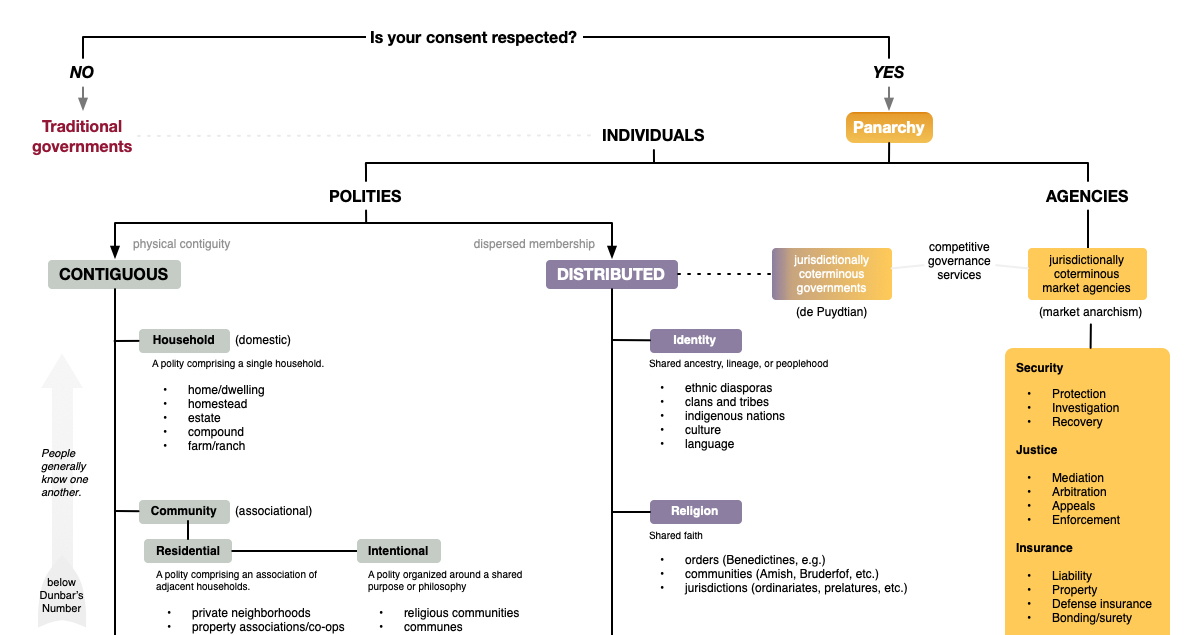
That said, you do have a right to withdraw yourself from any arrangement to which you did not consent.
You cannot rightly be held to a contract you did not sign, a purchase you did not make, or an ‘agreement’ to which you did not actually agree. This applies equally to governance arrangements.
How could it not? The centrality of consent doesn’t magically vanish when the word “government” is uttered. If valid consent is the only rightful foundation of political authority—AND IT IS—then an individual who has not consented to that authority cannot rightfully be compelled to remain subject to it.
Consequently, the individual has the right to withdraw from any involuntary political relationship. We cannot call this not a right to revolution, since we do not have such a right (at least in its commonly understood meaning of overthrow + imposition of a new system). Rather, it is
The Right to Secede
To discontinue, unilaterally and without hindrance, any association with, allegiance to, or subjection under any government; to withdraw oneself and one’s property from the claimed authority and jurisdiction of any government; and to establish, alone or in affiliation with others, any new polity or other social or political arrangement.
Even Single Individuals Have the Right to Secede
If you think that is an edgy claim, it gets even better. Here is where most people’s gears really begin to grind:
The right to secede cannot logically depend upon the number of individuals exercising it. In other words,
The right to secede goes all the way down to the individual level.
One person—just one—can decide to withdraw, and his decision must be respected. The practical implications of such a notion may seem tricky, but what moral choice do we have?
If ten million people have the right to secede, why wouldn't ten thousand?
If ten thousand, why not a hundred? And if a hundred, why not one?
What is the morally relevant threshold at which the right suddenly comes into existence?
If individual consent is the foundation of rightful authority (and it is), then the right of secession must originate with the individual, not with the group. A collective can exercise a right only because its constituent individuals already possess it.
Secession for Me, Not Imposed Upon Thee
If you do not have a right to trespass the person, property, or liberty of another—and you definitely do not—then your secession does not confer upon you any exemption from that rule. Secession does not confer authority over anyone else.
You cannot rightly include anyone else in your secession efforts, subject them to your new system, or claim a jurisdiction over their property, unless they give their valid consent.
This follows directly from the principle of self-ownership. No individual, majority, government, or other institution possesses a superior claim to another person's self-authority.
You may secede for yourself only. If others wish to join you voluntarily, that is their choice. You have a right not to be ruled without your consent. You do not have a right to rule others without theirs.
The right to secede does not come from government. It is a preexisting right that all people—whether they are government officials or not—are morally obligated to respect.
How individual secession might work out in practice is a separate question. But the moral math itself is unavoidable.
So, we don’t have a right to use violence to overthrow an existing system and impose a new system upon everyone. We do have a right to secede from any system of government.
We might even have the right to use protective force in defense of a secession effort, were that effort met with violence from a government. But would that be our best course of action?
That will be the subject of our next installment.