I recently spoke with a pioneering, risk-taking friend who spent a decade campaigning for transparency in governance. Now she jokes about homesteading and raising chickens because, as she puts it, “things are ******.”
Her thoughts have me pondering, “is something big coming?”
We’ve been watching old systems crumble. As Paris burns, Korea shakes awake, Iran wrestles a sleeping tyrant, and the U.S. sometimes appears farcical, we can feel the cracks beneath our feet.
Soulless jobs hold little appeal. We’re tired of the game: stepping around our neighbors on the sidewalk, chasing “just a bit more” money, endlessly shopping on Amazon. These structures are starting to feel sickening.
We know we can care for the planet, but we miss caring for one another. We sense there’s a better way to live, yet feel blocked, overwhelmed, and underwhelmed by how our fellow humans have shown up so far.
If the world is resigned to watching AI cat videos, where is the hope?
What’s missing is the sense that many of us are feeling this way. It isn’t just simply “others are fine, and then there’s us.” It is us.
Across the world, people are growing discomfited with the dominant authoritarian paradigm and its ill-fitting clothes. We can no longer ignore the mismatch.
Who in your life isn’t saying the world is a giant mess? We can feel a shift coming.
When We Mistake Silence for Agreement
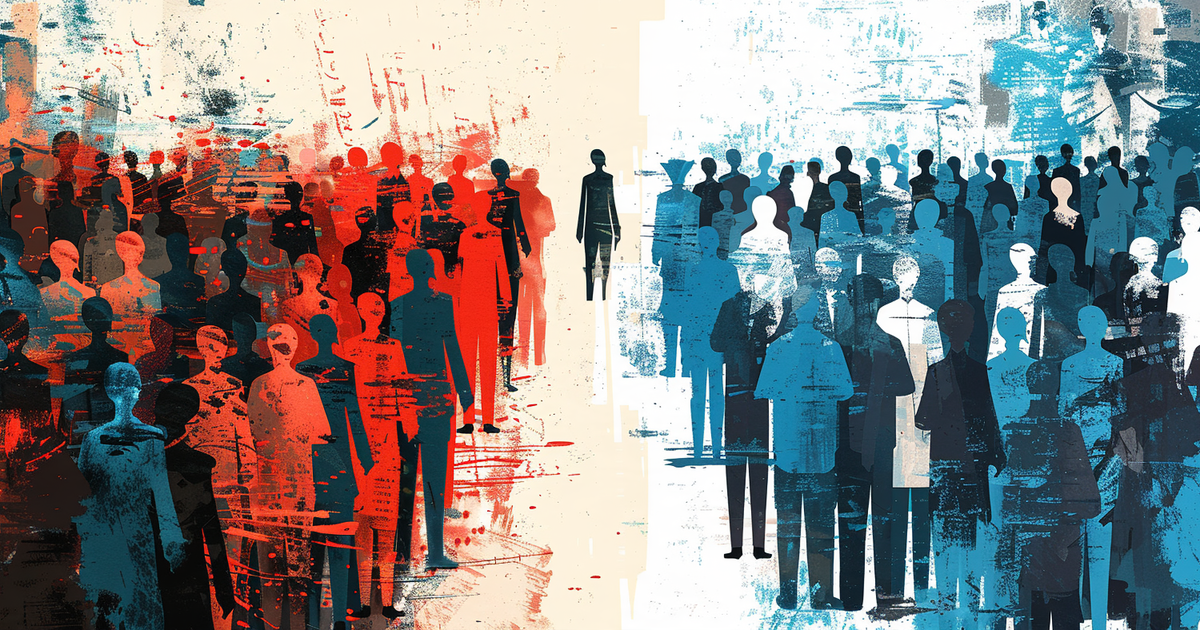
Pluralistic ignorance is a social psychology phenomenon where people privately reject a group’s norm, belief, or behavior but publicly conform because they mistakenly assume everyone else accepts it.
It’s akin to watching everyone go to work on Monday, numb to the latest mass shooting, another drastic climate event, or further evidence of atrocities committed by global leaders.
Then we act as if this is just a normal weather pattern. As if “this is how the world is, and there’s nothing we can do to change it.”
In September 1982, Leipzig’s Nikolaikirche began holding a prayer for peace every Monday. Seven years later, in September 1989, people began staying in the square afterward. The gatherings grew into weekly demonstrations.
Those demonstrations helped build pressure on the East German government. On November 9, amid sweeping changes across East Germany, the Berlin Wall fell.
This was pluralistic ignorance breaking. Under the threat of surveillance and arrest by the Stasi, people had good reason not to speak openly about the status quo. Many didn’t know they weren’t alone in wanting change until they stood beside one another in the street.
So why don’t we speak?
Imagining a More Cooperative Way to Live
Sociologist Martha Beck has written about her own sense of systems crumbling. She describes a concept that has stayed with me since reading it:
“The Pyramid isn’t just a political or economic problem. It’s a state of consciousness. And we’ve all been in it most of our lives.”
By “the Pyramid,” Beck means a top-down social order in which power, status, and authority concentrate toward the top while most people occupy the broader base below.
Beck builds on the idea that the Pyramid is a relatively recent historical construct, even if the social arrangements it describes have existed much longer. In recent decades, anthropologists and philosophers have examined the possibility that many human societies lived in comparatively egalitarian, cooperative communities for much of our history.
Some of this work examines the far-reaching social bonds that preceded modern states, when kinship and community were essential to survival. Other writers point to the shift toward settled agriculture as one turning point in the growth of coercive hierarchy.
These are broad claims about a complicated history. They invite a useful question: what changes when we imagine human flourishing through a lens of cooperation and exchange, rather than treating competition and hierarchy as inevitable?
That question doesn’t require us to condemn private property, markets, or every form of hierarchy. Property acquired and exchanged voluntarily can create incentives to care for resources and be accountable for how they’re used. Unequal outcomes can reflect different choices, knowledge, skills, risks, and circumstances without coercion.
Voluntary exchange and competition can be deeply cooperative: strangers coordinate, specialize, and create value together. Producers may compete intensely, while consumers benefit from better prices, better products, and more choice. Voluntary exchange turns that rivalry into a broader form of social cooperation.
People may also choose to organize themselves through firms, churches, families, clubs, and other associations with different roles and authority. Hierarchy and domination are not the same thing. A voluntary hierarchy can help coordinate knowledge, responsibility, and specialization.
The test is not whether an arrangement looks flat, equal, or cooperative in aspiration. It’s about whether people have a choice as to whether or not to consent, whether they can leave, what incentives the arrangement creates, what tradeoffs it imposes, how it corrects mistakes, and what happens when people disagree. The problem is coercive hierarchy, not hierarchy itself; involuntary systems, not voluntary differences; domination, not competition.
One of my favorite voices in this line of thinking is Ursula K. Le Guin. In her fiction, she explores communities built on mutual aid and voluntary solidarity, including worlds without gender. In her essays, she challenges dominant narratives of success ladders and competition. She argues that the first tool wasn’t a violent spear, but a bag for gathering and carrying. She shares a line that changed my thinking:
“To me the ‘female principle’ is, or at least historically has been, basically anarchic. It values order without constraint, rule by custom not by force.”
I’m worn thin by the constant browbeating about patriarchy. True or not, it feels tired. What’s generative? To me, it’s thinking toward the future. In other words, what do we want?
Like adolescents who have had to veer away from center to explore different ways of being, many of us sense a return to that center, to more intrinsic ways of cooperating. “Hate your neighbor for how he voted” is yesterday’s flaccid form of reactivity.
Breaking Out of Hopelessness
Breaking out of the trance of mainstream media narratives requires critical thinking.
When I proposed a salon—a hosted gathering where writers, thinkers, artists, and others discuss intellectual or cultural topics—to a professional organization, they were initially confused:
“What do you mean, we all talk to each other?”
What’s your political type?
Find out right now by taking The World’s Smallest Political Quiz.
Take the Political QuizThe model in their mind was an expert at the front of the room. They speak; we listen. They have credentials, likes, followers, and published work. We don’t, so we’re the audience.
We’re often taught to sit quietly, accept what we’re taught as gospel, and avoid challenging authority. Critical thinking and practical financial literacy can get short shrift. Is it any wonder we fall into that pattern?
If you’re here, if you’ve read this far, you probably don’t identify with complacency or conformity. That may make it even more likely that you feel alone, or at least in the minority.
We’ve been conditioned to believe our voices don’t matter. “Go sit on the couch and watch Netflix” is the directive we’ve received. So we do. We’ve seen elected officials unable to deliver what voters chose, wars waged against public opinion, and powerful institutions shape our lives beyond public view. The lies we’ve been presented with in recent years are staggering.
Hence, hopelessness.
If we feel alone in wanting change, hopelessness makes sense. If we feel wholly outgunned, hopelessness is rational. Where we risk the most is in giving up on exploring other possibilities.
It might be that the bow has to pull back before the arrow shoots forward. Things may continue to get worse before they get better. They probably will.
My friend jokes that chickens are the exit plan. I sense that the reactionary movements of the last few years are responding to the same rumblings. Tradwives, the reemergence of hypermasculinity, and extreme homesteading can signal a wish to “go back” to more stable, idealized times, when roles were clear and the world seemed sane, if not wildly oppressive. It’s the same impulse, moving in the opposite direction.
Many people around us are clinging to what they perceive as certainty. But those of us who cling hardest may be the ones most disrupted.
There is no “steady” in a time of great change. Wisdom traditions have been warning us of this for millennia.
Connection Is a Source of Strength
Whatever solace we can find lies in connection with one another. Reaching out to support, bolster, and simply be with each other is what will get us through. Alone, we’re isolated and vulnerable. In peaceful collaboration, we’re resilient, creative, and strong.
How we speak to one another right now matters. Who we choose not to speak to, who we make wrong, who we penalize and vilify: every act that moves us away from connection is a choice to close ourselves off.
This moment is a call to curiosity:
What do I have in common with people who seem different from me?
What changes would I like to see?
If I had a magic wand, what shift would I make in the world tomorrow?
Mine would be to wake us up: from the story of separation, from the illusion that we have no agency, creativity, or capacity for change, and from the bullshit narrative that “this is the way it is.”
Communities Are Already Solving Problems
We are problem-solving, mostly cooperative creatures, and communal innovation happens all the time. Today’s systems are not immutable. But good intentions and cooperative language aren’t enough to tell us whether an arrangement serves people well.
We have to ask what incentives it creates, what knowledge it can use, what tradeoffs it imposes, how it handles disagreement, and what consequences follow. And we have to talk to each other about what we want.
I host idea salons because I think Step One is to return to conversation. We can’t move forward from a place of division.
Next is to envision the future: What upgrades would we make? Unedited, big thinking.
Finally, we need to put those ideas into action. But if we jump straight to feasibility, we’ll overwhelm ourselves and raise too many objections.
At the end of the day, we need to come together and rehumanize one another. Have thoughtful conversations. So far, the feedback from our salons has been unanimous: we miss it.