
Gaining Consent — Part 6
Part 1 | Part 2 | Part 3 | Part 4 | Part 5
In this series, we have covered the concept of panarchy in detail.
We examined the centrality of consent in human social relations. We explored the longstanding fallacy that coexistence requires everyone to be subjected to single systems, institutions, and beliefs. We examined in detail the kind of world that might unfold if consent were truly respected. We even picked a possible name for the likely jurisdictional manifestation of such a condition.
But some people—myself included—are visual learners, so it may also help to put all of this into an infographic. To wit,
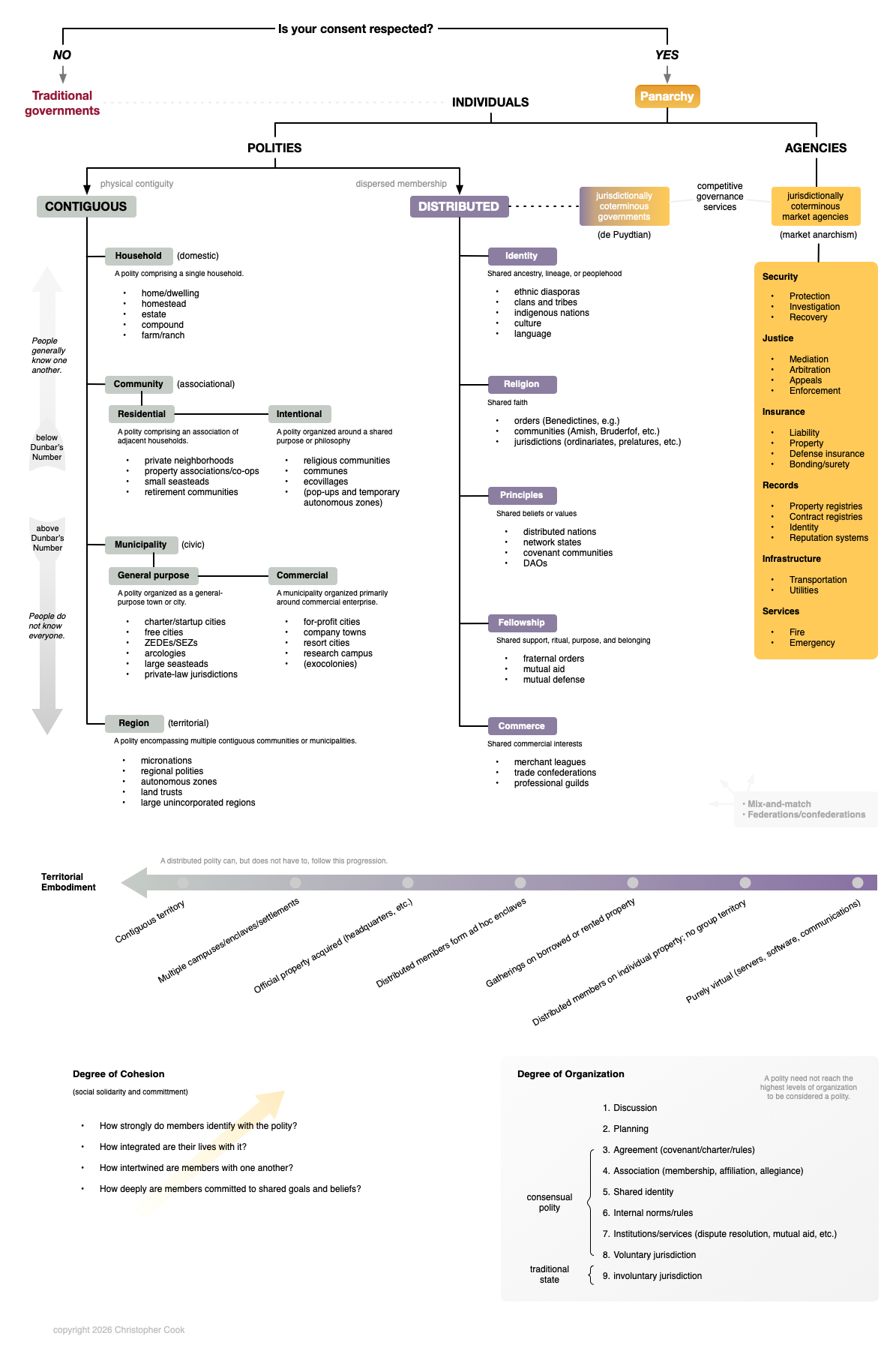
(For a closer look, try opening the infographic in a new tab and zooming in.)
Here is a textual version of the infographic, with added definitions and supplementary details.
The Foundational Distinction: Is Your Consent Respected?
A. NO — Traditional Governments
Traditional governments do not seek consent; they impose themselves by force.
Cherished phrases like “the consent of the governed” notwithstanding, voting is not actual consent. For consent to be valid, it must be voluntary, explicit, specific, transparent, informed, and revocable. No one alive granted such consent to participate in any governance arrangement.
B. YES — Panarchy
A condition of jurisdictional pluralism in which individuals, acting alone or in concert with others, are free to organize themselves voluntarily into polities, obtain governance-related services from providers of their choosing, or remain independent, without being subjected to involuntary authority.
Panarchy is a likely manifestation of, and almost certainly a necessary condition for, a world in which consent is actually respected.
I. Individuals
The individual human person is the fundamental unit of moral concern, and respect for individual consent is a moral necessity for any peaceful social order.
This means the individual must be free to choose any offered social arrangement, create his or her own, or remain completely unaffiliated and outside any jurisdiction. This is represented in the
Jurisdictional Rights
Respect for the consent and self-authority of the individual necessitates, and will be characterized by, the free exercise of
I. THE RIGHT TO ESTABLISH
To create—in any unowned or consenting privately owned physical or virtual space—any system of social or political organization (POLITY); to administer, maintain, modify, transfer, or dissolve said POLITY according to any chosen set of rules or principles; and to offer, encourage, decline, or refuse voluntary participation or membership therein.
II. THE RIGHT TO AFFILIATE
To choose voluntarily to affiliate with a POLITY (where such affiliation is offered), subject to the admission rules and terms established by that POLITY.
III. THE RIGHT TO EXIT
To discontinue, unilaterally and without hindrance, any affiliation with or membership in any POLITY; to settle or remain liable for any prior voluntary contractual obligations without forfeiture of EXIT; and to depart, unhindered, from the physical, legal, or practical control of any POLITY or GOVERNMENT.
IV. THE RIGHT TO SECEDE
To discontinue, unilaterally and without hindrance, any association with, allegiance to, or subjection under any GOVERNMENT; to withdraw oneself and one’s property from the claimed authority and jurisdiction of any GOVERNMENT; and to ESTABLISH, alone or in affiliation with others, any new POLITY or other social or political arrangement.
V. THE RIGHT TO REMAIN
To remain unmolested on one’s own property without being subjected to the claimed authority or jurisdiction of any GOVERNMENT or compelled to affiliate with any POLITY; and, if desired, to make private and voluntary arrangements for security, justice, or any other desirable SERVICES.
Individuals must also be free to choose to remain as citizen-subjects of traditional governments, so long as they do not force, or materially support the forcing of, other individuals to do the same.
Though we cannot predict all outcomes in a condition of consensual order, we can posit that available options fall into two broad categories: agencies and polities.
II. Agencies
One of the most common visions of a condition of consensual order is market anarchism, a.k.a. anarcho-capitalism, in which private agencies provide services normally associated with governments. Instead of a government imposing its version of security, justice, infrastructure, etc., on captive citizens, competing agencies can offer such services to willing customers.
Such agencies would likely be jurisdictionally coterminous—no single agency would have a jurisdictional monopoly over a given territory. (If they did, they would be moving away from being an agency and heading toward being a polity or a traditional government.)
A. Jurisdictionally Coterminous Market Agencies
Here are some of the services such agencies might provide:
1. Security
Protection
Investigation
Recovery
2. Justice
Mediation
Arbitration
Appeals
Enforcement
3. Insurance
Liability
Property
Defense insurance
Bonding/surety
4. Records
Property registries
Contract registries
Identity
Reputation systems
5. Infrastructure
Transportation
Utilities
6. Services
Fire
Emergency
B. Jurisdictionally Coterminous Governments
In the latter half of the nineteenth century, Paul Émile de Puydt envisioned governments with geographically overlapping jurisdictions rather than exclusive territorial boundaries. Needless to say, the primary operational requirement would be consent: such a condition would require respect for something like the jurisdictional rights enumerated above.
III. Polities
Set free of compulsory monopoly governments, some people will try forming governance experiments of their own, which we here are calling polities.
We can define a polity, roughly, as
A durable association of individuals voluntarily constituted as a common social or political order
possessing some means of determining its own collective affairs,
providing governance services, and/or
exercising sole jurisdiction over its members or territory.
In addition to a more flexible range of degrees of cohesion and organization, the main distinguishing feature of polities, in our parlance, is that they are voluntary. No one may rightly be forced to be a member, the way people are currently forced to be citizen-subjects of traditional monopoly governments.
We can further posit two types of polity: physically contiguous (a particular geographical region or jurisdiction, or a group of adjacent properties united in some way) or distributed (formed around a common identity, despite members residing in geographically dispersed locations).
A. Contiguous Polities
We can expect contiguous polities to vary in size and purpose:
1. Household (domestic)
A polity comprising a single household.
The logic of consentism naturally leads to the conclusion that any property, regardless of size, can qualify as an independent jurisdiction. Your land is yours, allodially.
Examples:
Home/dwelling
Homestead
Estate
Compound
Farm/ranch
2. Community (associational)
People may affiliate themselves and their properties into jurisdictional communities.
Two types of communities:
a. Residential
A polity comprising an association of adjacent households.
Examples:
Private neighborhoods
Property associations/co-ops
Small seasteads
Retirement communities
b. Intentional
A polity organized around a shared purpose or philosophy.
Examples:
Religious communities
Communes
Ecovillages
(Pop-ups and temporary autonomous zones)
3. Municipality (civic)
Multiple communities may form larger associations and/or larger areas may incorporate to form municipal jurisdictional polities.
Two types of municipalities:
a. General Purpose
A polity organized as a general-purpose town or city.
Examples:
b. Commercial
A municipality organized primarily around commercial enterprise.
Examples:
For-profit cities
Company towns
Resort cities
Research campus (exocolonies)
4. Region (territorial)
A polity encompassing multiple contiguous communities or municipalities.
All of this can further be expanded to larger areas, so long as participation remains consensual.
Examples:
Micronations
Regional polities
Autonomous zones
What’s your political type?
Find out right now by taking The World’s Smallest Political Quiz.
Take the QuizLand trusts
Large unincorporated regions
Dunbar's Number and Social Scale
Our chart visually depicts (to the left) the fact that smaller polities are more likely to fall below Dunbar’s Number (the theoretical number of people with whom one can maintain stable social relationships). The household and community levels tend toward personal familiarity, while larger municipalities and regions extend beyond it.
Below Dunbar's Number: People generally know one another.
Above Dunbar's Number: People do not know everyone.
B. Distributed Polities
Distributed polities form based on common identity or purpose rather than physical contiguity.
1. Identity
Shared ancestry, lineage, or peoplehood.
Examples:
Ethnic diasporas
Clans and tribes
Indigenous nations
Culture
Language
2. Religion
Shared faith.
Examples:
Orders (Benedictines, e.g.)
Communities (Amish, Bruderhof, etc.)
Jurisdictions (ordinariates, prelatures, etc.)
3. Principles
Shared beliefs or values.
Examples:
4. Fellowship
Shared support, ritual, purpose, and belonging.
Examples:
Fraternal orders
Mutual aid
Mutual defense
5. Commerce
Shared commercial interests.
Examples:
Merchant leagues
Trade confederations
Professional guilds
Territorial Embodiment Scale
In the lower portion of the chart, we show a continuum of territorial embodiment, extending from physically contiguous territory to entirely virtual association. (A distributed polity can, but does not have to, follow this progression.)
From least to most territorial embodiment:
Purely virtual (servers, software, communications)
Distributed members on individual property; no group territory
Gatherings on borrowed or rented property
Distributed members form ad hoc enclaves
Official property acquired (headquarters, etc.)
Multiple campuses/enclaves/settlements
Contiguous territory
The underlying distinction is that distributed membership does not preclude acquiring or developing physical territory.
Degree of Cohesion
We also can envision degrees of social solidarity and commitment within a polity:
How strongly do members identify with the polity?
How integrated are their lives with it?
How intertwined are members with one another?
How deeply are members committed to shared goals and beliefs?
(These are dimensions of social cohesion, not discrete organizational categories.)
Degree of Organization
The chart identifies nine ascending levels of organization.
Level | Degree of organization |
1 | Discussion |
2 | Planning |
3 | Agreement (covenant/charter/rules) |
4 | Association (membership, affiliation, allegiance) |
5 | Shared identity |
6 | Internal norms/rules |
7 | Institutions/services (dispute resolution, mutual aid, etc.) |
8 | Voluntary jurisdiction |
9 | Involuntary jurisdiction |
Levels 1 and 2 are pre-polity.
Levels 3–8 represent degrees within a consensual polity.
Level 9, involuntary jurisdiction, is associated with the traditional state.
(Note: A polity need not reach the highest levels of organization to be considered a polity.)
As we have said, this is not—and cannot be—an exhaustive list.
People might mix and match—belonging to multiple polities and being customers of multiple agencies at the same time. Various federations and confederations might form.
Humans are amazingly creative, so we can also be sure there will be many other forms and combinations we haven’t even considered.
What would you build if you were totally free?