
The Goal: Consensual Order
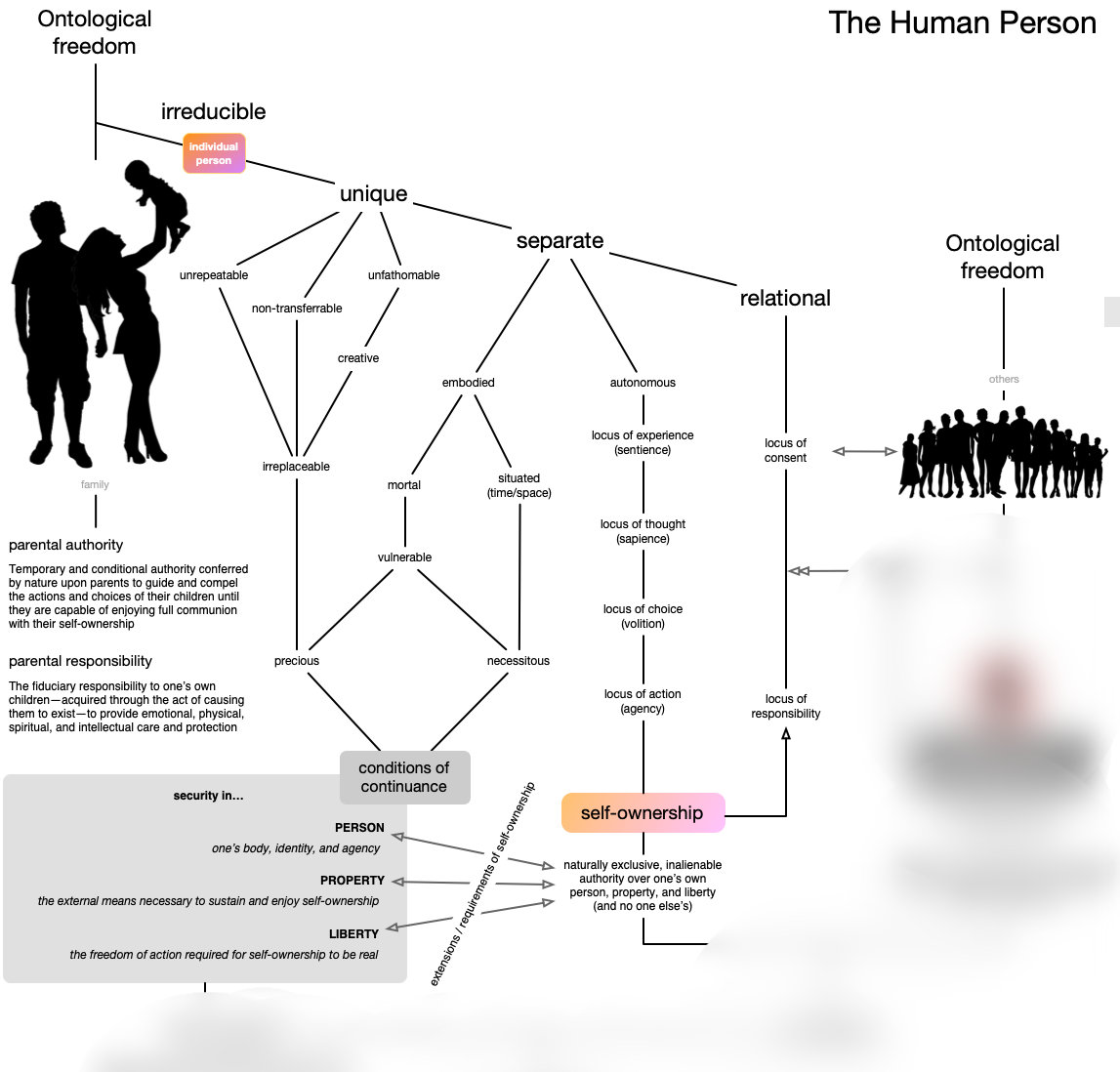
We know that in order to survive and thrive, you must be secure in that which belongs to you and no other: your person, property, and liberty. This is your rightful domain.
We have reasoned our way to a conclusion most people already know intuitively: that consent is the sole source of legitimacy for actions within the rightful domain of another.
Your rightful domain does not shield you from proportionate defensive action in response to your own aggression, of course, but otherwise, it is, and rightly ought to be, sacrosanct.
And thus, we can state with absolute confidence that the consent of the individual human person, within his or her rightful domain, is, and ought to be, the fundamental unit of moral concern in any society. There are many other moral concerns, but this is the baseline. We must not trespass the person, property, or liberty of others.
We further recognize that consent, in order to be valid, must be voluntary, explicit, specific, transparent, informed, and revocable.
Therefore, we know that a condition of consensual order is necessary for genuine peace and justice. We will define this as
A social condition in which no person is subjected to any exchange, agreement, authority, or other action within his or her rightful domain without valid consent.
The freedom movement has been reaching toward this goal for more than 2,000 years. Though we are continually treading water in a swamp of governance to which we did not consent, we can see—if we lift our heads out just far enough—the sunlit uplands that lie beyond.
We can see a future in which our consent isn't violated from the day we draw our first breath until our last exhalation and beyond.
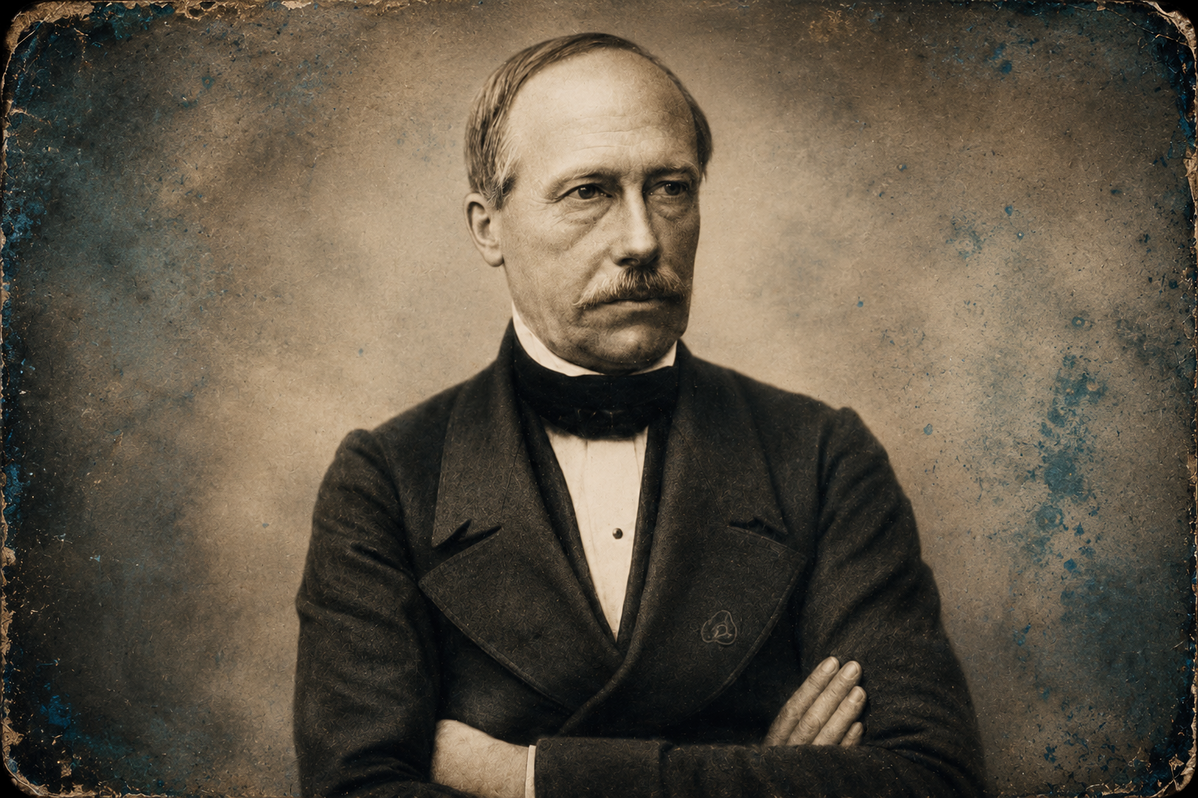
This is what visionaries like Paul Emile de Puydt and Gustave de Molinari had glimpsed. It is what many subsequent innovators have fleshed out with such clarity in the nearly two centuries since.
The One-True-System Trap
We are all straining at a question: how can we create a world in which consent is respected? A world in which there is no special class of people initiating force against the rest of us. A world of real peace.
In our efforts to envision such a world, however, we make an understandable error. We dig deeper and deeper, trying to figure out exactly what such a world should look like.
Can you consent to anything you want? Is intellectual property real property? Do libel and slander constitute aggression?
We’re trying to figure it out. We’re trying to get it right. This is only natural. But it also leads us straight into the jaws of an unfortunate assumption: that such a world can only look one way.
Next thing you know, we’re writing each other off for being “wrong on intellectual property” and dozens of other doctrinaire points. And suddenly, each of us has become a central planner—sure that we know the one true way.
A Framework for Many Answers
Robert Nozick famously did not fall into this trap. In his 1974 classic Anarchy, State, and Utopia, he posited that a world of freedom would require a “framework” within which people are free to create their own voluntary experiments in governance and living.
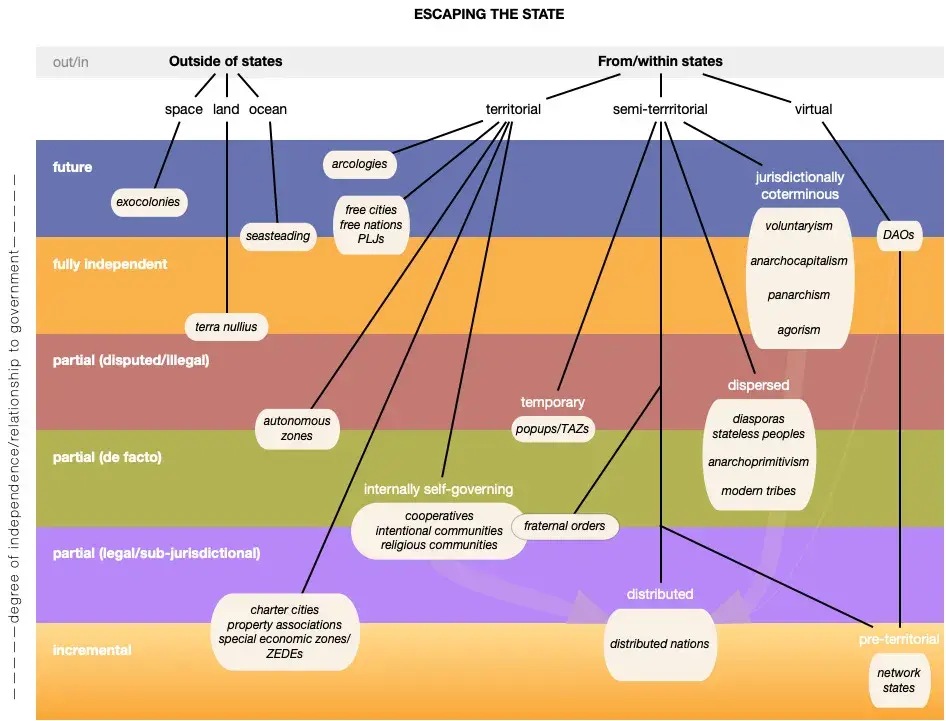
How such experiments—which we here are calling polities—would coexist is a subject we have explored elsewhere, but something like this framework seems necessary if consent is truly to be respected. People must be free to establish new polities, affiliate with the polities of others on mutually agreed terms, and exit without hindrance.
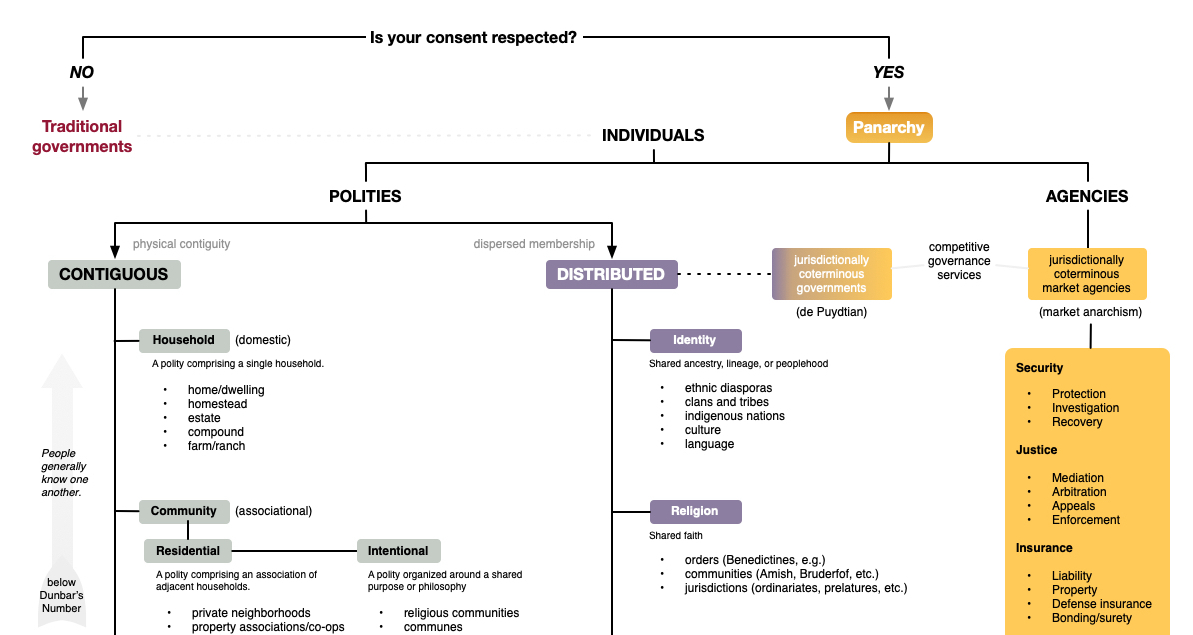
We must also have the freedom to secure governance services from private agencies, or even to remain completely ungoverned and unaffiliated. To prescribe a single system, even an anarchist one, runs counter to our cherished principles.
In other words…
Whatever your preferred flavor of anarchism, it cannot be imposed, or it’s not really anarchism.
Will there be difficulties reconciling one polity’s or agency’s way of doing things with another’s? Sure. Then again, such difficulties exist with traditional states too, and we shouldn’t pretend that they don’t.
In all likelihood, this reconciliation will happen in a very human way. Over time, common laws and protocols will arise through the process of resolving inter-polity and inter-agency disputes. These protocols will bubble up organically, guided by accumulated wisdom and experience, rather than being invented and imposed by central planners. They will be tempered by market forces and market incentives, rather than tainted by the perverse incentives of government officials.
Perhaps some polities will not participate in these common protocols, and that too must be “allowed.” If you want to go live in a micronation that doesn’t participate, but does protect intellectual property rights, you should be free to do so.
Does that mean that you might not be able to stop someone in another polity from making a knockoff of your product? Yes. Then again, you can’t stop the Chinese from doing that now. And at least you will have had a choice about the legal system to which you are subject, which is more than anyone alive today can say.
Panarchy, Not Anarchy
What we are describing here is a condition in which individuals are free to establish, join, leave, or decline any polity, and to obtain governance-related services from providers of their choosing, without being subjected to authority to which they have not consented.
What should we call this?
Thus far, “anarchy” has been the most commonly employed catch-all term for an absence of involuntary governance, which is, at least in part, what we are describing here.
Etymologically, this makes some sense. Libertarian anarchists are not advocating for a society without order, merely a society without a special class of overlords ruling over us without our consent. Rules without rulers, as it is commonly described. And that’s what the word means: an + arkhos = “without rulers.”
What’s your political type?
Find out right now by taking The World’s Smallest Political Quiz.
Take the QuizUnfortunately, that is not how most people understand the word. The first thing most people picture when they hear “anarchy” is chaos and mayhem.
Violence. Burning buildings. Possibly zombies.
If the average person even knows of the libertarian sense of the word at all, it is still a distant second to this dark vision. And no matter how hard we try to spread the word, the picture of chaos persists.
That isn’t going to change anytime soon.
What’s more—and I am sorry to be the bearer of bad news, libertarians, but—the average person would rather be oppressed than live in a condition of “dangerous liberty.” So, even if you could get the libertarian sense of anarchy fully ensconced in people’s minds, most would hear “rules without rulers” and still think of chaos.
I use the word anarchy myself, of course, because it is still the primary term of art. But in the long run, it’s a dead end, and continuing to try to use it, while simultaneously expecting to win people over, is the definition of insanity.
It’s also not quite as on-point as it could be. Auberon Herbert’s consent-focused term “voluntaryism” is closer to the mark, but it never really caught on. Besides, it frequently gets confused with “volunteerism.”
Nozick’s “framework” is a decent term to describe the likely manifestation of (and arguably the necessary condition for) a consensual order. However, I believe de Puydt’s “panarchy” is a much better choice.
In fact, I think it has real legs.
It includes “anarchy,” so it’s an easy move for libertarians.
It gets other people curious, since it’s a slight alteration of the scary word they already know.
And it has an excellent pedigree…
De Puydt Would Approve
In 1860, Paul Emile de Puydt coined the modern political definition of “panarchie,” and our use of it is consistent with his (all emphases added):
Our panacea, if one may use the word, is therefore free competition in matters of government. It is the right of each person to seek his well-being where he believes he sees it, and to obtain security on the conditions that please him. … To seek this liberty, it will not be necessary to renounce the traditions of one’s homeland or the comforts of family life; it will not be necessary to learn to think in a foreign language; nor will there be any need to cross rivers and seas, carrying with one the bones of one’s ancestors. It will be merely a matter of making a simple declaration before the political registry of one’s commune, and, without having removed one’s dressing gown or slippers, one will find oneself, at will, passed from republic to monarchy, from parliamentarism to autocracy, from oligarchy to democracy, or even to the anarchy of M. Proudhon.
Setting aside the reference to “the political registry of one’s commune,” this is precisely the sort of jurisdictional pluralism and freedom we would expect to arise in a condition of consensual order. His focus is on jurisdictionally coterminous governments, but—following Molinari and presaging anarchocapitalism—he also appears to allow for the possibility of jurisdictionally coterminous agencies providing governance-type services, especially when he says “to obtain security on the conditions that please him.”
He takes a wide-open view as to the definition (and thus, presumably, the source) of that security. And his reference to “the best possible terms” is a powerful endorsement of competition. As such, we can expect that he likely would have endorsed competition among agencies as well as governments:
What, fundamentally, setting aside every prejudice of education, is the function of any government whatsoever? It is, as I have already indicated, to provide citizens with security (I take this word in its broadest sense) on the best possible terms.
The entire concept of unbundling security, justice, arbitration, restitution, etc., and allowing private agencies to provide them to willing customers, was still embryonic at that time, so we cannot expect de Puydt to have given it a sophisticated exposition. But it is fairly clear, given his panoramic catalog from republic and monarchy all the way to “the anarchy of M. Proudhon,” that he likely would have endorsed it.
Would he also have endorsed the formation of voluntary polities on private land? I believe we can safely say he would.
First, he instructs a reader eager to choose his own system of governance to
assemble; declare your program; draw up your budget; and, if you are numerous enough, establish your republic. Whereabouts? In the Pampas? No, certainly not; here, where you are, without moving.
That, on its own, could be taken as solely an endorsement for non-territorial, jurisdictionally coterminous governments. However, he is clearly saying that anyone who wishes to form a government should be free to do so. This can be taken as an endorsement of secession down to the individual level. That is incredibly radical, even today. It also happens to be a necessary condition for consensual order, and he was visionary enough to see it in 1860.
And then there is this:
You wish to found a political schism? You are free to do so, but on one condition: that you do it among yourselves, within your own circle, without in any way touching the rights or beliefs of others.
“Among yourselves, within your own circle” isn’t an endorsement of small territorial polities in as many words, but it is reasonably close. His limiting principle isn't that you may create only a nonterritorial government. It is essentially that you may create your own political arrangement so long as you don't impose it upon others.
Given his highly inclusive language elsewhere, he appears fairly open to any possibility, so long as it is peaceful. Indeed, he was quite explicit about the need for peace:
I desire that we continue to live together, where we are … but without discord, as good brothers, each freely professing his opinions and subject only to the powers which he has personally chosen or accepted.
If people could let go of their belief that everyone in a given area must be crammed into a single system, it would go a long way to realizing this lovely vision.
He made it clear that he was explicitly anti-coercion and pro-consent:
But let all coercion cease; let every adult citizen be and remain free … always and everywhere, to choose … free to choose, let us understand one another, but not to impose his choice upon others: and all disorder ceases, every sterile struggle becomes impossible.
Based on all of this, I believe that the best name for the jurisdictional pluralism we are here endorsing is panarchy. It is consistent with the approach de Puydt envisioned, and even if it were a slight expansion of that approach, it is one of which Monsieur de Puydt would surely have approved.
It also works etymologically. The self-authority of each and every individual is the ground upon which our principles are built. Each of us has exclusive, inalienable self-authority, not as some plea or contestable claim, but as a fact of reality. Pan (all, every) + arkhos (ruler). Every person rules himself or herself. Everyone gets to choose.
It’s short and punchy. And few people have already begun using it.
A Definition of Panarchy
Panarchy gets us thinking in a new way. We’re not just waiting until the leaders (the archons) are gone. We can start building the jurisdictional pluralism of the future now, a little at a time.
Evolution rather than revolution. Exit and build. A little more independence when we can get it.
It isn’t perfect, but it helps move us from doctrine to practice.
Let us now hazard a definition.
Panarchy is
A condition of jurisdictional pluralism in which individuals, acting alone or in concert with others, are free to organize themselves voluntarily into polities, obtain governance-related services from providers of their choosing, or remain independent, without being subjected to involuntary authority.
Consensual order is the desirable normative condition. Panarchy is the jurisdictional architecture most likely to emerge from, and sustain, such a condition. It’s hard to imagine one without the other.
How do we get there from here? What might it look like in detail? Those are the subjects of our next installments.