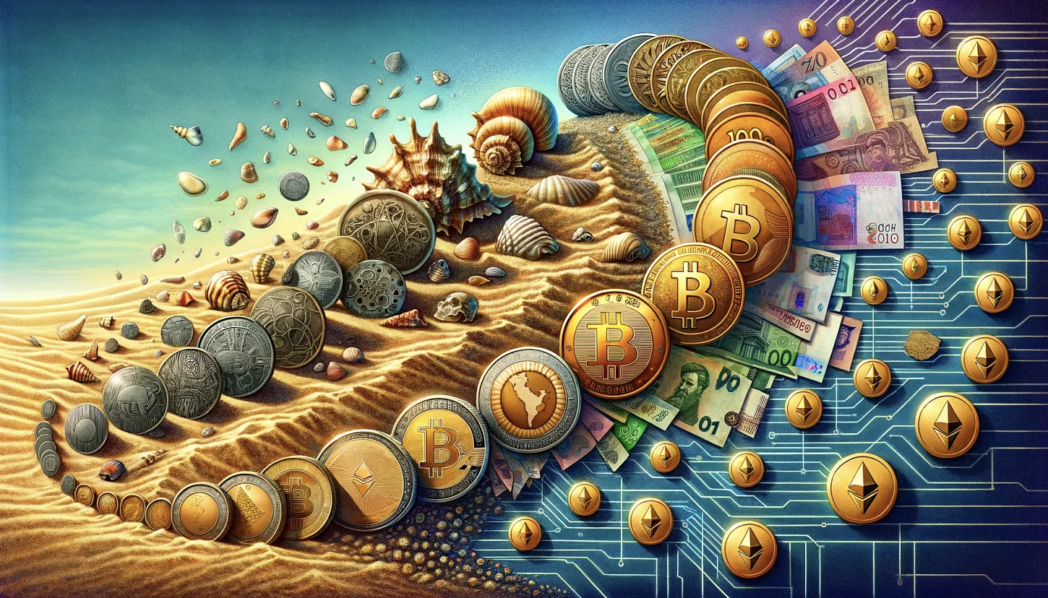

In a conversation with Edge CEO Paul Puey at this summer’s FreedomFest in Las Vegas, I posed a thought-provoking question to him about the evolving nature of global currency:
Can people govern themselves if someone else controls the money they use?
Money is already digital. We use Apple Pay at the grocery store, pay an invoice using an app, and watch dollars move between accounts without ever seeing a banknote. But as Paul Puey pointed out when I spoke with him, digital payments are not the same thing as digital money.
Puey, CEO and co-founder of the self-custody platform Edge, draws a distinction that changes how we think about money. A bank transfer, he argues, is primarily a promise to pay. The money remains inside an older system of accounts, intermediaries, checks, and settlement procedures. Cryptocurrency is “digitally native”: the money and the means of payment exist together.
That may sound technical, but the stakes are political. For anyone who believes people should govern themselves, the key question is simple: Who can hold, move, delay, or block your money? The design of a payment system can either concentrate that power or put more control in your hands.
Fast Payments but Your Money Stays Put
Puey offered a useful explanation for a familiar frustration: Why can’t money move between banks instantly on a weekend?
In his account, the quick digital transaction often moves an IOU between institutions. Final settlement comes later, after the system completes its checks.
Banks verify account details, screen for fraud, and meet know-your-customer and anti-money-laundering requirements. Those safeguards serve practical purposes. They can also make transfers slower, less private, and more dependent on institutional permission.
Puey then pointed to another incentive. When settlement takes time, institutions may have opportunities to earn money from funds their customers cannot yet access. “If it takes even just hours to transfer money,” he said, “those hours, that money can be lent out for an hour.” A delay that looks like a software flaw may also suit a system built around intermediaries.
That does not mean every delay is a deliberate scheme or that fraud controls are pointless. It does mean we should ask who benefits when financial institutions retain control over our money.
Bitcoin’s original proposal was striking because it joined money and payment in one system. Rather than asking banks to update separate ledgers and settle the difference later, the network recorded the transaction on a shared ledger.
That did not make Bitcoin perfect, cost-free, or effortless. It changed the question from “Which institution will approve this?” to “Can the network verify it?”
For anyone who believes people should govern themselves, that distinction matters. Political liberty is limited when the ability to exchange depends entirely on a gatekeeper’s approval.
“Digital” Is Not the Same as Sovereign
Puey’s distinction also helps explain why payment apps, though convenient, do not answer the deeper question. Apple Pay and Google Pay may make it easy to spend dollars with a phone. They do not change who issues those dollars, who sets the rules for the underlying account, or who can freeze it.
Crypto’s most consequential features, in Puey’s view, are censorship resistance, self-custody, unrestricted access across borders, and monetary rules that are visible in advance. He described how crypto allows for transactions without one having to supply personal information, though access still depends on practical conditions like a smartphone, a network connection, and enough money to cover transaction fees.
The vision is meaningful. So are its limits. A person may hold their own digital keys and still have to navigate volatile crypto prices, confusing software, exchange rules, tax requirements, or high fees.
Puey acknowledged that Bitcoin’s everyday payment experience has not kept pace with ordinary digital payments. Many people who own crypto leave it with a custodial service, where using it can require transferring it somewhere else first. The technology may promise direct control while users voluntarily return to intermediaries for convenience.
That tension is familiar in political life. We demand independence, then rebuild the institution that makes dependence feel easy.
Self-Custody Is a Practice, Not a Slogan
The word self-custody can sound like a product feature. In political terms, it is closer to an obligation. You control the keys, and therefore you carry more of the responsibility for protecting them. A digital wallet provider may make that responsibility easier to manage, but the principle is that no custodian holds your money on your behalf.
Puey says that his company has served millions of users. That scale is notable, but the more important test is whether ordinary people can use self-custody without turning a basic act of financial independence into a full-time security job.
A system that is technically sovereign but practically inaccessible is sovereign mainly for the technically confident. A system that asks users to memorize obscure procedures, accept confusing risks, and pay unpredictable fees may protect their theoretical freedom while putting their actual funds beyond their comfort zone.
This is where the work of building usable tools matters. It also shows why no single wallet, coin, or founder can deliver economic liberty on its own. The infrastructure has to be understandable. Users need ways to transact, recover access, protect privacy, and make informed choices about risk. And they need to understand the difference between a wallet that holds their keys and an account that holds a claim on someone else’s assets.
Why the Changing World-Order of Money Is Not a Dollar Collapse
The dollar remains central to global finance, even as debate over its long-term role has sharpened. Recent reporting describes growing fiscal pressures and a Treasury market adjusting to higher borrowing costs. In August 2026, U.S. national debt crossed $40 trillion, according to Reuters. On October 1, they reported that the 10-year Treasury yield had reached 5.34 percent, its highest level since 2002.
Those numbers deserve attention. They do not prove the dollar is about to disappear. The IMF’s chief economist said in June that the global economy remained firmly dollar-centered, despite questions about its future. A gradual diversification of trade and reserves is different from a sudden collapse.
Still, for people who believe money should not depend on political discretion, the fiscal backdrop raises a hard question: what happens when the issuer of the world’s most important currency borrows at a scale that becomes increasingly expensive to sustain?
Economist Friedrich Hayek raised a related challenge decades ago. In Denationalisation of Money, he argued for competition among currencies, believing that people should be able to choose among different forms of money rather than being dependent on a government monopoly.
What’s your political type?
Find out right now by taking The World’s Smallest Political Quiz.
Take the QuizBitcoin brings that argument into a new technological setting. It does not need a state to declare it legal tender in order to exist. But neither does its fixed issuance make it automatically useful for every transaction, immune to market swings, or guaranteed to preserve purchasing power over any particular period.
That is where economist, investment banker, and author Jim Rickards offers a useful foil. Rickards shares the concern that governments may manage heavy debts through inflation and monetary expansion, but he looks to gold as a defense and has argued that money must remain elastic enough to accommodate credit.
His view is not the crypto-anarchist view. Where the latter seeks voluntary money outside state control, Rickards expects gold and the state’s own monetary system to remain central to any reset. The disagreement is not over whether money and power are connected. It is over who should supply the alternative.
Harry Dent brings a different warning. His analysis emphasizes demographics, debt, and the possibility of a severe downturn. That forecast should be treated as a forecast, not as proof that a crash is imminent or that a specific asset will protect everyone. But the question his work presses—how much of recent prosperity rests on borrowing and monetary support?—is worth asking whether or not his timing proves right.
The larger point is that an alternative monetary system should not need a catastrophe to justify its existence. If its only argument is “the old system will soon collapse,” then it is betting its case on a prediction. The stronger argument is about freedom of choice now.
Crypto’s Complicated Story
The current crypto economy does not fit neatly into the slogan “Bitcoin is replacing the dollar.” According to Chainalysis’s 2026 Global Crypto Adoption Index, estimated on-chain activity slipped only 1.6 percent, from $9.5 trillion to $9.4 trillion, during a period when total crypto market value fell about 50 percent. The report also found that domestic transfers between personal wallets rose 302.9 percent, from $56.8 billion to $228.7 billion.
That gap between falling market prices and steadier transaction activity matters. People may be using crypto rails for reasons that have little to do with getting rich. But much of this activity is in stablecoins: dollar-linked tokens moving over crypto networks. The rails may be new while the unit of account remains familiar.
That is both useful and ironic. A stablecoin can move around the clock across a blockchain while extending the reach of the dollar. It can make payments more accessible without freeing users from dollar policy, issuer controls, or the possibility that funds may be frozen. The technology can open a door and still lead into the same monetary room.
For a self-governing reader, the distinction is essential. Crypto is not one unified political project. A custodial account, a dollar stablecoin, a self-custodied Bitcoin wallet, and a privacy-focused payment tool do not offer the same kind of freedom. “Crypto” is a broad label for systems with different rules, risks, and power structures.
Puey Sees Two Possible Futures
When I asked Puey where crypto fits into the larger struggle for economic freedom, he described the future as binary.
He asserts that one possibility is that crypto becomes “that treasury asset,” held as a store of value while the existing financial system keeps its payment and custody infrastructure. In that future, crypto could become another asset class managed by the institutions it was meant to bypass.
The other possibility is a sweeping change in how people store and move money. Puey called that transition “violent,” in the sense of a disruptive chemical reaction, not physical violence. If self-custody and peer-to-peer settlement became ordinary for billions of people, banks and payment processors could lose central roles. That kind of transformation would not be painless, as groceries, utility bills, payroll, and credit all depend on legacy systems woven deeply into everyday life.
Puey made a point worth taking seriously even if you share his hopes for disruption: liberty-minded people are deeply entangled in the very institutions they may be apt to criticize. We rely on banks, electricity grids, credit networks, payment processors, and government-supported infrastructure. A break in those systems would not spare people simply because they oppose centralized power.
That complicates the romance of collapse. It is easy to cheer for the destruction of a system when you imagine only the powerful losing their privileges. Harder to picture are ordinary people trying to buy food, pay rent, or keep the lights on while replacements are still being built.
Puey told me his personal financial strategy and political convictions do not always align. He may hold Bitcoin as a treasury asset, he said, while also supporting the adoption of technologies that could disrupt the existing system. The currencies that ultimately serve liberty, he acknowledged, might be ones he does not currently hold.
That admission felt more honest than the usual certainty of crypto evangelism I heard during my days as a blockchain and cryptocurrency journalist. A person can support a cause without pretending to know its final winners. The point is not to predict the perfect coin in advance. It’s to build and use systems that give people more freedom and choice.
The Looming AI Question: Convenience for Whom?
Our conversation eventually turned to artificial intelligence and crypto. Puey called much of the combined “blockchain plus AI” conversation “buzzword soup.” If an AI tool is operated by a person or company, he argued, it can use existing financial systems. Crypto becomes more relevant only in a more independent setting, where an agent needs to transact without relying on a human-managed account.
His deeper concern was that AI is immediately useful to consumers while often demanding a trade-off in privacy and personal control. “You will fall behind if you don’t use it,” he said, describing a technology people may feel they have to adopt even when they dislike the costs.
He called AI “the least disruptive technology ever built” because, in his view, it upends the smallest entities in society more than the largest institutions. It is a provocative claim. Whether one agrees or not, it raises a question familiar to anyone concerned with self-government: when a tool makes life easier, who gains the power to observe, influence, or restrict the person using it?
The relationship between AI and crypto is neither automatically liberating nor inherently dangerous. It depends on the architecture, the incentives, and the control users retain. Adding a token to an AI service does not make it private. Adding a blockchain does not make it decentralized in any meaningful human sense. Technology’s branding tells us less than its inherent power structure.
The Deeper Question
Murray Rothbard and other advocates of free markets in money challenged the state’s monopoly over currency. Hayek argued for competition. The cypherpunk tradition pushed further, imagining cryptography as a way to protect speech, exchange, and privacy from centralized control.
These traditions do not promise that every alternative will thrive. They insist that people should be able to experiment, transact, and choose without asking permission from a single authority. That is the radical question beneath the technical details of wallets and settlement layers: can people meaningfully opt out?
Puey’s interview in Las Vegas left me with a useful way to judge the claims. Ask whether users control the keys. Or whether transactions can settle without an institution’s approval. Then ask whether the system protects privacy or merely markets itself as private. Or who can freeze funds, change the rules, or deny access. Or what happens when the network is expensive, inconvenient, or under pressure.
A monetary system can be digital and still be deeply centralized. A currency can be decentralized in one respect and dependent in another. A technology can promise freedom while nudging users back toward custodians because that is easier. None of these contradictions means the experiment has failed. They tell us where the work remains.
The future of money may not arrive as a clean handoff from dollars to Bitcoin, or from banks to an entirely new order. It may arrive as a contest among systems: state currencies, private dollar tokens, self-custodied crypto, gold, and options that have not yet been invented.
Self-government begins with the ability to choose among them. It also requires the discipline to understand what each choice costs.