
I don’t recall anyone handing me a script early in life. No one slid a document across the table and said, “Here’s how you should think.” Yet for much of my early adulthood, I lived by a few flawed assumptions I unconsciously chose, honoring them righteously, as if I were a signatory.
I’ve now spent years drawn to Taoist philosophies, which question rigid formulas and warn against forcing life into someone else’s design. But knowing a teaching and living by it are two different things.
No one forced the script on me. Nonetheless, I embodied narratives built around custom, institutions, family, culture, political views, and my own desire to be seen as responsible. Over time, these inherited expectations began to sound like my own conclusions. That’s how an ideology can silently govern us without ever announcing itself as one.
One of my favorite libertarian thinkers, Lysander Spooner, the nineteenth-century lawyer and abolitionist, made a related argument about government. In No Treason, Spooner argued that the Constitution could not bind people who had never personally consented to it. The delegates signed the document, but Spooner denied that their signatures—or the actions of later generations—created a voluntary contract binding everyone else.
You can disagree with Spooner’s politics, as many do. But turn his logic toward your own life and the question becomes uncomfortable:
Which of your views and ideologies did you actually choose, and which were assumed on your behalf?
Three centuries before Spooner, a young Frenchman named Étienne de la Boétie asked why people submit to rule at all. His answer, in Discourse on Voluntary Servitude, was not force but habit. People born into servitude and raised in it, he argued, come to see it as their natural condition.
In 2009, I walked away from a secure W-2 career for good and became an independent journalist. I'd love to tell you it was a heroic act of clear-sighted liberation, but I’d be lying. Rather, it was a slow awareness that the walls around me had been built by someone else, and that I had fallen for them hook, line, and sinker.
In fact, let me be honest about something the freedom literature rarely mentions:
Thinking for yourself is lonely and at times scary work, and the loneliness doesn't always pass.
That’s the claim at the heart of this essay, and the cost that comes with it. Most of us never choose the standard life. We attach to it, the way we inherit a language accent. But before anyone can choose freedom, they first have to notice that the script is a script. And that awareness has a price.
The Frog, the Butterfly and the Circle of Sky
In chapter 17 of the Zhuangzi, “Autumn Floods,” a frog lives in a broken-down well. He boasts to a great turtle from the Eastern Sea about his kingdom: the mud he splashes in, the ledge where he rests, the little puddle he rules.
Then he invites the turtle down for a visit. The turtle tries to enter, but before he can get his left foot inside, his right knee is already jammed against the wall. So he stays above and tells the frog about the sea, a body of water so vast that years of flood and drought barely change its level.
The frog is stunned into silence. His kingdom had felt complete because he had never seen beyond its walls.
What I love about this story is that the frog isn't stupid. His description of the well is accurate. The problem he encounters, though, isn't bad data but a boundary he can't see because he has never stood outside it. Zhuangzi suggests elsewhere in the chapter that you can't discuss the ocean with a well frog because he is limited by the space he lives in.
“The frog's problem isn't bad data. It's a boundary he can't see because he has never stood outside it.”
The story ends with the frog’s astonishment, not his happiness. He now knows the well is small, and he still lives in it. Seeing more is not the same as feeling better. Sometimes it's just the opposite.
The standard script works the same way. Inside it, everything checks out. The socialist ideology appears compassionate. A new government program appears to be the right thing to do. The thirty-year mortgage is how “people like us” buy homes. These facts may appear to be true, but the circle is small, and the water is comfortable.
Then there is the butterfly dream, from chapter 2 of the Zhuangzi. This is where Zhuangzi dreams he is a butterfly, flitting about, content, with no idea he is Zhuangzi. He wakes, and there he is, solidly himself. But now he can't say whether he is a man who dreamed of being a butterfly or a butterfly now dreaming it is a man.
While most people read this as a poetic metaphor about reality, I read it as a puzzle about certainty. The butterfly felt completely, self-evidently, like a butterfly. Nothing in the dream announced itself as a dream. That’s the trouble with inherited lives: they don't feel inherited. They feel like the way things are.
Thoreau came to see the same sleepwalking during his sojourns at his cabin on Walden Pond. “The mass of men lead lives of quiet desperation,” he wrote, and he meant it less as an insult than as a diagnosis. His neighbors weren't miserable due to a lack of options, but because they never critically thought about other possibilities.
The Tao Te Ching names the cure in chapter 33: knowing others is cleverness, but knowing yourself is clarity. In other words, you can know everything about the well and nothing about yourself.
The Loneliness of the One Who Notices
The oldest description of this discomfort I know is in chapter 20 of the Tao Te Ching. The narrator watches everyone around him celebrating as if at a great feast—cheerful, purposeful, well supplied. He alone feels adrift, unsure, like an infant who hasn't yet learned to smile.
Paraphrased, others seem bright and sharp; he feels dim and muddled. Others have more than enough; he alone seems to be missing something. And then the turn: he alone is different, because he draws nourishment from the Tao itself.
I have read that chapter more times than I can count, and I still find it bracing. Lao Tzu doesn't pretend the separation feels good. He describes it as disorientation, almost embarrassment. The reward comes at the very end, and it's subtle.
Maybe you know this feeling. A conversation where everyone nods at something you can't quite agree with, and you weigh whether speaking up is worth the backlash that may follow. A family gathering where your life choices need explaining, and others’ don't. A moment when the consensus is so confident that your own doubt starts to feel like a defect.
“I still feel the pull of the herd. I've just stopped mistaking it for the truth.”
Here is the tension I want to sit with honestly, because I don't think it resolves neatly. The discomfort of standing apart is not, by itself, proof that you are right. Humans are social animals. That pull toward agreement is ancient, and it has kept our species alive.
Sometimes the uneasy feeling is your conscience. At other times, it's your ego enjoying its own isolation. Or it's simply information that you're wrong.
So I've learned to treat the discomfort as a question rather than a verdict. Not “I feel alone, therefore I'm onto something,” and not “I feel alone, therefore I should fold.’’
Rather,
“What is this feeling actually telling me?”
Traps, Spooks, and the Question from Athens
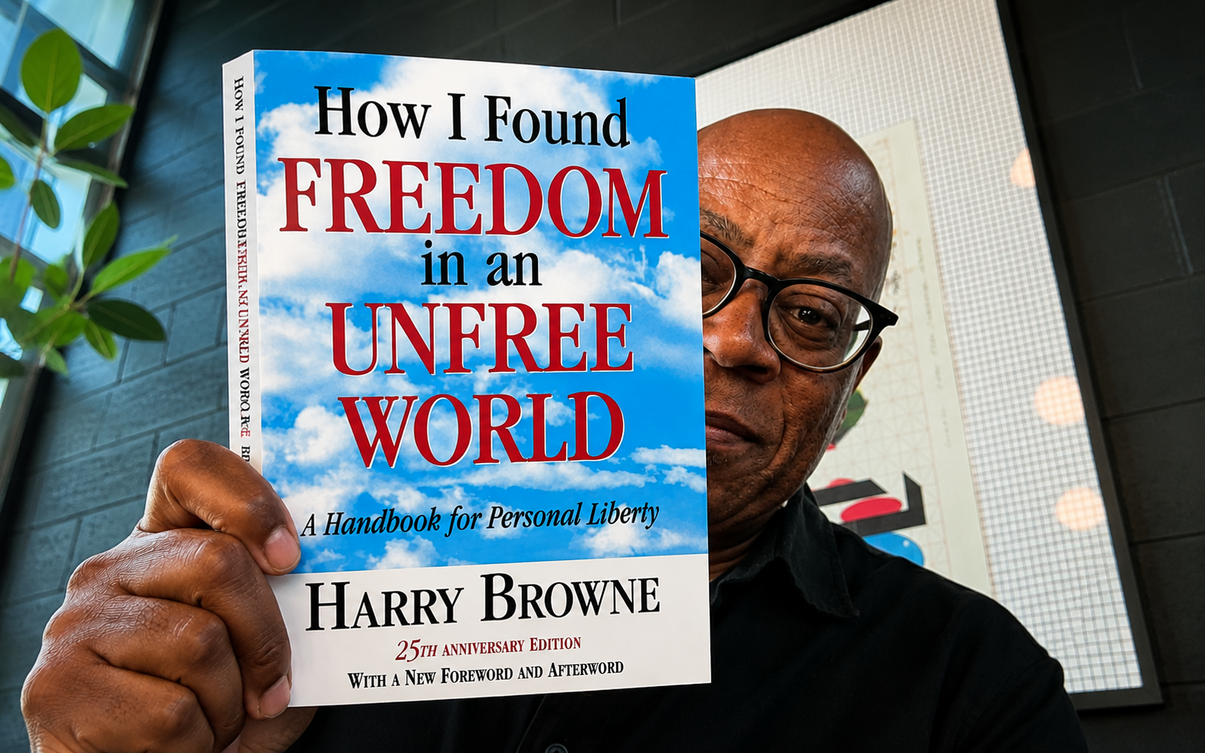
In 1973, Harry Browne, a former investment adviser, published the book How I Found Freedom in an Unfree World. I keep it on my bookshelf next to my bed because Browne names the traps with the bluntness of a man who stepped in several of them.
First is the Identity Trap, which involves believing you ought to be someone other than who you are, living by other people's ideas of what is right for you.
What’s your political type?
Find out right now by taking The World’s Smallest Political Quiz.
Take the Political QuizAnother is the Box Trap, which is staying in a confining situation because leaving looks too expensive, when an honest accounting often shows the exit costs are less than you feared.
Together, these two form the script's engine.
The Identity Trap tells you who to be: the dependable employee, the homeowner, the progressive citizen, the sensible one.
The Box Trap keeps you there: the pension vesting schedule, the sunk cost of a bad investment, the dread of being asked about your political position at the holiday table. Much of what keeps people in the box isn't money. It's the anticipated loneliness of leaving.
The German philosopher Max Stirner had a wonderfully strange word for the ideas that rule us without our consent. He called them spooks: abstractions like duty, respectability, and what one does, which we serve as though they were real masters. A spook has no body, yet it can steer an entire life. These are similar to Browne’s traps, which are like spooks with a mortgage.
Emerson put the challenge plainly in ‘‘Self-Reliance’’: ‘‘Whoso would be a man, must be a nonconformist.’’ I would add a Taoist footnote: Nonconformity isn't the goal but a side effect of seeing clearly, and it comes with a bill.
Socrates paid that bill in full. On trial in Athens, he gave us the line that outlived the city that condemned him:
‘‘The unexamined life is not worth living.”
Personally, I would soften his words ever so slightly. An unexamined life can hold plenty of worth: love, good work, grandchildren. But it isn't fully yours. It’s on loan.
Socrates examined life through argument and cornering assumptions in the marketplace. Zhuangzi explored his existence through a lens of play, loosening certainty until it couldn't hold its shape. Browne examined cost accounting. Stirner examined through mockery. Different temperaments, one discipline: look hard at what you've been taking for granted, and accept that others may not thank you for it.
The Strongest Case for the Script
So here it is. The script exists because it works for a lot of people. Defaults are civilization’s way of sparing us from deciding everything from scratch.
A pension is boring precisely because it is reliable. For many families, a mortgage is the only forced savings plan they will ever stick with. And the freedom to opt out is unevenly distributed. In other words, it’s easier to question the script when you have a safety net, a marketable skill, or nobody depending on your paycheck.
There’s a sharper version, too. Rejecting the script can become its own script. I've met plenty of proud independent thinkers whose every opinion arrives prepackaged from their own tribe. Contrarianism is still herd behavior. It just stampedes in the other direction, and it offers its own warm belonging to anyone willing to dissent on cue.
Many libertarian thinkers would turn the critique back on us. By way of example, F. A. Hayek spent his career warning planners about the limits of their knowledge, arguing that economics shows people “how little they really know about what they imagine they can design.”
That humility applies to self-designed lives as much as to central plans. The person who tears up the script to engineer a perfect alternative may simply be swapping a mass-produced blueprint for a homemade one, with less testing behind it.
I take all of this seriously because I have paid the costs. Working as an independent journalist and writer since 2009 has at times meant irregular income, insufficient medical coverage, and long stretches when freedom felt indistinguishable from exposure. My nomadic years gave me a rich life of temporary homes and surprising encounters. They also cost me (until the last three years) the steadiness of one fixed community.
“Thinking for yourself is lonely work, and the loneliness doesn't always pass. I'd be lying if I told you otherwise.”
So my answer to the critic isn't “you're wrong.” It's narrower. Choosing a standard life is fine. Not noticing that you could have made a different choice is the problem. The person who examines the mortgage and signs it is free. The person who signs because that's simply what one does is a frog admiring his puddle.
Sun Tzu helps here. In chapter 3 of The Art of War, he says, roughly, that if you know your opponent and know yourself, you need not fear a hundred battles. Most people wrestling with the script know neither. They don't understand the terrain of the life they inherited, and they don't know what they actually want.
Coda: The Well, the Sea, and the Morning After
More than thirty years after walking away from the script, I'd love to report that I've arrived somewhere. That I wake each morning certain, settled, and immune to the opinions of others. I don't.
Some mornings I feel like the turtle, at home in open water. Other days, I feel like the frog the day after the turtle left: aware that the well is small, unsure what to do with that knowledge, and quietly missing the comfort of not knowing.
What I've come to believe is that this back-and-forth isn't a failure of freedom. It is what freedom feels like from the inside. A herd mentality offers certainty in exchange for authorship. Thinking for yourself offers authorship and asks you to live with uncertainty. Neither bargain is free. Only one of them is yours.
The quiet revolution isn't necessarily a different life. It's a chosen life, without coercion.
All of this is lonely work, and the loneliness doesn't always pass. I still feel the pull of the herd. That being said, I've just stopped mistaking it for the truth. Somewhere between those two sentences is the life I've chosen: imperfect, often uncomfortable, and unmistakably my own.
At the end of the day, the frog doesn't have to leave the well. But once he knows it's a well, every day he stays becomes a choice. That’s no small freedom. It may be the only kind that was ever truly his.