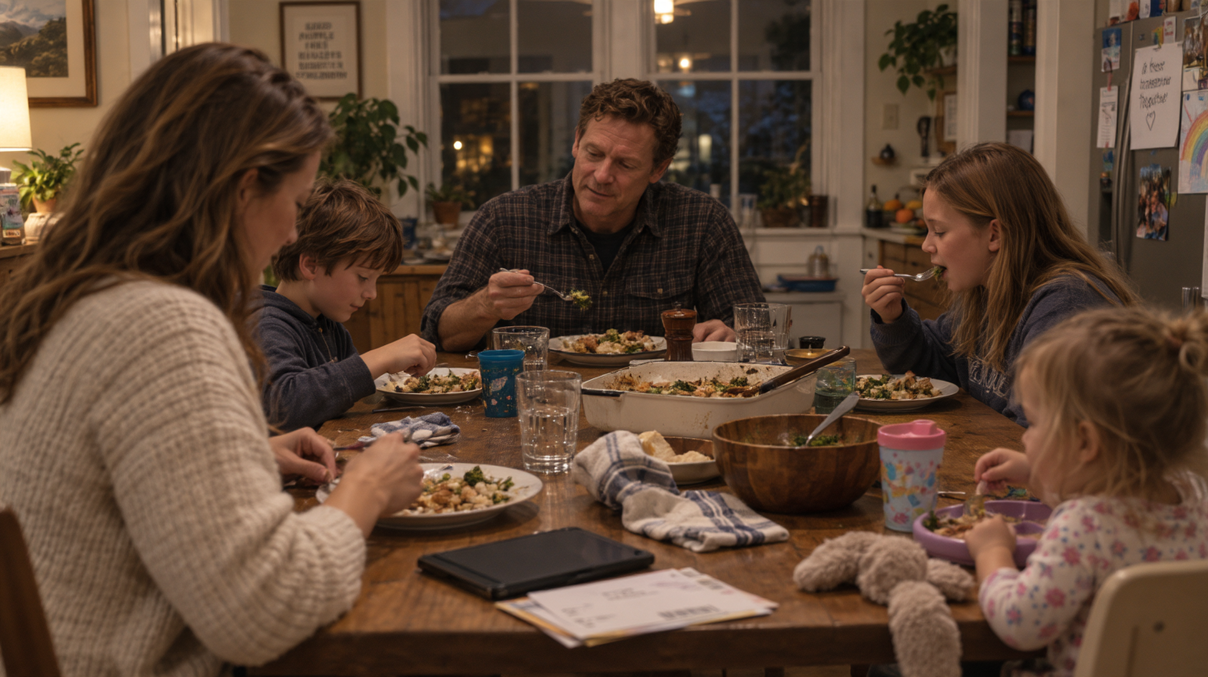

The Kane family’s noise dispute scene contains the kinds of elements skeptics treat as a knockout argument against market anarchism. How do you handle neighbors who aren’t acting neighborly? What do you do when fines don’t work? Who enforces rules without a designated overarching authority?
The chapter’s answer is not some utopia. It is the application of tools we are all already familiar with: contract, cost, exit, and reputation. It all boils down to property rights and free association. These simple tools can move mountains if we only let them.
Rules Without a Territorial Monopoly
That is also the answer given, in different vocabularies, by the major theorists describing a private-law society.
It’s important to keep in mind that an anarchist order is not the absence of rules. Who would want that? Rather, it is the absence of a territorial monopolist who can impose rules on people who never agreed to them. In Murray Rothbard’s vision, all property is private, and neighborhoods (even as small as a single street) can set their own rules and terms of residence. The result, he argued, would be a “gorgeous mosaic”: some places tight and quiet, others loose and loud, none entitled to conscript the whole countryside into one set of mandates.
Hans-Hermann Hoppe (and many others) show how private property leads to integration, organization, and order — all without a state. Owners have dominion over their property, yet they may desire to bind themselves and their successors with restrictive covenants to reap the benefits of having their neighbors also bind themselves to the same rules. Quiet hours, aesthetic norms, rules regarding “the commons” and their upkeep — all this can be had via property rights and contracts. There’s no need for a municipal ordinance. You may dislike a community’s terms. You may not annex its land and force your will upon others. Opting in or out is proper. Using force isn’t.
Who Enforces the Rules?
Notice the moral power of consent here. Society stays civil when relations are voluntary. The relevant consent is not a Rousseauean “social contract” covering millions of strangers. It is the ordinary consent of buying, leasing, or remaining on land whose deed already carries the rules. Linda and Morris Tannehill insist that statutory “law” is clumsy precisely because it pretends otherwise: it binds people who never contracted and then pretends the binding is justice. Market arbitration, by contrast, has a feedback loop. Bad rules and bad judges lose customers.
A skeptic may still ask who enforces Lex-2 quiet hours if Halvorsen keeps the lathe running. The answer is “whatever the contract specifies.” Perhaps fines. Perhaps security patrols with polite suggestions. Perhaps men with guns if things escalate far enough. The critical question is, “what did these people actually agree to?”
Michael Huemer notes that this is less exotic than it sounds. Homeowner associations and business groups already hire security; commercial contracts already send disputes to private arbitration. Competing protection agencies and courts do not have to invent solutions any more than they need to invent demand. All they need to do is scale up institutions that already exist. Look around you. Private security and arbitration already thrive. They could and would do more if the state would just get out of the way.
Edward Stringham’s work on private governance presses the same empirical point. Clubs, exchanges, hotels, and HOAs write rules, exclude nonpayers, and compete for members. Governance is often a “club good,” not a so-called public good that only a state can supply. When statists assert that only a monopolist can provide order, it’s just that: an assertion.
Pricing Rules Change the Incentives
At dinner, Alex notes an important economic mechanism: when you pay for investigators, mediators, and collection, you discover how many rules you actually want. David Friedman’s consequentialist case for anarcho-capitalism turns on that incentive. Under monopoly government, the cost of a noxious rule is spread across taxpayers who cannot easily leave. Under private law, a community that multiplies covenants multiplies enforcement costs and drives away the residents who pay the dues. Victimless ‘crimes’ and low-value restrictions tend to die off because their supporters value them less than victims and neighbors value freedom — and because those supporters must fund the patrols, prosecutions, and prisons. Turns out, tyrannical busybodydom is prohibitively expensive.
Walter Block’s broader privatization argument is the same logic applied to streets, roads, and “common” nuisances. Private owners who set good rules increase the value of their holdings when they successfully provide valuable things — peace, access, safety, etc. — to customers. They have much stronger reasons to get the trade-offs right than a city council spending other people’s money.
That is why the Kanes do not treat “kick him out” as the first move, nor do they treat infinite tolerance as the last. Restitution and scaled fines route payment to the people who actually lost sleep. Mandatory mediation inserts a cooling-off period that often leads to fruitful resolution. Skin in the game leads to smarter responses to these issues.
What About “HOA Hell”?
The remaining skeptic worry is “HOA hell.” We’ve all heard of (or experienced ourselves!) petty boards, aesthetic tyranny, rules that thicken and thicken until the neighborhood is an oppressive mini private state. The chapter’s reply is competition, actual owner-responsibility (read the CC&Rs, please!), and the basic fact that private owners profit when they satisfy homeowners. That’s not true of city hall.
Stringham posits that developers will sell packages of rules. Some buyers want Disney-level control; some want a workshop district; some want a more hands-off approach. Property values and free association reveal which packages work. In our current statist world, the vast majority of HOA homebuyers never bother to read the contract they are signing. They aren’t used to needing to. “Won’t the government just… handle all this?” Well … no, not really!
Spencer MacCallum’s proprietary-community analysis adds another insight: multiparty contracts aren’t necessarily required for good “common” governance. Often a single residual claimant — a landlord, a community firm, a competing service provider — has an incentive to keep common areas livable without smothering tenants, because empty lots and unrenewed leases show up on the bottom line. Good governance is profitable when choice is respected.
Exit, Reputation, and the Safety Valve of Choice
Hoppe and Rothbard beautifully describe the private community safety valve that zoning lacks: if the vote fails and Halvorsen remains a nuisance, the Kanes still have options, up to and including relocating to a community with a tighter covenant. Exit is costly, which is why people try repair first. It is not infinitely costly, which is why repair has a deadline. Ilya Somin’s contrast between zoning and planned communities makes the same point, but set in today’s political system: private covenants begin in consent and can be escaped by moving to the next development; municipal rules typically cannot.
None of this requires neighbors to become strangers or that security drones become the first line of response. The Kanes’ preferred middle path — mediation, then scaled restitution, then higher penalties only for repeats — is exactly what one would expect when the people drafting the rule also pay for the drama.
Ostracism and reputation still matter within a face-to-face community in ways they do not in a distant legislature. That messiness is not a bug in the model. It is the reason the model is livable. It is the way humans evolved to interact!
A skeptic can still say the system will be imperfect. Of course it will. So is every HOA, every condo board, and every city noise ordinance now. The anarchist claim is narrower and harder to dismiss: when rules are chosen and priced (rather than legislated and imposed), communities can sort by taste, internalize the cost of fussiness, and treat a late-night workshop as a contract problem instead of a pretext for either a dictatorial power grab or a descent into mob rule.
The Kane vote is not an example of the end of politics — we can always vote for the leader of our chess club if we want to, right? But it’s the end of politics with a captive population. That is why the inheritance Alex wants for his children is not some “perfect” set of rules. It is the right to live under a set of rules they can choose, leave, or replace.
What’s your political type?
Find out right now by taking The World’s Smallest Political Quiz.
Take the QuizPolitics Without a Captive Population
I’d use the words “living documents” if the modern statists hadn’t poisoned the term already. But that’s what they are — rules adopted voluntarily, and left or altered when no longer serving the interests of the participants.