The Debate Over NSA Spying is Finished. Or is it?
This article was featured in our weekly newsletter, the Liberator Online. To receive it in your inbox, sign up here.
On Tuesday, the United States Senate gave final passage to the USA Freedom Act, but not without drama on the floor of the upper chamber. Majority Leader Mitch McConnell, R-Ky., offered three amendments that, if passed, would have weakened the bill.
With the support of hawks in the Senate Republican Conference, McConnell
proposed amendments that would have increased the transition period from three to six months, removed essential transparency requirements, and required private companies to notify the federal government if they changed their data retention policies. Each of the amendments failed, falling short of the majority needed for passage.
After the USA Freedom Act
passed with significant bipartisan support, a visibly irritated McConnell railed against the bill from the floor, lecturing his colleagues that the Fourth Amendment, which protects Americans against “unreasonable searches and seizures,” doesn’t cover phone records.
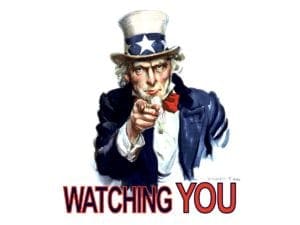
“No content. No names. No listening to the phone calls of law-abiding citizens. We are talking about call data records,”
said McConnell. “And these are the provider’s records, which is not what the Fourth Amendment speaks to. It speaks to: ‘The right of the people to be secure in their persons, houses, papers and effects.’”
Part of the legal justification for bulk collection of Americans’ phone records is grounded in a little-known 1979 case,
Smith v. Maryland, in which the Supreme Court ruled that the installation of the pen register on the phone of Michael Lee Smith without a warrant was not a violation of his Fourth Amendment rights. But as Jim Harper of the Cato Institute has explained, this interpretation of the case is wildly misleading.
“It is not possible to argue honestly that the facts of Smith are anything like the NSA’s bulk data collection. The police had weighty evidence implicating one man. The telephone company voluntarily applied a pen register, collecting analog information about the use of one phone line by that one suspect,”
Harper wrote in August 2013. “I can’t think of a factual situation that could be at a further extreme than NSA’s telephone calling surveillance program.”
Add to Harper’s point that Section 215 of the USA Patriot Act allowed only the collection of records related to specific investigation into terrorism. It didn’t permit the bulk collection of all phone records of every American, a fact that was
noted recently by the Second Circuit Court of Appeals.
Although
several organizations and
tech companies backed the USA Freedom Act, the bill wasn’t without opposition because it didn’t go far enough to protect Americans’ privacy. Sen. Rand Paul, R-Ky., made his opposition clear because he wanted the ability to
offer amendments to strengthen the bill.
Others, like Rep. Justin Amash, R-Mich., believe the USA Freedom Act merely shifts the method of bulk collection from the National Security Agency to private phone companies. The USA Freedom Act,
Amash said after it passed the House of Representatives in mid-May, “actually expands the statutory basis for the large-scale collection of most data.”
But with debate on the USA Freedom Act now over, at least for now,
President Barack Obama’s signature on the bill, some may be asking what’s next. The Guardian
reported on Wednesday that the administration is seeking to restart the bulk collection program “temporarily” to transition “the domestic surveillance effort to the telephone companies that generate the so-called ‘call detail records’ the government seeks to access.”
So, just to be clear, the administration will, according to The Guardian, “argue it needs to restart the program in order to end it.” Add that one to the growing list of Orwellian statements from this administration, and put it right under “if you like your health plan, you can keep it” and “never let a good crisis go to waste.”



















 A new CNN poll finds that Bush, who left office in January 2009, actually view Bush positively. “According to the poll, 52% of adults had a favorable impression of George W. Bush, 43% unfavorable,” CNN reported on Wednesday. “When Bush left office in 2009, only about a third of Americans said they had a positive opinion of him.”
Amazingly, it’s not just Republicans and conservatives driving Bush’s numbers upwards. CNN notes that his favorability has grown even among those who opposed most of his policies.
“Bush remains broadly unpopular among groups that made up his main opponents during his time in office: Democrats (70% unfavorable), liberals (68% unfavorable) non-whites (54% unfavorable), and those under age 35 (53% unfavorable),” CNN explained. “But even among these groups, he’s gained some ground since leaving office. In February 2009, 85% of Democrats and 90% of liberals had a negative take on the president, as did 75% of non-whites and more than 6 in 10 young adults.”
Some would argue that President Barack Obama, who received an even split at 49%, is just that bad. Certainly, Obama hasn’t been an improvement over his predecessor and, in many ways, has been much worse. But the absence of Bush in the Oval Office doesn’t mean that voters should have a favorable view of him.
The tension in the Middle East over the Islamic State of Iraq and the Levant (ISIL) may be part of the reason why Bush is rising and Obama is falling. At the same time, voters should remember that Iraq and the rise of ISIL is a failure of the Bush administration.
Certainly, Obama’s foreign policy has been hawkish in some respects, such as Libya, and disastrous in others, like Ukraine, where tensions with Russia have boiled over. But that it doesn’t compare to the utter disgrace that was Bush’s foreign policy.
And again, it’s not just Bush’s foreign policy. He was bad on almost everything. It’s been said voters have a short-term memory; that they’re willing to forgive and move on. That may be true, but failing to remember the lessons of bad presidents means we’re doomed to repeat them again and again.
A new CNN poll finds that Bush, who left office in January 2009, actually view Bush positively. “According to the poll, 52% of adults had a favorable impression of George W. Bush, 43% unfavorable,” CNN reported on Wednesday. “When Bush left office in 2009, only about a third of Americans said they had a positive opinion of him.”
Amazingly, it’s not just Republicans and conservatives driving Bush’s numbers upwards. CNN notes that his favorability has grown even among those who opposed most of his policies.
“Bush remains broadly unpopular among groups that made up his main opponents during his time in office: Democrats (70% unfavorable), liberals (68% unfavorable) non-whites (54% unfavorable), and those under age 35 (53% unfavorable),” CNN explained. “But even among these groups, he’s gained some ground since leaving office. In February 2009, 85% of Democrats and 90% of liberals had a negative take on the president, as did 75% of non-whites and more than 6 in 10 young adults.”
Some would argue that President Barack Obama, who received an even split at 49%, is just that bad. Certainly, Obama hasn’t been an improvement over his predecessor and, in many ways, has been much worse. But the absence of Bush in the Oval Office doesn’t mean that voters should have a favorable view of him.
The tension in the Middle East over the Islamic State of Iraq and the Levant (ISIL) may be part of the reason why Bush is rising and Obama is falling. At the same time, voters should remember that Iraq and the rise of ISIL is a failure of the Bush administration.
Certainly, Obama’s foreign policy has been hawkish in some respects, such as Libya, and disastrous in others, like Ukraine, where tensions with Russia have boiled over. But that it doesn’t compare to the utter disgrace that was Bush’s foreign policy.
And again, it’s not just Bush’s foreign policy. He was bad on almost everything. It’s been said voters have a short-term memory; that they’re willing to forgive and move on. That may be true, but failing to remember the lessons of bad presidents means we’re doomed to repeat them again and again.