2026 Version

Take The World's Smallest Political Quiz

Find where you stand with a 10 question political typology test. Taken over 27,843,269 times.

Personal Issues

Adults should be free to use recreational drugs without criminal penalties.

Agree
Maybe
Disagree

Government should not regulate private sexual conduct between consenting adults.

Agree
Maybe
Disagree

Government should not ban books from libraries or schools because of the ideas they contain.

Agree
Maybe
Disagree

People should be free to move across borders to live and work.

Agree
Maybe
Disagree

Citizens should be free to burn their own country's flag in protest.

Agree
Maybe
Disagree

Economic Issues

Taxes and government spending should both be cut significantly.

Agree
Maybe
Disagree

People should be able to start a business without government licenses or permits.

Agree
Maybe
Disagree

Prices and wages should be set by the market, not the government.

Agree
Maybe
Disagree

Businesses should face far fewer government regulations.

Agree
Maybe
Disagree

Parents should control their children's education, with tax money following the child.

Agree
Maybe
Disagree
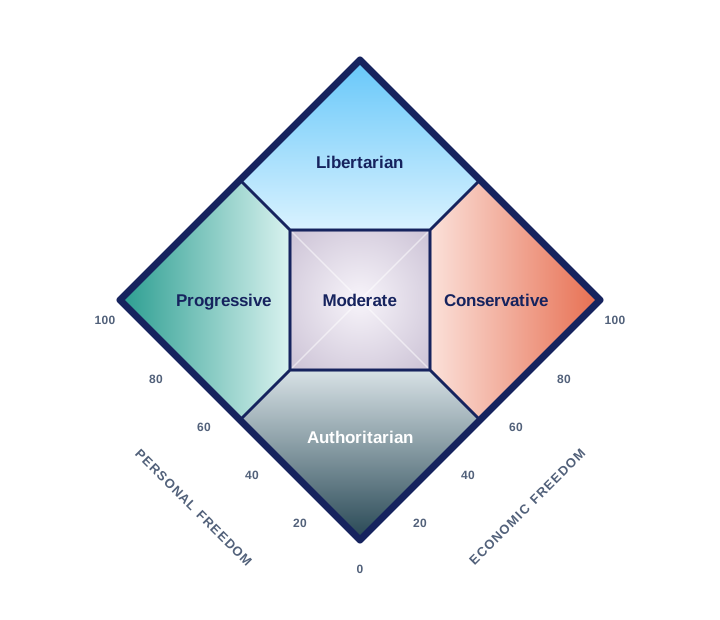
Methodology

How the Quiz Works: A Two-Axis Political Test

The World's Smallest Political Quiz is a 10-question political test: 5 statements on personal issues and 5 on economic issues. For each one, you choose Agree, Maybe, or Disagree. It takes about two minutes.

Your five personal answers give a personal freedom score from 0 to 100, and your five economic answers give an economic freedom score on the same scale. Those two scores become a point on the Nolan Chart, a grid of 121 possible positions grouped into five political types.

A one-line left-right political spectrum test can only tell you how far left or right you are. Two axes show how much government control you favor in your personal life and in the economy, separately.

The Nolan Chart: the five political types placed by personal freedom and economic freedom
questions
10
questions
axes: personal and economic
2
axes: personal and economic
possible positions
121
possible positions
to finish
~2 min
to finish
Scoring
AnswerPoints
Agree20
Maybe10
Disagree0

Five answers per axis, so each axis runs 0 to 100 in steps of 10.

Where it comes from

Marshall Fritz, founder of the Advocates for Self-Government, created the quiz in 1987 from the chart David Nolan devised in 1969. It has been taken more than 27 million times and is used in high school and college classrooms. Read the quiz's history.

Quiz version 6.3.0 · Page reviewed

Your result

The Five Political Types on the Nolan Chart

Every result lands in one of five types.

Compare the political types side by side or learn how the Nolan Chart works.

Go deeper

Want a Longer Political Test?

Start with the 10-question quiz, then go further. These build on the same two-axis approach.

About the Quiz

The Original and Acclaimed Internet Political Quiz

The world-famous World's Smallest Political Quiz is a fast, fun and accurate assessment of a person's overall political views. The Quiz is composed of two parts: a political map that is far more informative than the old "Left versus Right" line, and ten questions on specific political issues to help a Quiz-taker find their place on the new political map.

The Quiz's political map is based on the "Nolan Chart" devised in 1969 by David F. Nolan. In 1987, Advocates Founder Marshall Fritz created the World's Smallest Political Quiz by adding ten questions to Nolan's chart, along with other refinements.

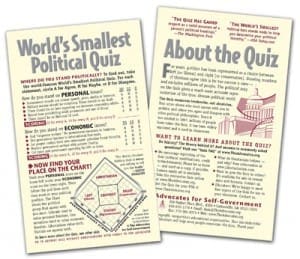
The original printed World's Smallest Political Quiz card
The World's Smallest Political Quiz

Challenging the Simplistic "Left versus Right" Model of Politics

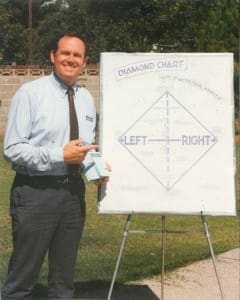
Marshall Fritz with one of the first printed World's Smallest Political Quizzes
Founder Marshall Fritz with one of the first quizzes

The Quiz challenges the traditional "Left versus Right" political model. The Left versus Right model tries to categorize virtually all political opinions into either left and right. This model is misleading and fatally flawed. It has no place for many millions of people who don't fit neatly into some variant of liberal (progressive) or conservative, left or right. In effect, it disenfranchises the tens of millions of Americans who don't think "left" or "right," "liberal/progressive" or "conservative," accurately describe their views.

Thomas Jefferson, for example, wouldn't fit comfortably on either left or right. Neither would Bernie Sanders, Alexandria Ocasio-Cortez, or Ron Paul, or even Donald Trump, Joe Biden or Clint Eastwood. America's real political spectrum is much more complicated. And we challenge viewers to appreciate that diversity.

The Left versus Right model doesn't give any useful insight into the differences between the various political categories. It doesn't tell us what the important differences are between liberal-progressives, conservatives, moderates, libertarians, and authoritarians.

The Theory Behind the Quiz Model

The Quiz model is far more inclusive and accurate, despite only including two dimensions. It is based on the idea that the majority of political issues can be divided broadly into two categories: Economic and Personal.

The Personal category includes what you do in relationships, in self-expression, and in general what you do with your own body and mind. Examples of personal activities: marriage; choosing what books you read and movies you watch; what foods, medicines, and drugs you choose to consume; sports; your religious choices; organizations you join; who you choose to associate with.

The Economic category includes what you do as a producer and consumer: what you can buy, sell, or produce. Where you work, who you hire, or what you do with your money. Examples of economic activity: starting a business; buying a home; constructing a building; purchasing groceries; working in an office. In essence, the trading of goods and services.

Since most government activity occurs in these two major areas, political positions can be defined and compared by determining how much government control a person favors in these two areas.

The central insight of the political model The Quiz promotes is that the major difference between the various political philosophies, the real defining element in what a person believes, is the amount of government control over human action in both the personal and economic spheres.

In other words, there's not just a left-right axis reflecting your personal values, but also an up-down one reflecting how willing you are to use force to get others to follow your values.

A Breakthrough Concept

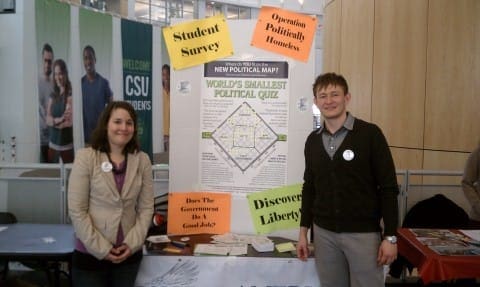
Cleveland State Young Americans for Liberty's Operation Politically Homeless outreach

The World's Smallest Political Quiz model is a breakthrough concept that instantly gives far more insight into politics. The Quiz chart more accurately places totalitarian or interventionist philosophies (fascism, communism, and so on) close to each other, instead of at opposite ends of a single line, as the outdated and inaccurate Left vs. Right model does.

The Quiz map is far more inclusive, with room for virtually every political philosophy. Compare the five political types or learn more about the Nolan Chart.

Political Quiz FAQ

How many questions are on the World's Smallest Political Quiz?

10 questions: 5 on personal issues and 5 on economic issues. Each one has three answer options: Agree, Maybe and Disagree. See how the scoring works.

How long does the political test take?

About two minutes. There are 10 statements with three answer choices each, and your result appears as soon as you finish.

Is the quiz free? Do I need an account?

Yes, it's free, and you don't need an account to take it or to see your result. You can sign up afterward if you'd like your results by email.

Is this political test based on the Nolan Chart?

Yes. Your personal freedom score and economic freedom score become a point on the Nolan Chart, the two-axis political map David Nolan devised in 1969.

Who created the World's Smallest Political Quiz?

Marshall Fritz, founder of Advocates for Self-Government, created the quiz in 1987. He built on the chart David Nolan devised in 1969, the first widely used two-axis model for mapping political beliefs.

What are the five political types?

The quiz identifies five types: Libertarian (more personal and economic freedom), Progressive (more personal freedom, less economic freedom), Conservative (more economic freedom, less personal freedom), Authoritarian (less of both) and Moderate (the middle). See how the types compare with each other.

What do most people get on the political quiz?

Among quizzes completed on this site: Moderate 39%, Libertarian 25%, Progressive 25%, Conservative 7%, Authoritarian 5%. Percentages are rounded and refreshed daily.

Is there a longer version of the political quiz?

Yes. The Deep-Dive adds 10 more questions to your quiz answers and places you on a finer grid. For issue-by-issue detail, try the single-issue surveys.

Which political test is the most accurate?

It depends on what you want to know. Short tests like this one tell you which broad type you are on two axes in a couple of minutes. Longer tests ask more questions on more axes and give a finer reading, but take longer and can be harder to compare with other people. A good approach is to start here, then take the Deep-Dive if you want more detail.

How is the quiz different from the Political Compass test?

Both place you on two axes. The World's Smallest Political Quiz came first (1987), asks 10 questions instead of 62, offers a Maybe option and gives you one of five named types rather than only a point on a grid.

Is the political quiz accurate?

It is a quick, useful starting point. It measures two separate dimensions, personal freedom and economic freedom, which captures views that a single left-right line misses. With only 10 questions it gives a broad type, not a detailed profile; the Deep-Dive adds detail.

Can I use this quiz in my classroom?

Yes. Teachers use the World's Smallest Political Quiz in civics, government and political science classes at the high school and college level. We offer classroom activity guides and discussion questions.

What does it mean if I'm politically homeless?

Many Americans feel neither major party represents their views. That's normal: a single left-right line doesn't capture the full range of political beliefs, and the Nolan Chart shows politics in two dimensions. Learn more about being politically homeless.