











Beta

Password Reset Confirmation

If an account matching the email you entered was found, you will receive an email with a link to reset your password.

Welcome to our Beta

The Advocates of Self-Government is preparing a new experience for our users.

User Not Found

The username/email and password combination you entered was not found. Please try again or contact support.

Skip to main content

Quizzes & Apps

Articles

Tag: Los Angeles

Los Angeles Spends Millions on Temporary Homeless Shelter, as Root Cause Goes Ignored

California continues to struggle to deal with its homeless problem, but while even county and local officials admit that government-imposed housing regulations are worsening the situation, the state continues to allocate millions in taxpayer-backed funds to cities for the implementation of programs that “fight” homelessness. But is there a real solution that wouldn’t involve looking at homelessness’ root causes? As part of this campaign, the Los Angeles Services Authority (LAHSA) has been working on developing expensive housing to thousands of homeless residents. Unfortunately, simply housing them in brand-new apartments isn’t working, as this series of Los Angeles Times articles have shown. But despite the city’s failures to address the problem, the Los Angeles City Parks Commission announced recently that the Griffith Park in the trendy neighborhood of Los Feliz is going to get a temporary homeless shelter. The structure would be located on the southern end of Griffith Park, the home to the historic Griffith observatory and a favorite hot spot for tourists trying to take a photo under the Hollywood sign. The temporary shelter is expected to house only 100 people and cost $4.6 million. It will be built just south of the Griffith Park Recreation Center and it’s part of the “Bridge Home” program. Unveiled by L.A. Mayor Eric Garcetti in 2018, the effort is meant to put up two dozen temporary shelters for the homeless across the city. But while a total of five shelters are already in use, there is only so much that temporary housing can do.
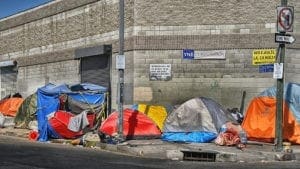
A Crisis That Goes Way Back

California’s homelessness problem is one that can only be explained when you step back and look at the state’s history of meddling with the housing industry. While the federal government also has housing regulations in place, state and local officials have long subsidized, regulated, and used restrictive urban planning policies that made housing in urban areas prohibitively expensive to low- and middle-income families and individuals. These policies are often meant to hurt the poor, as it is only the rich and connected who manage to successfully lobby lawmakers to impose restrictions that insulate them from seeing their neighborhoods change as the demand for more housing increases. And as housing becomes increasingly restrictive, the number of people unable to afford a roof over their heads grows. That coupled with other policies such as the high minimum wage also helped to push the working poor out of the state. Who’s left behind? The millionaires, who can afford to live in a reality far removed from what the working class experiences, as well as those who have called the streets their home. In any case, cities like Los Angeles and San Francisco are on the verge of collapse, with rare diseases such as typhoid fever and, some experts say, the bubonic plague, making a come back. If the goal is to make housing affordable again, and give entrepreneurs incentives to work to truly address the homelessness, California and local city officials should roll back its regulations and minimum wage law, especially if they want the unskilled and poor to get back on their feet.

Major Spike in LA Homelessness Doesn’t Change Attitudes of Central Planners

The homeless populations in both the county and city of Los Angeles are increasing so rapidly, elected officials say even they are “stunned.” But don’t expect anything other than more government spending, higher taxes and tighter regulations in the near future. A year after celebrating a small decrease in homelessness, Los Angeles politicians have less to say now that a point-in-time count shows a 16 percent increase in the city and a 12 percent increase across the county. That brings the total number to nearly 59,000 countywide, with over 36,000 in the City of Angels.

“We are pretty well stunned by this data,” LA City Councilman Mark Ridley-Thomas told the LA Times on Tuesday, reacting to a report published by the LA Homeless Services Authority. Stunned indeed, as in unshaken. There is no sign from anyone on the city council or county board of supervisors that cutting red tape for private developers is in the works. In fact, LA Mayor Eric Garcetti used the news to promote another “investment” of $42 million toward homeless services. “And I know that, if we keep working together, believing in one another, and caring for people in desperate situations, we will end homelessness in this city,” Garcetti said. More than ever, the blame is being placed on the lack of affordable housing. Although lip service is paid to the issues of mental illness and drug addiction, the official narrative is that people are “pushed” into “experiencing homelessness” by exorbitant rent rates and federal disinvestment. While libertarians understand that an increase in housing supply would lower prices, what if much of the time that didn’t address the hardcore elements of this crisis? After all, Pasadena saw a steep decrease of 20 percent in its homeless population, but housing is quite expensive there. There are other cities like that too. By far, the highest increase of homeless by age was the 18-to-24-year-old group, which grew 24 percent since last year. Why aren’t they living with their parents, as roughly 42 percent of all Los Angeles millennials do? There was a 17 percent uptick in “chronic homelessness,” those who are mentally or physically impaired and homeless for over a year. The report also found that over 2 percent of the homeless population was transgender, while transgender people have been estimated to be as high as 0.5 percent of the total LA County population. All this is to say that a big part of the problem can’t be solved as simply as building more housing, because there are special needs in more difficult circumstances. Yes, developers in California and LA County especially have to go through hell and back to build anything. But election after election, the people vote in more top-down socialist leaders and approve more taxes by the ballot as well. Homelessness in LA is not new, though it has grown in intensity and danger and produced more medieval diseases in recent years. It’s probably not realistic to expect much progress in terms of liberty or free market reforms, considering the demonization of Airbnb and similar innovations in lodging decentralization across California. Maybe it will take the bubonic plague, which Dr. Drew says is likely already present in LA, to discourage more homelessness. Aside from the taboo of suggesting the forceful institutionalization of the mentally ill, the other most uncomfortable part of the homelessness issue is how much of it might be a lifestyle choice. LA is set to host the 2028 Olympics, so what’s going to happen until then? If the sense of urgency grows, will that mean a mass conversion to freeing the housing industry? Or, a rejection of the “right” to live in the streets?

Drug War Makes Criminals Out of California Physicians

Drug War Makes Criminals Out of California Physicians

This article was featured in our weekly newsletter, the Liberator Online. To receive it in your inbox, sign up here. To those who are born and raised in the City of Angeles, stories of violence set in motion due to poorly written drug and health-related laws aren’t particularly unique. PillsOver the decades, Southern California has been in the news over instances of police brutality against minorities, wrongful killings by the police, deadly gang fights, and police union scandals. Los Angeles has also been the backdrop of countless gangster rap songs and videos, as well as the actual setting of several real life criminal conspiracies, so it’s not a surprise that even physicians are now being arrested for working directly with drug gangs. According to a local NBC affiliate, two doctors working out of the Lynnwood area in South Los Angeles were arrested and charged for selling prescription drugs “without medical purpose.” The two physicians surrendered to federal authorities this past Friday and were later released on bond after appearing on court. They were allegedly linked to gang members who were also arrested on the same day. The United States Attorney’s Office’s Central District of California claimed that both physicians were “significant suppliers of drugs to a street gang.” Some of the drugs they allegedly helped gang members obtain include Vicodin, which is also known as Norco, Xanax, and Soma. The opioids, psychoactive, and barbiturate-like drugs were all prescribed “at or near maximum strength,” the report states. One of the charged physicians was allegedly involved in these transactions between 2011 and 2015. The second doctor was accused of signing purposeless prescriptions in 2014 and 2015. While the operation that led detectives to the gang members associated with the Lynwood doctors targeted East Coast Crips involved in California burglaries, officers looked into the relationship between the physicians and gangsters after learning that both doctors “served as large-scale sources of supply to [gang] members and associates.” The doctors were allegedly caught after a series of undercover operations, meaning that officers or cooperating witnesses approached both physicians asking for these prescriptions. In most cases, officials stated, doctors failed to examine patients. As the nation goes through one of its toughest drug epidemics in history, putting countless of drug users and addicts in morgues over tainted batches of opioids, stories like these remind us that, if there’s a market, even if the demand is for something considered illegal, there will always be someone willing to break the rules. Why? Because financial incentives often push otherwise decent people into breaking the law. Even gang members are drawn into a life of crime over the promise of high turnouts for little work, even if the risks are also high. They might have never wanted to be part of a criminal gang, but when faced with the decision of becoming rich fast—even if it’s just a promise—they change their minds. In a free society, these incentives also exist, but without prohibition, addicts and those who provide them with their drug of choice have freedom to do so in a peaceful manner. In the black market sprung out of prohibition, gangs use force to maintain contracts and fight over territory. They are also not worried about branding, making it easy for them to set morals aside to produce bad batches of whatever drug customers are after. In a free market setting, the opposite is true. Also, addicts are more likely to be safe in an environment where drug consumers aren’t stigmatized. In a free society untainted by prohibitionist laws, drug users are more likely to look for help. Under the current laws, addicts are often afraid of being arrested—for a good reason. This fear pushes them deeper into their addiction, and the consequences are often deadly since they often become dealers themselves to sustain their habit. Compassion can only exist in a society where people are free to develop their own sets of values. When forced upon us, morals are ignored. But when all we have is freedom, consumers and their welfare hold the key to good business practices. Why make criminals out of inner city kids and doctors when you can put an end to the drug war?​

Airbnb to Collect Taxes from Los Angeles Users

Airbnb to Collect Taxes from Los Angeles Users

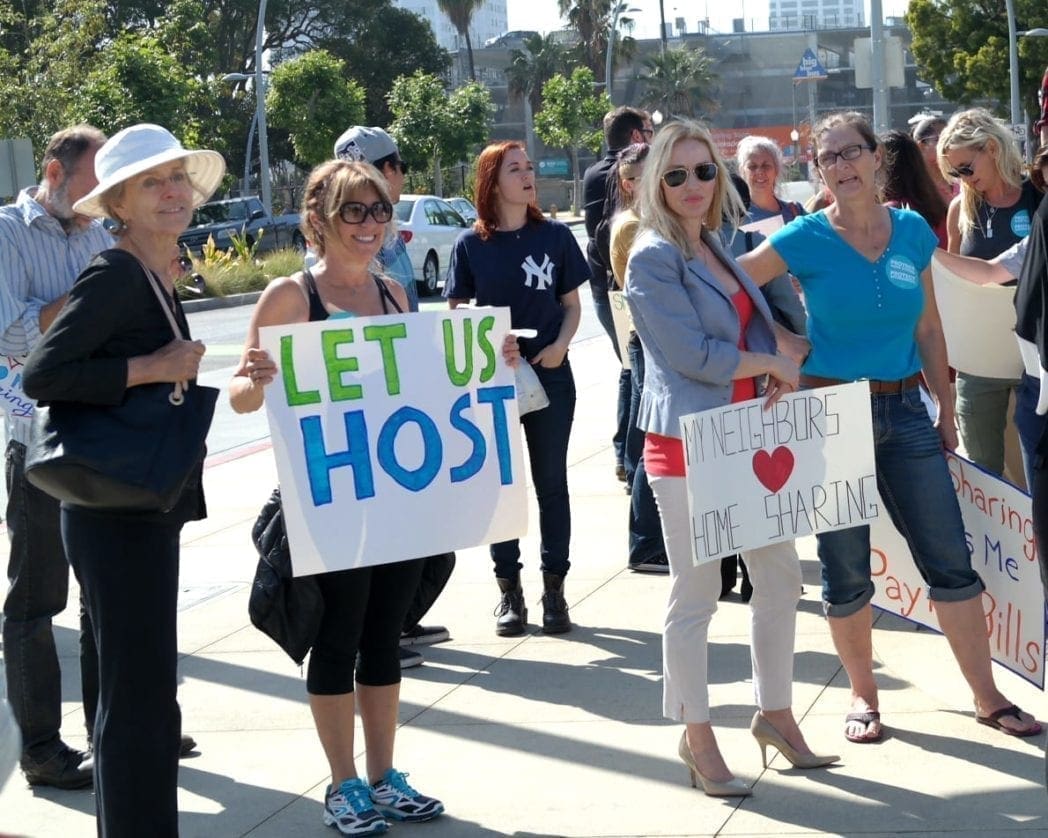
This article was featured in our weekly newsletter, the Liberator Online. To receive it in your inbox, sign up here. Airbnb, the short-term rental app, has recently agreed to go along with officials in Los Angeles by requiring users to collect hotel taxes from their clients. The three-year agreement was signed early this week. And according to LA city officials, money collected by Airbnb in Los Angeles would bring $5.8 million in annual revenue. ProtestThe agreement follows the city’s efforts to regulate Airbnb and similar companies locally. As City Council members discussed what to do with Airbnb in the past few months, the company lobbied its users to stand up against suffocating regulations in a series of emails sent out regularly. In one of these emails, Airbnb explained that the LA City Planning Commission was considering putting a 90 day cap on the number of nights Airbnb hosts can list their space, a rule Airbnb called “restrictive and arbitrary.” City officials were also considering limiting the number of listings hosts can have, which could affect users who have more than one room to rent, and instituting a registration procedure that would render the process of hosting through Airbnb difficult and expensive. Another rule LA city officials had considered would also force Airbnb to turn over users’ personal information to the authorities, giving them information on how many nights a host books through the site and how much money renters make. Airbnb warned its users that the city did not detail how this information could be used. Accusing property owners of evicting tenants to turn their properties into “commercial hotel and motel businesses,” Councilman Mike Bonin was one of the first in Los Angeles to propose Airbnb regulations. But while it is true, many users have, in fact, evicted their tenants in order to list their properties on Airbnb, that alone is not an excuse to regulate Airbnb out of existence. After all, the system works because it’s still affordable. To tourists looking for an affordable accommodation option, the extra financial burden tied to the hotel tax could mean that renting through Airbnb might not be that affordable after all. To those who use the service as renters to make ends meet, being part of Airbnb may not be as appealing if rates are high because of the new rules. In an article for US News, Mercatus Center’s Matthew Mitchell urges regulators to “deregulate traditional industries” if their goal is to help all industries and local businesses thrive. Instead of regulating the sharing economy and stifling competition, deregulation could also make it easier for visitors to stay and spend money locally. Airbnb’s decision to go along with Los Angeles city officials may represent the company’s willingness to compromise, but a real solution to this dilemma will only be produced when lawmakers are honest about their goals. After all, regulation will always makes things difficult for the consumer and the businessman, no matter how you slice it.

No, Immigrants Don’t Make the U.S. Less Safe

No, Immigrants Don’t Make the U.S. Less Safe

This article was featured in our weekly newsletter, the Liberator Online. To receive it in your inbox, sign up here. Immigration has been catapulted back into the national political discussion in recent weeks, thanks to the comments of a bloviating celebrity businessman who is desperately seeking relevance. immigrant family “When Mexico sends its people, they’re not sending their best. They’re sending people that have lots of problems, and they’re bringing those problems with us. They’re bringing drugs. They’re bringing crime. They’re rapists,” he said last month. “And some, I assume, are good people.” While some justifiably cringed at the notion, immigration restrictionists have praised the comments, especially after the tragic death of Kate Steinle, who was murdered by an illegal immigrant in San Francisco. Mark Krikorian, executive director of the Center for Immigration Studies, a rabidly anti-immigration group, declared, in the wake of Steinle’s murder, that the celebrity’s “widely mocked warnings of this very danger have been vindicated.” Former Arizona Gov. Jan Brewer, a Republican, who, in 2010 signed the toughest anti-immigration law in country, said the celebrity “is kind of telling it like it really, truly is.” “I think that the people of Arizona realize that we picked up the tab for the majority of the violence that comes across our border in regards to the drug cartels, the smugglers, the drug houses,” Brewer said. “It has been horrendous.” But is it true that immigrants bring crime to the United States? The answer may surprise you. Writing at Reason in July 2009, Radley Balko noted that despite its close proximity to Ciudad Juarez, which has been ravaged by Mexican drug cartels, El Paso, Texas “is among of the safest big cities in America.” “There were just 18 murders in El Paso [in 2008], in a city of 736,000 people. To compare, Baltimore, with 637,000 residents, had 234 killings,” Balko explained. “In fact, since the beginning of 2008, there were nearly as many El Pasoans murdered while visiting Juarez (20) than there were murdered in their home town (23).” “Numerous studies by independent researchers and government commissions over the past 100 years repeatedly and consistently have found that, in fact, immigrants are less likely to commit crimes or to be behind bars than are the native-born. This is true for the nation as a whole, as well as for cities with large immigrant populations such as Los Angeles, New York, Chicago, and Miami, and cities along the U.S.-Mexico border such as San Diego and El Paso,” he added. On Tuesday, Alex Nowrasteh, an immigration policy expert at the Cato Institute, further countered the argument that more immigrants mean more crime in the United States. “Both the Census-data driven studies and macro-level studies find that immigrants are less crime-prone than natives with some small potential exceptions. There are numerous reasons why immigrant criminality is lower than native criminality,” Nowrasteh wrote. “One explanation is that immigrants who commit crimes can be deported and thus are punished more for criminal behavior, making them less likely to break the law.” “Another explanation is that immigrants self-select for those willing to work rather than those willing to commit crimes,” he added. “According to this “healthy immigrant thesis,” motivated and ambitious foreigners are more likely to immigrate and those folks are less likely to be criminals.” None of this touches on the economic benefits of immigration or the dishonorable intentions of anti-immigration groups that drive the fear mongering. Those are topics, perhaps, for another day. But the fears about crime committed by immigrants are completely and utterly unfounded.

They Said It… With Ron Paul, The Libertarian Party and More

(From the They Said It section in Volume 19, No. 19 of the Liberator Online. Subscribe here!) UBER BRINGS WEALTH TO THE MASSES: “Once, only the privileged few, the studio bosses and pampered starlets, could afford to have a chauffeur and a waiting car to transport them around sprawling Los Angeles. Now anyone with a credit card can enjoy that freedom. … A short ride through downtown in UberX, the company’s lower-priced service, introduced here last spring, can cost as little as $4.” — journalist Melena Ryzik, “How Uber Is Changing Night Life in Los Angeles,” New York Times, Oct. 31, 2014. RON PAUL FEELS A DRAFT: Ron Paul“As the burden of our hyper-interventionist foreign policy increases, it is increasingly likely that there will be serious attempts to reinstate the military draft. … This is an issue that has long united authoritarians on the left and right. … It is baffling that conservatives who (properly) oppose raising taxes would support any form of national service, including the military draft. It is similarly baffling that liberals who oppose government interference with our personal lives would support mandatory national service. Mandatory national service is a totalitarian policy that should be rejected by all who value liberty.” — Ron Paul, “National Service is Anti-Liberty and Un-American,” weekly column, Oct. 19, 2014. CIA NAZIS: “In the decades after World War II, the CIA and other United States agencies employed at least a thousand Nazis as Cold War spies and informants and, as recently as the 1990s, concealed the government’s ties to some still living in America, newly disclosed records and interviews show. “At the height of the Cold War in the 1950s, law enforcement and intelligence leaders like J. Edgar Hoover at the FBI and Allen Dulles at the CIA aggressively recruited onetime Nazis of all ranks as secret, anti-Soviet ‘assets,’ declassified records show. They believed the ex-Nazis’ intelligence value against the Russians outweighed what one official called ‘moral lapses’ in their service to the Third Reich.”  — Eric Lichtblau, “In Cold War, U.S. Spy Agencies Used 1,000 Nazis,” New York Times, Oct. 26, 2014. THE LIBERTARIAN PARTY AND THE BALANCE OF POWER: “Libertarian candidates may have decided the winner in at least six federal and governor races, despite record-shattering spending levels in support of the Democratic and Republican candidates. Each race where a Libertarian threatens to affect the outcome of an election puts pressure on the old parties to move in a libertarian direction by reducing government’s size, scope, and authority. “It’s also a sign that more Americans reject the argument that there’s any substantial difference between Democratic and Republican politicians. Voters are seeing that which of the two wins is of little consequence.” — Libertarian Party,  post-election blog post, “Libertarians play key role in highly contested races,” Nov. 5, 2014.