












Freedom Of the Press at Lowest Point in 12 Years
According to a report from Freedom House, an independent organization that promotes freedom around the world, in 2015, press freedom has declined to its lowest point in 12 years, as political, criminal and terrorist forces worked to silence the media.
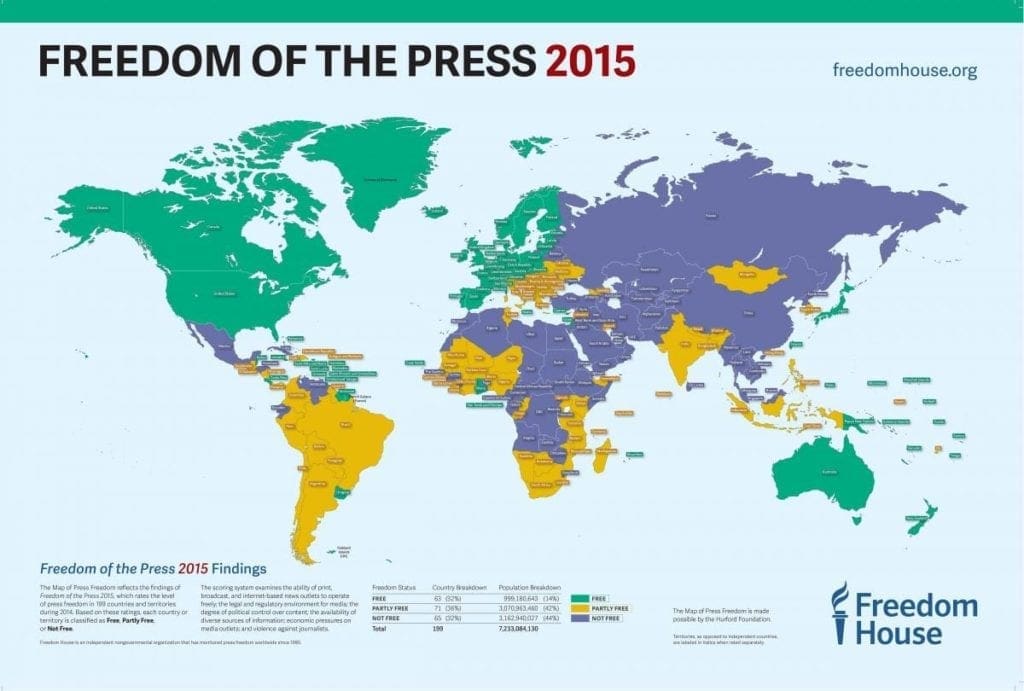 Only 13 percent of the world’s population experiences a free press, meaning that coverage of political events is prevalent, the government minimally interferes in media happenings, and the safety of journalists is guaranteed.
These declines are attributed to the partisanship of a country’s media and the amount of intimidation and violence journalists experience world-wide.
This data is best visualized in the Newseum’s world press freedom map located in the Time Warner World News Gallery in Washington, D.C.
This giant map shows which countries have the greatest amount of press freedom. A green-colored country means the most, yellow is somewhat, and red is least to none at all.
The majority of these problems for the press happen in the Middle East where governments, militias and extremists groups pressure journalists and media outlets to push alternate narratives. Often times, these groups distribute news through their own networks without needing to rely on traditional journalists or other outlets.
And recently, extremist groups have attempted to silence or eliminate news organizations that they don’t agree with, have taken journalists hostage, or have had them killed.
Only two countries improved their practices against journalists in 2015. Burkino Faso and Sri Lanka removed prison sentences for libel and saw a change in government that lead to fewer physical threats against journalists.
More than 15 countries like Turkey, Saudi Arabia, Egypt and others declined in their practices against freedom of the press. For example, the majority of these countries declined to provide protections for journalists against violence and censored websites and other medium. North Korea, Turkmenistan, and Uzbekistan lead the list in countries with the worst press freedom scores.
Freedom House lists China, Poland and India as some of the countries to watch in the next year as they may be moving towards important changes in their press freedom conditions.
The United States has a “free” press freedom status, however, since the terrorist attacks of 2001, journalists have had difficulties in gaining access to proceedings and facilities related to counterterrorism. These include reporting on the military detention facility at Guantanamo Bay, where more than 100 detainees continue to be held.
Only 13 percent of the world’s population experiences a free press, meaning that coverage of political events is prevalent, the government minimally interferes in media happenings, and the safety of journalists is guaranteed.
These declines are attributed to the partisanship of a country’s media and the amount of intimidation and violence journalists experience world-wide.
This data is best visualized in the Newseum’s world press freedom map located in the Time Warner World News Gallery in Washington, D.C.
This giant map shows which countries have the greatest amount of press freedom. A green-colored country means the most, yellow is somewhat, and red is least to none at all.
The majority of these problems for the press happen in the Middle East where governments, militias and extremists groups pressure journalists and media outlets to push alternate narratives. Often times, these groups distribute news through their own networks without needing to rely on traditional journalists or other outlets.
And recently, extremist groups have attempted to silence or eliminate news organizations that they don’t agree with, have taken journalists hostage, or have had them killed.
Only two countries improved their practices against journalists in 2015. Burkino Faso and Sri Lanka removed prison sentences for libel and saw a change in government that lead to fewer physical threats against journalists.
More than 15 countries like Turkey, Saudi Arabia, Egypt and others declined in their practices against freedom of the press. For example, the majority of these countries declined to provide protections for journalists against violence and censored websites and other medium. North Korea, Turkmenistan, and Uzbekistan lead the list in countries with the worst press freedom scores.
Freedom House lists China, Poland and India as some of the countries to watch in the next year as they may be moving towards important changes in their press freedom conditions.
The United States has a “free” press freedom status, however, since the terrorist attacks of 2001, journalists have had difficulties in gaining access to proceedings and facilities related to counterterrorism. These include reporting on the military detention facility at Guantanamo Bay, where more than 100 detainees continue to be held.
Only 13 percent of the world’s population experiences a free press, meaning that coverage of political events is prevalent, the government minimally interferes in media happenings, and the safety of journalists is guaranteed.
These declines are attributed to the partisanship of a country’s media and the amount of intimidation and violence journalists experience world-wide.
This data is best visualized in the Newseum’s world press freedom map located in the Time Warner World News Gallery in Washington, D.C.
This giant map shows which countries have the greatest amount of press freedom. A green-colored country means the most, yellow is somewhat, and red is least to none at all.
The majority of these problems for the press happen in the Middle East where governments, militias and extremists groups pressure journalists and media outlets to push alternate narratives. Often times, these groups distribute news through their own networks without needing to rely on traditional journalists or other outlets.
And recently, extremist groups have attempted to silence or eliminate news organizations that they don’t agree with, have taken journalists hostage, or have had them killed.
Only two countries improved their practices against journalists in 2015. Burkino Faso and Sri Lanka removed prison sentences for libel and saw a change in government that lead to fewer physical threats against journalists.
More than 15 countries like Turkey, Saudi Arabia, Egypt and others declined in their practices against freedom of the press. For example, the majority of these countries declined to provide protections for journalists against violence and censored websites and other medium. North Korea, Turkmenistan, and Uzbekistan lead the list in countries with the worst press freedom scores.
Freedom House lists China, Poland and India as some of the countries to watch in the next year as they may be moving towards important changes in their press freedom conditions.
The United States has a “free” press freedom status, however, since the terrorist attacks of 2001, journalists have had difficulties in gaining access to proceedings and facilities related to counterterrorism. These include reporting on the military detention facility at Guantanamo Bay, where more than 100 detainees continue to be held.