

















For decades, I have been haunted by F. A. Hayek’s “great lesson” in his essay “Individualism: True and False”:
While it may not be difficult to destroy the spontaneous formations which are the indispensable bases of a free civilization, it may be beyond our power deliberately to reconstruct such a civilization once these foundations are destroyed.
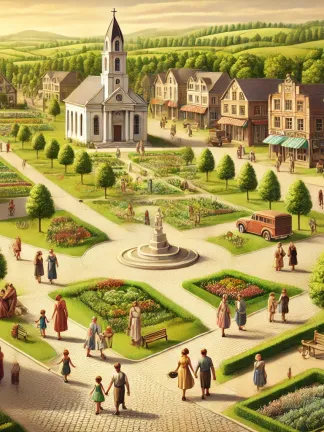
Today, Hayek’s words are more than a great lesson; they are an urgent warning. For years, like you, I have watched with anxiety “the indispensable bases of a free civilization” erode.
I do not welcome the chaos that will come if “these foundations are destroyed.” Like Hayek, I don’t believe a classical liberal paradise will emerge in the aftermath. I believe that the human suffering caused by a collapse in civil society is mostly unimaginable. Unimaginable because most of us take the blessings of civil society for granted. If we didn’t, we would live our lives in a perpetual state of awe and gratitude.
You may disagree with my prognosis. Nevertheless, asking what can be done to shore up civil society is always worthwhile.
What’s your political type?
Find out right now by taking The World’s Smallest Political Quiz.
Nock’s Answer
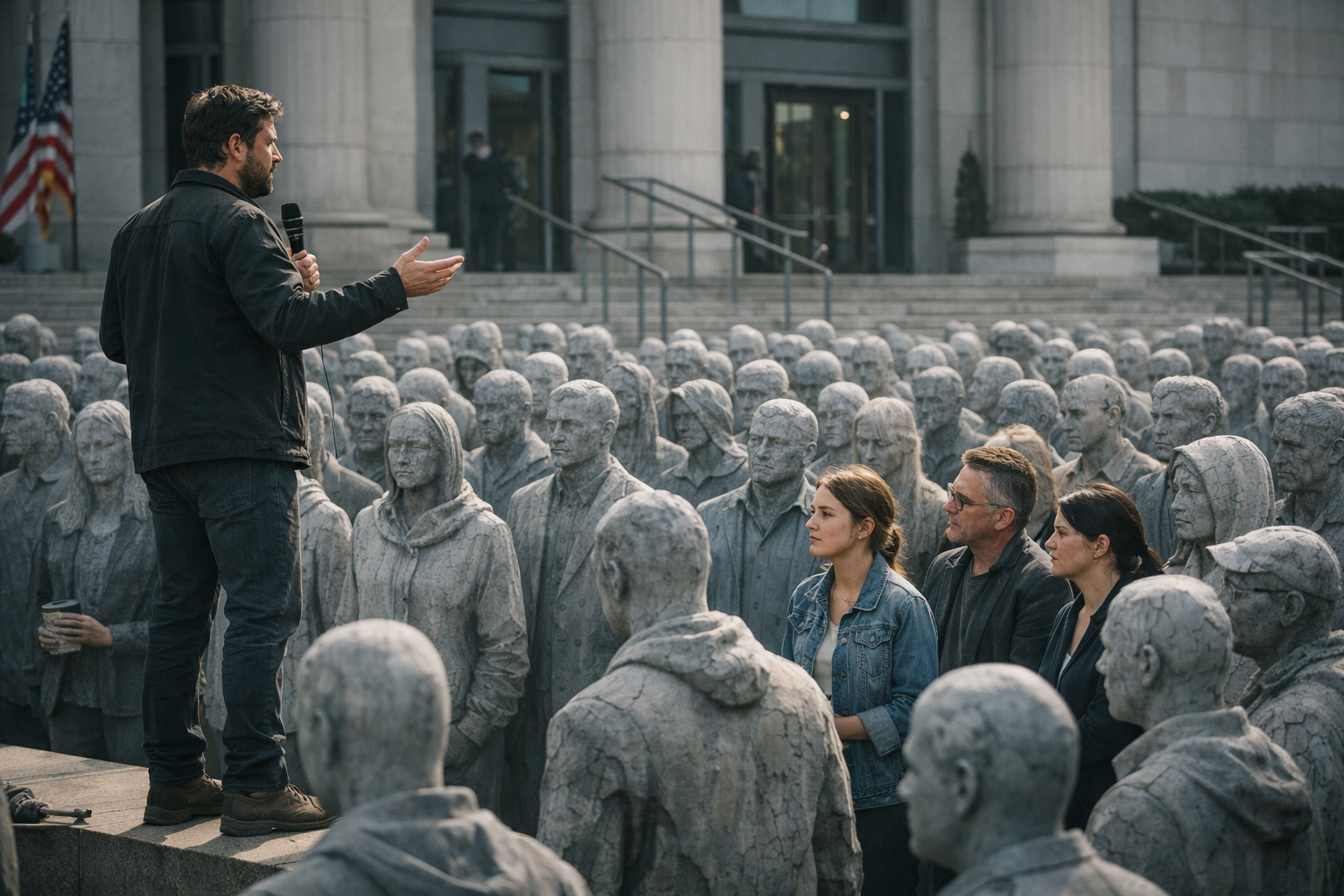
While it is tempting to try to save the world by shouting into the void of the “masses,” Albert Jay Nock offered a different, harder piece of advice. He suggests that our actual task is not to convert the “masses” but to “brace and reassure the Remnant.”
In his 1936 classic essay, “Isaiah’s Job,” Nock used the biblical story of the prophet Isaiah to make his points. “The Lord” warned Isaiah that he would not be successful in showing people they were sleepwalking towards destruction: “The official class and their intelligentsia will turn up their noses at you, and the masses will not even listen.”
Nock argued that the masses are beyond the reach of reason, and it is not our job to convert them. Nock is not saying don’t talk to or write for them, but drop the evangelical attitude that somehow you will get the “ear of the people” and lead them out of the wilderness.
By “masses” Nock doesn’t mean “poor and underprivileged people, laboring people, proletarians.” Nock’s “mass-man is one who has neither the force of intellect to apprehend the principles issuing in what we know as the humane life, nor the force of character to adhere to those principles steadily and strictly as laws of conduct.”
Bleak, isn’t it?
At this point, you might think of F.A. Hayek’s description of the masses in The Road to Serfdom. He saw why it is “the lowest common denominator which unites the largest number of people.” He wrote, “If we want to find a high degree of uniformity and similarity of outlook, we have to descend to the regions of lower moral and intellectual standards where the more primitive and ‘common’ instincts and tastes prevail.”
For Nock, the mass is a group of people who simply cannot appreciate what it takes to build a “humane life” and society.
Similarly, for Hayek, the mass is “docile and gullible,” a group having “no strong convictions of their own but are prepared to accept a ready-made system of values if it is only drummed into their ears sufficiently loudly and frequently.”
Both understood, in Hayek’s words, “It is easier for people to agree on a negative program—on the hatred of an enemy, on the envy of those better off—than on any positive task.”
What the masses want from their politicians, intellectuals, entertainers, experts, and journalists is what Nock calls their “god Buncombe”— empty, insincere speech spouting nonsensical ideas.
We see this Buncombe in all areas connected with politics. Lowest common denominator mass education, mass Big Pharma healthcare, subsidized corn and soybeans ending up in ultra-processed foods, and on and on.
The Remnant
Nock’s good news was that there is a “Remnant” of people who are,
obscure, unorganized, inarticulate, each one rubbing along as best he can. They need to be encouraged and braced up, because when everything has gone completely to the dogs, they are the ones who will come back and build up a new society.
The Remnant are those who “by force of intellect” can understand the principles by which individuals and society flourish and who “by force of character are able, at least measurably, to cleave to them.” Thus, individually, we shore up civil society by attending to our spiritual and moral development and being a person of high character.
Those in the Remnant live their life as best they can and, in the process, learn what works best to promote their own flourishing and that of those they love. They build businesses and create families. They love. They seek meaning.
The masses are trying to live your life, too. They tell you how to live and what to do. They are menacing because they know nothing about individual and societal flourishing.
If individuals do not attend to their intellectual, spiritual, and moral development now, there will be no foundation left to build upon when the current cycle of Buncombe collapses.
Our moral and intellectual development acts as an immune system. It allows us to recognize Buncombe and refuse it. Civil society requires a critical mass of people who cannot be bought, intimidated, or fooled.
Nock taught that the Remnant needs “encouragement and consolation.” By explaining that the masses will almost always ignore the truth and that the “official class” will mostly take counterproductive actions, the prophet helps the Remnant accept the tragedy of the present without losing their character.
Spiritual patience is required to work for an audience whom you can’t see and who will never give you “mass-approval.” In Nock’s words, “You do not know and will never know who the Remnant are, or where they are, or how many of them there are, or what they are doing or will do.”
When I was a professor, I received real-time feedback; I knew from my inner state and the audience’s reaction how my message was being received. Today, as a writer, reactions are asynchronous, and every day I must attend to my inner state.
If my inner state is anything but gratitude for the fact that I can enhance my own development and share what I learn, I know I have fallen into Nock’s trap of seeking immediate results.
Nock saw clearly that the Remnant is “too small … to be of any avail against the ignorant and vicious preponderance of the masses.” With the pressure off, a prophet encouraging the Remnant can work without “fear or favor,” answerable only to his principles.
We are all prophets because every day our actions teach. For example, our friendliness or unfriendliness to the supermarket cashier teaches. In his 1948 essay “On Living in an Atomic Age,” C. S. Lewis had timeless advice for our responsibilities as prophets:
The first action to be taken is to pull ourselves together. If we are all going to be destroyed by an atomic bomb, let that bomb when it comes find us doing sensible and human things—praying, working, teaching, reading, listening to music, bathing the children, playing tennis, chatting to our friends over a pint and a game of darts—not huddled together like frightened sheep and thinking about bombs. They may break our bodies (a microbe can do that) but they need not dominate our minds.
Our most hopeful acts are to “pull ourselves together” and remain answerable to our principles and to Love.

Barry Brownstein is an author and educator. He is a professor emeritus of economics and leadership at the University of Baltimore. You can find his work at Mindset Shifts on Substack.
What do you think?
Did you find this article persuasive?