















What’s your political type?
Find out right now by taking The World’s Smallest Political Quiz.
I don’t know if it’s just me, but the beginning of 2026 feels like the part of the movie when everything starts happening really fast—where the supervillains are pulling out all the stops, it’s hard to identify who the good guys are (if there are any), and nobody knows what to expect next. It feels as if the whole world is in free fall, and in some ways it is.
Those who have had their eyes on global politics and economics for decades, who have made careers out of crisis investing and apocalyptic preparedness, will tell you that what we are experiencing now was entirely predictable. To some extent, they are correct, and indeed, there are mountains of resources offering to help folks do well financially, and in other practical ways, during times like these.
But what we are experiencing is not only collapse and upheaval in practical realms. It is also happening in our social, emotional, and psychological lives.
The Covid pandemic response was an all-out assault on our social fabric, already worn thin by decades of the polarization that comes from politicizing every single aspect of our lives. All of this eats away at our spiritual and emotional well-being, and none of it is letting up any time soon. Unfortunately, there is no newsletter industry devoted to spiritual and psychological preparedness.
So, with the caveat that this is in no way comprehensive, I give you my own personal list of things you can do not only to survive spiritually and psychologically, but to thrive during these turbulent times:
1. Start by recognizing how little power you have over world events.
And then make an effort to focus your time and energy on areas of your life where you do have some power.
This may sound defeatist—it is not. Allowing ourselves to be caught up in and emotionally involved with far-off events takes precious time and energy away from those pursuits where we can have an impact.
2. Read old books.
There are many, many reasons to do this. One especially stands out for me: It is the most powerful way I can think of to connect with those who came before us, including those who lived through times of great turmoil. There is something comforting about taking a long step back from our immediate condition and looking at all the crazy—and sometimes wonderful—places humanity has been before we got here. This also provides a bit of perspective: We’re not the first ones to deal with troubled times.
Here are a few specific recommendations off the top of my head: Antigone; Basho’s The Narrow Road to the Interior; Kenko’s Essays in Idleness; Beowulf (check out the translation by Tolkien, with his commentary!); King Lear; absolutely anything by Dickens; pretty much anything by P.G. Wodehouse (these are especially fun as audiobooks, but only with a British narrator); Pride and Prejudice; and my latest favorite (I’m about a fifth of the way in), Gone With the Wind. It goes without saying that this is not even the beginning of a comprehensive list.
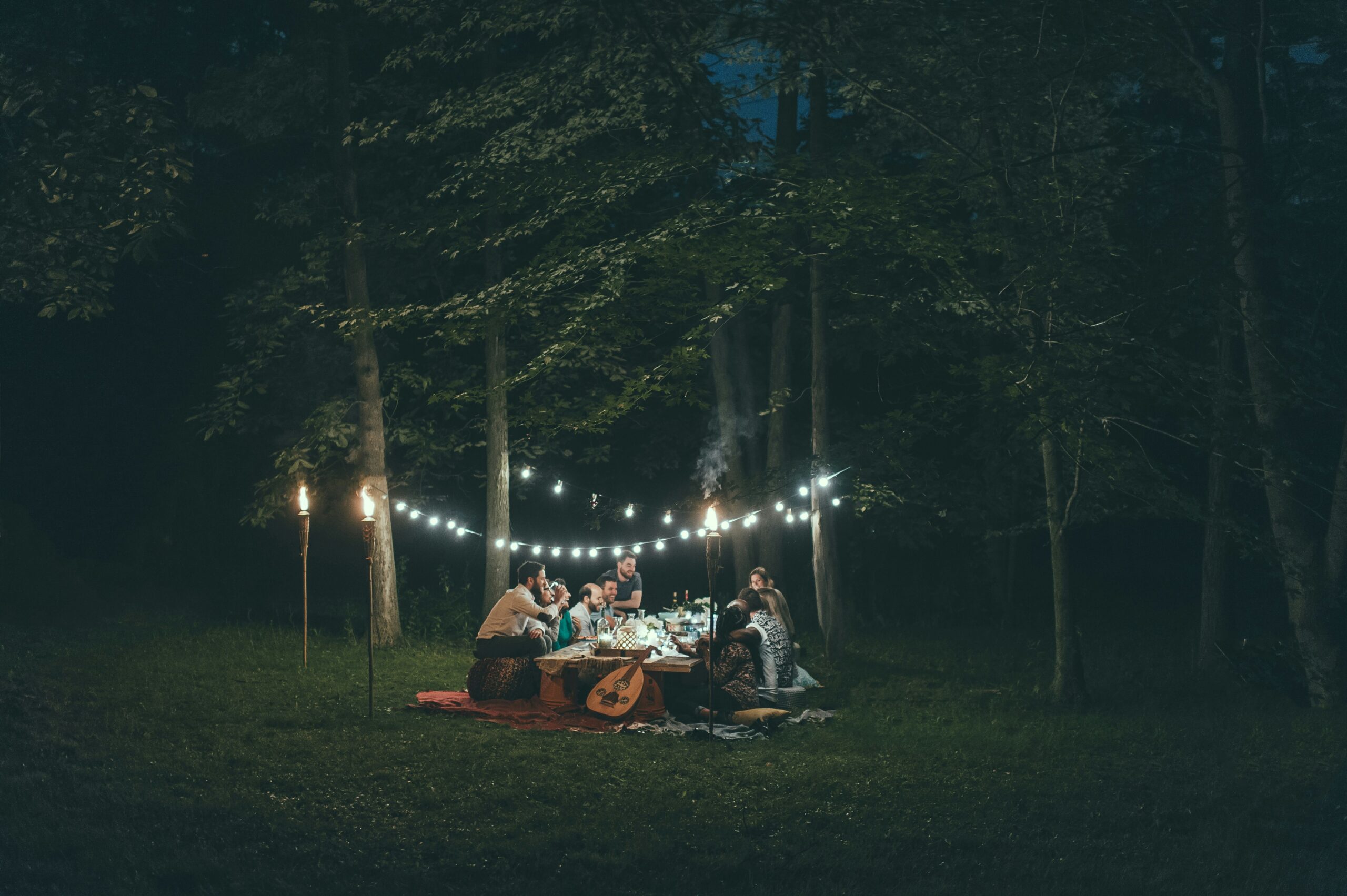
3. Host dinner parties and other in-person gatherings.
We started doing more of this during Covidmania, and I was surprised at how important it became for people during that time, especially for people who felt they could not speak freely elsewhere. We also came to realize how necessary it is for people to get together in person, with good food, maybe good wine, and most importantly, good conversation.
4. If you want to take #3 a step further, turn off the power.
A few years ago, there was a tremendous windstorm where we live, and our power was out for several days. It was wonderful.
Nighttime came when the sun went down, morning came when it rose, and everything just got quieter. We were still able to cook on our stove, we had gatherings of family and friends, and the teenagers sat transfixed, playing with the wax dripping from the candles and talking. Since that time, I’ve often thought about going downstairs, flipping the power switches off for a few days, and blaming the weather.
5. This one is critical: Make sure that you have at least one person in your life—a person you love—who is on the “other side.” Preferably more than one.
These days, the other side generally refers to political sides. But it doesn’t have to be that. It could be a religious or philosophical divide. Whatever gap feels the most unbridgeable to you—that’s the one. Make sure there is at least one person in your life who is on the other side of that divide, whom you love, and will continue to love no matter how wide that divide grows.
Why is this so important? Because that division is itself one of the deadliest of spiritual assault weapons, and it is wielded against all of us by the real “other side.”
6. Have something in your life, some pursuit, that you do only because you love it.
For me, it is ballet. I started when I was 31 (I’m not counting classes as a child), long past the point where there was any possibility of doing it professionally. I’m not especially good at it, but I do it because I love it. I love being able to touch a little of the beauty of that art, and to feel myself a part of it.
Why is this one important? Because, as with many of the other items on this list, it is one way to reclaim sovereignty over our own lives. It is a way to repudiate the darkness that moves through the world, screaming and begging for our attention, and threatening to dominate our minds and our lives. Don’t let it. Dance instead.
7. Speak the truth.
Speaking out may not change anything. Or it may. Certainly, as Matthias Desmet reminds us, not speaking out makes it much easier for those who seek total power over the rest of us to attain it.
This item may seem to contradict what I said in #1 above. But I don’t think it does. One need not be obsessed with world events, or dragged down by them, to recognize when something is not right and to say something about it. And it can be something as simple as a comment to the cashier at your local grocery store about how inflation happens. Or politely letting the TSA agent know that what he or she is doing is unconstitutional.
Quite apart from the impact your words will have on the people, and the world, around you, speaking truth is liberating. It fills you with a kind of energy that nobody can take away from you. It is, again, one more way to claim sovereignty over your own life when so many forces are working so hard to take it away.
8. Create.
If we are in a spiritual war (and we are), then the forces that are arrayed against humanity—whatever you want to call them—do not want us creating. They want us consuming, even “producing” (for them), but not creating. Not generating anything from our own imaginations, and certainly not tapping into our own connection to the divine in order to do so. There are, of course, a million and a half other wonderful reasons to unleash your creative forces. But if this one isn’t enough by itself, I don’t know what is.
9. Related to the above: Make beauty a priority.
Whether in the home you live in, the meals you enjoy, the clothes you wear, the work you do … make things beautiful. Why? Because beauty is uplifting—not only for ourselves, but for those around us. Fortunately, there seems to be a resurgence of appreciation for beauty, and a recognition of just how far we have fallen in this regard. One of the leading voices on this subject is The Culturist, on Substack and on X. I highly recommend subscribing.
10. Celebrate.
Whenever and whatever you can. Ideally with cake. Homemade, of course.
There is more that I did not include in this list. Things that are, if not obvious, at least already widely talked about. For example: Take good care of your health (notwithstanding #10 above). Get good sleep, get sunshine, eat well, and exercise every day. Find a spiritual community you can connect with. All of these are extremely important.
Of course, there are also other things I have not even thought of. But there is a common theme here: Powerful forces are at work to pull us from our centers, from our connection to the divine, and from our knowledge of why we are here and what it means to be human in the best possible sense.
None of this is unique to our times, though it may feel wildly ramped up right now. As those who came before us did, we need powerful tools to combat these forces. I hope this list helps to provide some of those tools.
What would you add to this list? Feel free to e-mail me with suggestions and comments at bretigne@gmail.com

Bretigne Shaffer is a former journalist who now writes fiction and commentary and hosts a podcast. She blogs at Bretigne, and her fiction writing can be found at Fantastical Contraption.
What do you think?
Did you find this article persuasive?