


















Imagine a town where a private company provides schooling, hospitals, and infrastructure (including roads). That’s not just libertarian theory. Such towns exist.
There’s a Latin American country you rarely hear about. It’s one of only two landlocked nations in the region. It has a record of sheltering persecuted people: Paraguay.
In the first half of the twentieth century, Mennonites (an Anabaptist Christian denomination with pacifist teachings) left Canada, the Soviet Union, and Germany over state interference and compulsory military service. They went into the Paraguayan Chaco, a largely uninhabited region once thought uninhabitable. Despite heat, distance, and little outside investment, they built their colonies.
In the first half of the twentieth century, about 8,000 Mennonites arrived in three waves. Today, roughly 40,000 Mennonites live in 20 colonies. They are a vital part of Paraguay’s beef industry.
Although these colonies operate under Paraguayan law and the state technically retains authority, they are run largely privately. For decades, Western libertarians have argued for smaller government and local control. The Chaco offers a real-world case study of those ideas in practice.
Time Preferences
The term time preferences comes up a lot in economics, but it’s really just a fancy way of referring to the differences between short-term and long-term thinking. A person with high time preferences is primarily concerned with the present moment—preferring instant gratification over planning for the future. A person with low time preferences defers gratification in the present in favor of laying the groundwork for long-term objectives.
Building a colony, such as those in the Paraguayan Chaco, requires low time preferences. It requires commitment. As the aphorism goes, it requires planting seeds for trees in whose shade one will never sit.
A private business, like a private colony, must have low time preferences. Large investments require plans measured in years or decades. To endure, firms must create lasting value and must thus consider how their decisions will affect the broader community over time.
A quintessential example is Henry Ford’s 1914 decision to double the daily wage while cutting the workday. Short-term thinking suggests that he should have lost money, but his goal was to curb costly turnover and attract skilled workers. It worked—productivity climbed, and employees’ lives improved in the process. He was thinking long-term.
Low time preferences are directly correlated with success, both in business and in life—which makes recent trends toward short-term thinking all the more tragic. This trend has even impacted businesses. Many CEOs emphasize next-quarter numbers because their incentive pay often hinges on short-term metrics. As a result, long-term planning frequently takes a back seat. Expected CEO tenure has dropped from ten years in the 1970s to six years today. That churn can dull incentives to invest in long-term development.
In order to survive, a colony, like a business, must do better.
Shared Beliefs, Shared Vision
In order to sustain a plan with generational time horizons, the people involved must share a vision in common. This is helped, especially in the early going, by having a set of common beliefs. As John Eicher, Associate Professor of Modern European History, describes it, “The Menno colonists arrived in the Chaco with a stable and coherent group narrative. They drew on biblical stories with comic plot progressions to interpret their situation.”
Even so, tensions among Mennonite factions surfaced over the years. The Chaco model can’t be reduced to shared beliefs alone; there’s more to it.
What’s your political type?
Find out right now by taking The World’s Smallest Political Quiz.
Public Goods, Managed Privately
Whether you’re talking with a visiting foreigner or a Paraguayan local, the terms below often get used interchangeably. To keep things straight, here are the key terms:
- Colony (“colonia”): settlement with its own farms, neighborhoods, and infrastructure
- Municipality/Town (“municipio”, “distrito”; town/city): local public government headed by a mayor
- Department (“departamento”): first-level subnational government, roughly comparable to a U.S. state (with less autonomy) or a Canadian province
- Cooperative / “co-op” (“cooperativa”): private, member-owned enterprise that forms the settlement’s commercial backbone
- Association (“asociación civil”): private nonprofit closely linked to the cooperative that provides social and cultural services
Details differ across colonies (Neuland, Menno, and Fernheim among the best-known), but the basic structure is similar. The state handles law, policing, courts, and civil documentation. Most other services are handled by cooperatives and associations.
The government builds and maintains infrastructure up to the colonies’ boundaries; inside, infrastructure is maintained privately. Co-ops and associations also run schools, hospitals, museums, supermarkets, credit agencies, plants, dairies, slaughterhouses (“frigoríficos”), and external marketing.
Electricity and water are generally provided by public companies in Paraguay. As with roads, those companies extend service to the colonies. Inside the colonies, co-ops and associations operate and maintain local systems.
Livestock Economy
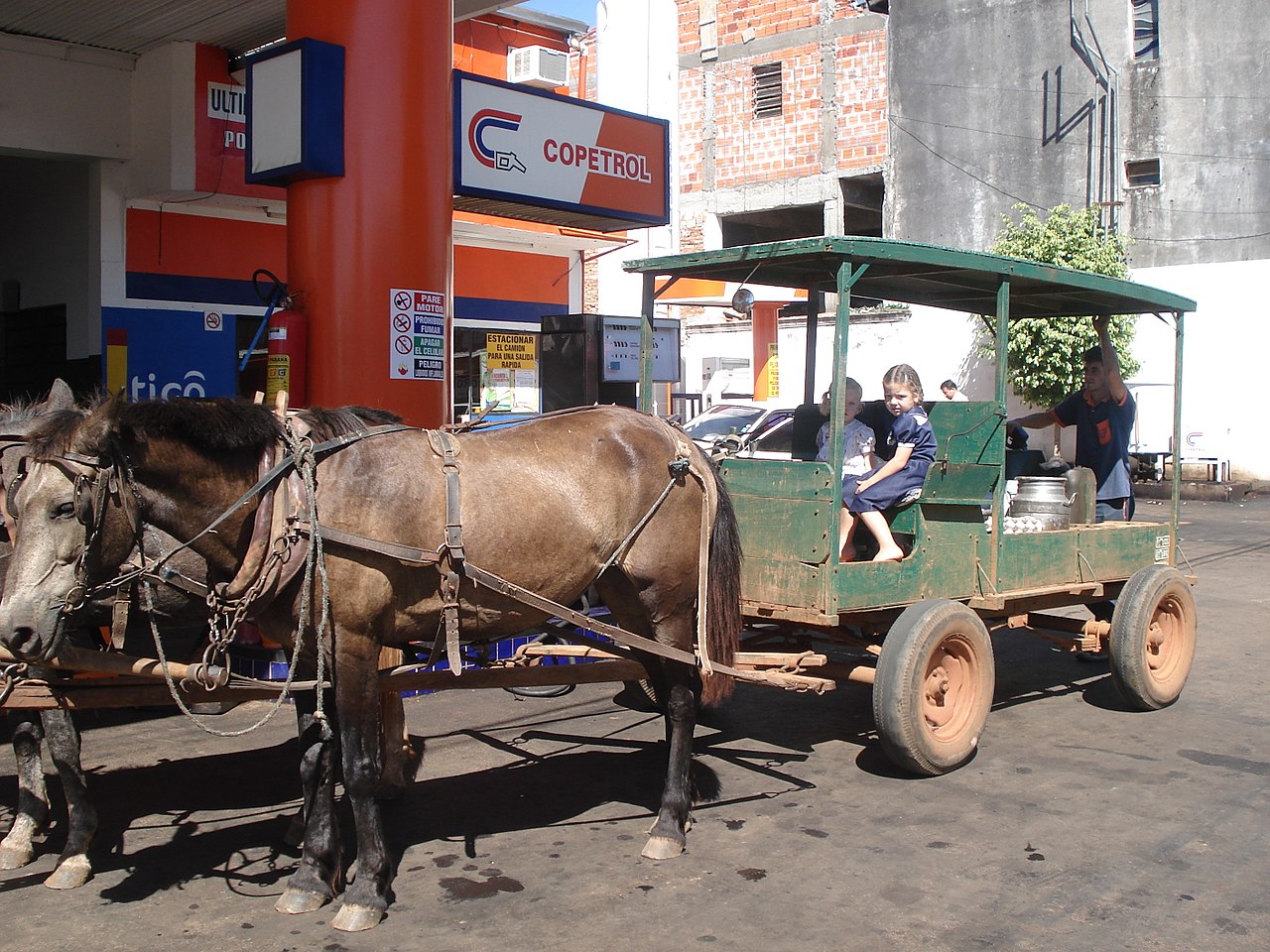
Step inside a local Paraguayan supermarket: much of the dairy and beef on the shelves comes from the colonies. Health and animal-welfare aficionados will find plenty to like. Livestock is raised on wide pastures and is at least partly grass-fed, often grass-finished. Outside the colonies, that approach is not the norm.
Census data show farms skew toward midsize and large operations, with hundreds of ranches running 200 head of livestock or more. Farms are encouraged or required (based on the specific colony’s rules) to sell through the cooperatives.
Cooperative profits are distributed mainly as patronage dividends, proportional to each member’s business with the co-op. Associations are financed by member dues, service fees, donations from cooperatives/companies, and formal contracts with the state.
Cooperative membership is voluntary. However, the monetary incentives are strong: members get dividend payouts and the ability to sell products under the cooperative’s brand. Association membership is also voluntary. However, the social incentives are strong: a say in local governance and access to member-only services.
Reliable counts are scarce, but public information suggests roughly half of colony residents are neither Mennonite nor association members.
Still, everyone can use the roads. Hospitals charge fees, so services are available to nonmembers. While shared values are emphasized, religious membership is not a prerequisite.
The Lessons
Non-violent rule enforcement
The Chaco colonies offer a case study in voluntary cooperation. Less state interference doesn’t mean no rules. Residents voluntarily participate in cooperatives and associations because they provide valuable services. Since co-ops and associations lack a monopoly on violence, enforcement has to be done peacefully. For instance, Fernheim’s credit policies require members to be current on cooperative obligations.
Unity and shared values
Shared narrative and values are central. “Diversity is strength” is not the operative principle here. Unity and social cohesion, rooted in a shared history of fleeing persecution, shape the colonies. Cooperation is vital to prosperity. No one finances a hospital alone. But living closely together requires a shared foundation.
Decentralization
We also see decentralization at work. “The way to have good and safe government, is not to trust it all to one; but to divide it among the many,” as Thomas Jefferson put it.
In a recent article, I explored how SEZs move governance toward the local level. Chaco towns are smaller still. Populations are in the low thousands, roughly two to three orders of magnitude smaller than well-known SEZs. Yet these small communities are well integrated into Paraguay’s economy and global markets.
Non-wasteful spending
Public goods are supplied prudently in the colonies. You can see your contribution make a difference. Membership fees aren’t swallowed by a distant state apparatus of politicians and officials hundreds of kilometers away. Dues and fees match services. If you fund 1,300 km of roads or a local hospital, you see where the money goes and who is responsible for outcomes.
Public goods by private companies
A strong state is not needed for good “public” services. In many Western countries, patients tend to prefer private over public hospitals. In the Chaco, a vast, sparsely populated region, diagnostics and inpatient capacity are strong for the setting. They’re not world-class, but by rural Paraguay standards, the services are excellent.
Theoretical Arguments
Within a century, the Chaco, a largely uninhabited region with difficult living conditions, has become an important part of Paraguay. The region early settlers dubbed the “Green Hell” now produces two-thirds of Paraguayan beef exports. It shows that decentralization with local rules doesn’t mean isolation. These communities can participate in open trade while enforcing specific local rules.
Some argue that a strong state is needed to provide “public goods.” The Chaco proves otherwise. Private enterprise can supply these goods, and if a good creates real value, the market will supply it. While many in the West insist they know how to organize every last detail of civic life, most colony residents don’t try to shape every institution themselves. They entrust that responsibility to those willing to shoulder it.
Mennonite colonies in Paraguay offer a case study of arguments often debated in theory. Founded in a harsh region by people fleeing persecution, the colonies embraced their own way of living. Perhaps surprisingly, the colonies not only survive but thrive.

With a background in business and tech, David brings clarity to ideas of individual freedom and Austrian Economics. He left Europe in search of liberty and he authors the Substack publication "In Pursuit of Liberty."
What do you think?
Did you find this article persuasive?