













I have lived long enough to understand that economics is never just merely “out there.”
It is not some abstract discipline reserved for PhDs, think tanks, and political pundits. It lives inside our bodies, households, dreams, anxieties, and aspirations.
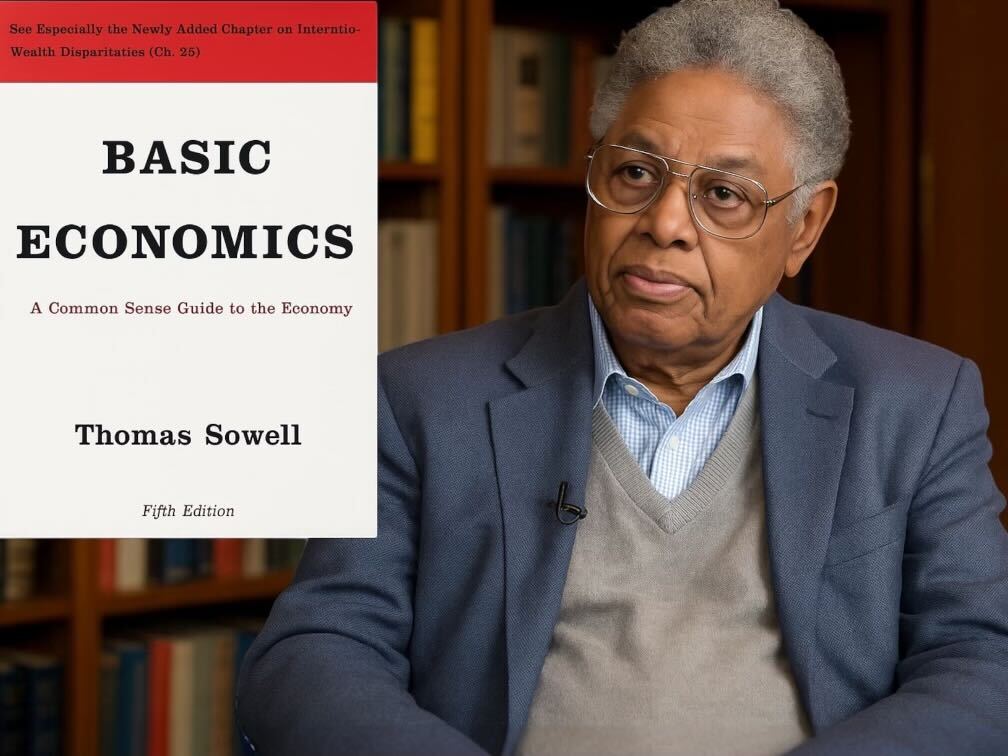
Thomas Sowell’s seminal bestselling book Basic Economics helped me see this with startling clarity. It offers a framework for understanding not only the macro world of nations, markets, incentives, and policies, but also the micro world inside each of us, where choices, habits, and disciplines shape our personal economy.
When I first encountered Sowell’s writing, I approached it cautiously. But when I started fact-checking Sowell, digging into primary sources and studying the unintended consequences of well-meaning policies, something remarkable happened: the world began to reveal itself in a way that reminded me of Taoist clarity.
I began to see the economy not as a struggle between heroes and oppressors, but as a complex flow of incentives, constraints, and natural consequences.
Sowell writes without jargon. He writes without emotional manipulation. And because of that, he writes in a way that feels eerily close to the Tao itself: simple, truthful, and grounded in the nature of things.
Thomas Sowell’s Evolution and the Tao of Reality
Sowell’s journey from studying Marxism in graduate school (and a brief embrace of socialism in his youth) to noted economist echoes a familiar arc in Eastern philosophy. The founder of Taoism, Lao Tzu, teaches that wisdom often arises only after we have run headlong into the limits of our assumptions. And Taoist sage Zhuangzi reminds us that true understanding emerges only when we loosen our grip on ideological certainties.
Sowell lived this as his early years were steeped in Marxist thought. But when he discovered that real-world data clashed with ideological theory, he followed the evidence rather than the emotion.
The Tao says: “Stop trying to force the world. Observe it instead.”
Sowell practiced this. He observed how incentives create behavior. He studied how scarcity shapes decisions. He watched how well-intended government orders often make problems worse because they violate economic laws as real as gravity.
His method?
Not an argument.
Not moralism.
Not abstract theory.
Just clarity.
Reading Sowell often feels like watching mist clear in the morning sun. You begin to see that wealth is not a default condition. Prosperity is not inevitable. Poverty is not a simple problem solved through slogans or redistribution. Human flourishing requires incentives, freedom, responsibility, and a respect for cause and effect.
Taoism calls this “following the Way.”
Sowell calls it “basic economics.”
What’s your political type?
Find out right now by taking The World’s Smallest Political Quiz.
The Economics of Self-Governance
A prosperous society is impossible without prosperous individuals. And personal prosperity is impossible without economic literacy. This is where Sowell’s writing becomes deeply personal for me.
As a student of Taoism, I’ve devoted my life to the idea of self-government. A good society emerges from the bottom up through voluntary association, persuasion, personal responsibility, and respect for persons and property.
Economics is the study of how people make choices under conditions of scarcity. Self-governance is the art of making those choices consciously, ethically, and responsibly.
Reading Sowell showed me that these two pursuits are inseparable.
If you misunderstand economics, you will misunderstand freedom.
If you misunderstand incentives, you will misunderstand society.
If you misunderstand tradeoffs, you will misunderstand your own life.
The personal mirrors the political.
The psychological mirrors the financial.
The Taoist mirrors the economist.
Just as water flows to the lowest point, incentives pull human behavior in predictable directions. Just as nature abhors a vacuum, markets abhor price ceilings and artificial shortages. And just as emotional distortions create suffering in the individual, policy distortions create suffering in the society.
Economics as Spiritual Discipline
Economics, properly understood, is not a cold science. It is a spiritual discipline rooted in clarity, humility, and non-illusion. Taoist thought encourages us to see reality as it is, not as we wish it to be. Sowell’s writing demands the same posture.
Life becomes more peaceful when we stop demanding that the world bend to our desires. Prosperity becomes more likely when we stop making choices based on wishes instead of consequences. Society becomes more harmonious when individuals understand the real forces that govern wealth, scarcity, and cooperation.
To understand economics is to understand how the world actually works. To see incentives is to “see the code in the Matrix.” When you see that code, you stop being manipulated by political rhetoric. You stop being seduced by utopian promises. You stop being confused by noise.
You become sovereign.
And sovereignty is the basis of freedom, prosperity, and peace.
A Reflective Call-to-Action: Your Personal Economy as a Path to Freedom
Pause for a moment. Take a breath. Consider your own personal economy, not as a ledger of numbers but as a living reflection of your everyday choices.
Ask yourself:
How do I save money?
Do my habits reflect clarity and sovereignty? Or avoidance and anxiety?
How do I spend money?
Every dollar expresses a value. Are those values chosen or unconscious?
How do I invest?
Not just financially, but in relationships, skills, health, and community.
How do I handle scarcity?
Time, money, energy. The Tao says every choice costs something. What do you choose?
What incentives shape my habits?
Vision or distraction? Long-term peace or short-term relief?
What tradeoffs am I denying?
Sowell teaches that ignoring tradeoffs does not make them disappear.
This is not guilt. It is sovereignty.
A Taoist life is a life aligned with the flow of things. An economically literate life is one aligned with the flow of resources. Put them together and you become a self-governing person: someone who moves with the currents of reality rather than against them.
If you want a freer society, start with a freer self.
If you want a more prosperous community, start with a more prosperous personal economy.
If you want clarity in the world, begin with clarity in your choices.
This is the promise of Sowell’s work.
This is the promise of the Tao.
And both begin with you.

Diamond-Michael Scott is an independent journalist and an editor-at-large for Advocates for Self Government. You can find more of his work at The Daily Chocolate Taoist.
What do you think?
Did you find this article persuasive?