(From the Ask Dr. Ruwart section in Volume 20, No. 9 of the Liberator Online. Subscribe here!)
QUESTION: Shouldn’t we all vaccinate so we don’t endanger others?
 MY SHORT ANSWER:
 My recent column “
Should Vaccines Be Mandatory?” made a civil liberties argument for the right of people to make personal medical decisions like vaccination for themselves. Several readers expressed concern. They wondered whether people who didn’t vaccinate might endanger others with compromised immune systems who couldn’t vaccinate, such as the elderly or infants.
People with poor immune function are more likely to be exposed to the flu and/or pneumonia than measles from an unvaccinated person. Many thousands of Americans get the flu annually, while less than 200 people each year develop measles. The flu can lead to pneumonia also,
making these two infections the 9th highest cause of death in the U.S.
The measures that compromised individuals take to protect themselves from these more common, deadly threats (e.g., avoiding crowds), would protect them from measles as well. These precautions are necessary, because the effectiveness of annual flu shots
can be as low as 10%.
Contrary to popular opinion, the measles vaccine
doesn’t always work, either. One-half of Canadian cases of measles come from vaccinated individuals; in the U.S., about one-third of people in a measles outbreak have received one or two doses of the vaccine.
Only about 25% of those vaccinated
maintain measles immunity for 10 years or more; 75% of the vaccinated population loses their protection before that, although they often get a milder form of measles if infected.
As one might expect, the immune system doesn’t respond as strongly to a vaccine as it does when it mounts a full scale response to an actual infection. Only people who have had measles as a child can expect a lifetime of protection.
I had measles before we had the vaccine. Back then, some people purposefully exposed children to make sure they had immunity to measles, mumps, and occasionally other childhood diseases. Parents wanted to be sure that their girl children especially had immunity, as getting measles while pregnant could be detrimental to the unborn child. The good news is that many of our seniors probably still have immunity to childhood diseases, even if they haven’t been able to vaccinate.
In conclusion, universal vaccination for measles is unlikely to significantly protect compromised individuals, not only because the vaccine has limitations, but because other infections (e.g., flu, pneumonia) are the real threat. If an immune-compromised individual alters their lifestyle to avoid those more common, deadly infections, they are likely to avoid the measles too.
Inexpensive Vitamin A is currently being
studied as a treatment and preventative for infections, including measles. If my immune system became compromised, Vitamin A supplementation is something I’d likely explore.
* * *
LEARN MORE: Suggestions for additional reading, selected by Liberator Online editor James W. Harris:
* “
Vaccine Controversy Shows Why We Need Markets, Not Mandates” by Ron Paul, M.D., February 8, 2015. Excerpt: “If government can mandate that children receive vaccines, then why shouldn’t the government mandate that adults receive certain types of vaccines? And if it is the law that individuals must be vaccinated, then why shouldn’t police officers be empowered to physically force resisters to receive a vaccine? If the fear of infections from the unvaccinated justifies mandatory vaccine laws, then why shouldn’t police offices fine or arrest people who don’t wash their hands or cover their noses or mouths when they cough or sneeze in public? Why not force people to eat right and take vitamins in order to lower their risk of contracting an infectious disease? These proposals may seem outlandish, but they are no different in principle from the proposal that government force children to be vaccinated.”

















 Except for a few psychopaths, taking up arms with the intention to kill others day after day is difficult, even when our nation is truly threatened. It’s a rare individual who remains unscathed by killing others and being a target, which is why so many return home with post-traumatic stress disorder or serious mental illnesses. Going to war should always be the last resort, since the cost in lives, money, and disabilities is so high. In recent times, however, sending troops overseas seems to be a knee-jerk response to any provocation.
When our young people perceive that a war is not just or not warranted, they become unwilling to risk their lives or kill for it. In Vietnam, a war I remember well, this is exactly what happened. Although young men enlisted early in the war, they soon concluded that Vietnam was not a threat to the United States, and resisted the draft overtly or covertly.
Today, not enough of our young men are enlisting to sustain the conflicts in the Middle East. Our troops look forward to going home after their tours are up, only to be forcibly reenlisted under the stop-loss fine print in their contracts. We claim to have a volunteer army, but in fact those who enlist can be drafted for another deployment. This discourages further enlistment, as new recruits start to understand that they are actually signing an open-ended contract.
Clearly, the government believes it will need a draft in the not-so-distant future to maintain its chosen military action. We are told that without a draft, our young people will not step forward when our country is threatened. This is patently false. After 9/11, volunteers flooded to sign up for the anticipated military action. Now they no longer do, as they perceive their government is embarked on never-ending wars.
If our nation is truly threatened, our young people step forward willingly; if it isn’t truly threatened, why should they risk life and limb? We can’t keep killing people overseas because maybe, someday, they might try to harm us. There are simply too many people who “might” try to hurt us. A better strategy is to make sure our domestic security is strong enough that those who would do us harm will be thwarted in their attempt.
If we engage in overseas wars that are not truly defensive ones, and may even be primarily in the service of special interests, our young people should refuse to go. These young adults become the canaries in the coal mine, warning us that the war we wish to fight might not be so right.
Killing is difficult enough when it is perceived as a necessary evil, but it’s even more difficult without the motivation to protect our homes and loved ones. The draft isn’t only involuntary servitude; its slavery of the worst kind as it asks the draftees to do things they find morally repugnant. How are we to spread freedom abroad by taking it away from our young people at home?
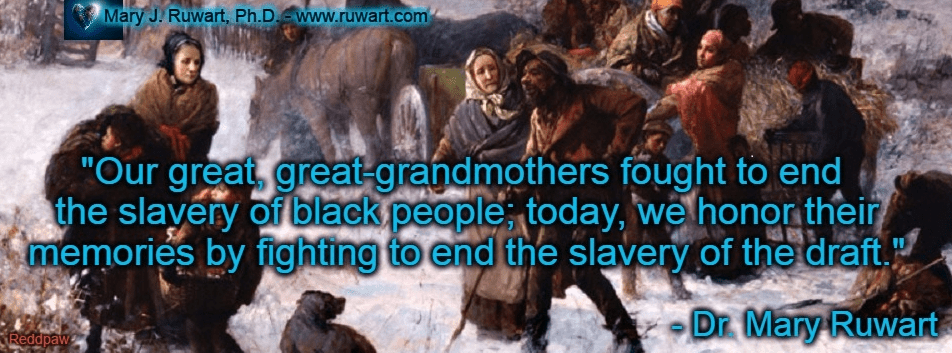
Women have a major role to play in discussions about the draft. They should indeed talk about equal rights—for both men and women. Self-determination, the decision whether or not we are willing to go out and kill others, is a right that belongs to both sexes. Instead of insisting that their own rights should be violated, as the rights of men are today, women should be lobbying for an end of the draft. Our great, great-grandmothers fought to end the slavery of black people; today, we honor their memories by fighting to end the slavery of the draft.
Except for a few psychopaths, taking up arms with the intention to kill others day after day is difficult, even when our nation is truly threatened. It’s a rare individual who remains unscathed by killing others and being a target, which is why so many return home with post-traumatic stress disorder or serious mental illnesses. Going to war should always be the last resort, since the cost in lives, money, and disabilities is so high. In recent times, however, sending troops overseas seems to be a knee-jerk response to any provocation.
When our young people perceive that a war is not just or not warranted, they become unwilling to risk their lives or kill for it. In Vietnam, a war I remember well, this is exactly what happened. Although young men enlisted early in the war, they soon concluded that Vietnam was not a threat to the United States, and resisted the draft overtly or covertly.
Today, not enough of our young men are enlisting to sustain the conflicts in the Middle East. Our troops look forward to going home after their tours are up, only to be forcibly reenlisted under the stop-loss fine print in their contracts. We claim to have a volunteer army, but in fact those who enlist can be drafted for another deployment. This discourages further enlistment, as new recruits start to understand that they are actually signing an open-ended contract.
Clearly, the government believes it will need a draft in the not-so-distant future to maintain its chosen military action. We are told that without a draft, our young people will not step forward when our country is threatened. This is patently false. After 9/11, volunteers flooded to sign up for the anticipated military action. Now they no longer do, as they perceive their government is embarked on never-ending wars.
If our nation is truly threatened, our young people step forward willingly; if it isn’t truly threatened, why should they risk life and limb? We can’t keep killing people overseas because maybe, someday, they might try to harm us. There are simply too many people who “might” try to hurt us. A better strategy is to make sure our domestic security is strong enough that those who would do us harm will be thwarted in their attempt.
If we engage in overseas wars that are not truly defensive ones, and may even be primarily in the service of special interests, our young people should refuse to go. These young adults become the canaries in the coal mine, warning us that the war we wish to fight might not be so right.
Killing is difficult enough when it is perceived as a necessary evil, but it’s even more difficult without the motivation to protect our homes and loved ones. The draft isn’t only involuntary servitude; its slavery of the worst kind as it asks the draftees to do things they find morally repugnant. How are we to spread freedom abroad by taking it away from our young people at home?
Women have a major role to play in discussions about the draft. They should indeed talk about equal rights—for both men and women. Self-determination, the decision whether or not we are willing to go out and kill others, is a right that belongs to both sexes. Instead of insisting that their own rights should be violated, as the rights of men are today, women should be lobbying for an end of the draft. Our great, great-grandmothers fought to end the slavery of black people; today, we honor their memories by fighting to end the slavery of the draft.







 I am coming around to libertarian ideas, but so many libertarian policies, while moving in the right direction, seem to go way too far. For instance, the idea of no taxation, only user fees, seems great. But it seems that some taxation would be necessary to pay government workers, maintain ambassadors and embassies to other nations, host state visits from other nations, and (a necessary evil) pay lawyers to defend the government against lawsuits, as well as a host of other little things that there couldn’t be a user fee for. Can zero taxation really stand up to reason?
Answer:
Yes!
Government workers would be paid by those individuals or groups that made their employment necessary. Lawyers defending the government in lawsuits, for example, would be paid for by the guilty party. Since government officials would not enjoy sovereign immunity in a libertarian society, they could be liable for attorney fees and damages for any wrongdoing. In other answers posted on the Web site, I’ve detailed the mechanism by which restitution could be made.
Since a libertarian government would not be restricting trade between nations, establishing embargoes, setting tariffs, handing out taxpayer guaranteed loans, etc., our top officials would not be wining and dining dignitaries from other countries as they do today. Naturally, heads of state from other countries could visit the U.S. at their own expense. Without the ability to pick the U.S. taxpayer’s pocket, however, few would bother.
If embassies were maintained in foreign nations, they would be supported by fees from travelers or others who might utilize their services.
Today, those who are too poor to travel pay taxes to support services for people who can afford to see the world. Taxes are one way in which government makes the poor poorer and the rich richer.
I am coming around to libertarian ideas, but so many libertarian policies, while moving in the right direction, seem to go way too far. For instance, the idea of no taxation, only user fees, seems great. But it seems that some taxation would be necessary to pay government workers, maintain ambassadors and embassies to other nations, host state visits from other nations, and (a necessary evil) pay lawyers to defend the government against lawsuits, as well as a host of other little things that there couldn’t be a user fee for. Can zero taxation really stand up to reason?
Answer:
Yes!
Government workers would be paid by those individuals or groups that made their employment necessary. Lawyers defending the government in lawsuits, for example, would be paid for by the guilty party. Since government officials would not enjoy sovereign immunity in a libertarian society, they could be liable for attorney fees and damages for any wrongdoing. In other answers posted on the Web site, I’ve detailed the mechanism by which restitution could be made.
Since a libertarian government would not be restricting trade between nations, establishing embargoes, setting tariffs, handing out taxpayer guaranteed loans, etc., our top officials would not be wining and dining dignitaries from other countries as they do today. Naturally, heads of state from other countries could visit the U.S. at their own expense. Without the ability to pick the U.S. taxpayer’s pocket, however, few would bother.
If embassies were maintained in foreign nations, they would be supported by fees from travelers or others who might utilize their services.
Today, those who are too poor to travel pay taxes to support services for people who can afford to see the world. Taxes are one way in which government makes the poor poorer and the rich richer.

 QUESTION: I am a homeowner in a low-income neighborhood. I work hard to keep my property up, and my yard is beautiful. I am enraged by people who leave tires and garbage cans in front of their houses, don’t cut the grass, and scatter their garbage all over the street. They do not have the right to denigrate my quality of life.
How do I reconcile my libertarianism with the fact that I call the city on these offenders and advocate stricter laws regarding how one keeps the outside appearance of his property?
MY SHORT ANSWER: In a libertarian society, when builders created a subdivision, they might choose to put deed restrictions on the homes. Prospective owners would need to accept these as a condition of purchase. Alternatively, property owners’ associations might be put in place with a starting set of restrictions, to be modified in time by the buyers into the subdivision. Such restrictions could include standards of upkeep. People who desired a well-kept neighborhood would likely buy in such communities.
People who would rather not be restricted would buy in communities or other areas where such standards were minimal or non-existent. In this way, everyone’s preference would be honored. Everyone wins!
Today, however, standards — even zoning — can fluctuate overnight with changes in city councils, zoning boards, or inspectors. Sometimes these standards are selectively enforced (e.g., a neighbor has to complain before action is taken). Buyers don’t always know what they are getting into and understandably become resentful when their neighbors use government to restrict them. Thus, unfortunately, today win-win solutions to these problems are rare.
QUESTION: I am a homeowner in a low-income neighborhood. I work hard to keep my property up, and my yard is beautiful. I am enraged by people who leave tires and garbage cans in front of their houses, don’t cut the grass, and scatter their garbage all over the street. They do not have the right to denigrate my quality of life.
How do I reconcile my libertarianism with the fact that I call the city on these offenders and advocate stricter laws regarding how one keeps the outside appearance of his property?
MY SHORT ANSWER: In a libertarian society, when builders created a subdivision, they might choose to put deed restrictions on the homes. Prospective owners would need to accept these as a condition of purchase. Alternatively, property owners’ associations might be put in place with a starting set of restrictions, to be modified in time by the buyers into the subdivision. Such restrictions could include standards of upkeep. People who desired a well-kept neighborhood would likely buy in such communities.
People who would rather not be restricted would buy in communities or other areas where such standards were minimal or non-existent. In this way, everyone’s preference would be honored. Everyone wins!
Today, however, standards — even zoning — can fluctuate overnight with changes in city councils, zoning boards, or inspectors. Sometimes these standards are selectively enforced (e.g., a neighbor has to complain before action is taken). Buyers don’t always know what they are getting into and understandably become resentful when their neighbors use government to restrict them. Thus, unfortunately, today win-win solutions to these problems are rare.
 MY SHORT ANSWER: In my opinion, the differences are more cultural than real, in political matters. Both Objectivism and libertarianism are based on the non-aggression principle of honoring our neighbors’ choice (not initiating physical force, fraud or theft) and making things right with our victims if we don’t.
Objectivism is a comprehensive philosophy of life that includes not just political beliefs but strong and unified beliefs on virtually every aspect of human existence, including religion, art, romance, and so on. Libertarianism, in contrast, is a strictly political philosophy.
Rand believed that government’s proper role was protection of rights and that government should have a monopoly on defensive force to fulfill this role. Many libertarians agree with her. Others believe that governments are a poor protector of rights and that competition in this realm is right and proper.
* * *
LEARN MORE: Suggestions by Liberator Online editor James W. Harris for additional reading on this topic:
Ironically, although Ayn Rand publicly disavowed libertarianism, she is unquestionably one of the most influential figures in the modern libertarian movement and is commonly identified today as a libertarian. And her political views are libertarian, by any common definition of the term.
Here are two short pieces that explore this seeming contradiction. Please note, this is a subject about which many people disagree.
* “
MY SHORT ANSWER: In my opinion, the differences are more cultural than real, in political matters. Both Objectivism and libertarianism are based on the non-aggression principle of honoring our neighbors’ choice (not initiating physical force, fraud or theft) and making things right with our victims if we don’t.
Objectivism is a comprehensive philosophy of life that includes not just political beliefs but strong and unified beliefs on virtually every aspect of human existence, including religion, art, romance, and so on. Libertarianism, in contrast, is a strictly political philosophy.
Rand believed that government’s proper role was protection of rights and that government should have a monopoly on defensive force to fulfill this role. Many libertarians agree with her. Others believe that governments are a poor protector of rights and that competition in this realm is right and proper.
* * *
LEARN MORE: Suggestions by Liberator Online editor James W. Harris for additional reading on this topic:
Ironically, although Ayn Rand publicly disavowed libertarianism, she is unquestionably one of the most influential figures in the modern libertarian movement and is commonly identified today as a libertarian. And her political views are libertarian, by any common definition of the term.
Here are two short pieces that explore this seeming contradiction. Please note, this is a subject about which many people disagree.
* “ MY SHORT ANSWER: With the new surge of measles cases, many people are calling for mandatory (forced) vaccination. At first glance, their arguments seem reasonable. Measles can kill and the vaccine is reportedly about 95% effective. Side effects are claimed to be minimal, although serious outcomes are reported on pp. 6-8 of the package