












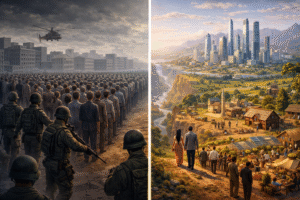


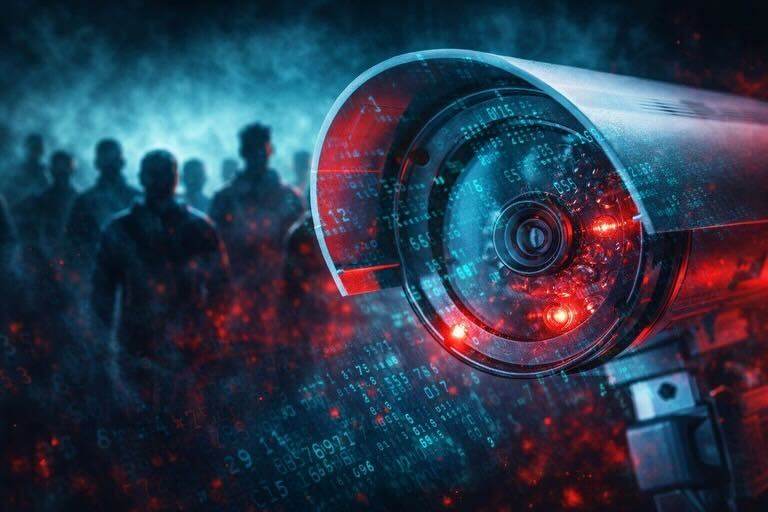
There’s no need to imagine a future dystopia in order to understand the collision between privacy rights and digital surveillance. We are already living inside it.
Every swipe, scan, click, and casual “I agree” has quietly rewritten the social contract. Not through a vote. Not through a constitutional convention. But through convenience. Through speed. Through the seductive promise that life will be easier if you simply stop asking questions.
As cybersecurity and digital privacy expert Wayne Lonstein said to me in our recent interview discussion, “While it’s been said that knowledge is power, personal data I believe is the ultimate power.”
In other words, when ultimate power concentrates, it does not remain neutral. It never has.
The Tao Te Ching warned of this long before fiber optics and facial recognition: when control becomes excessive, the people grow clever in survival but poor in spirit. The danger is not force but imbalance.
Homogenization Is Not an Accident
Lonstein calls himself a technology curmudgeon, but what he is really offering is structural foresight.
“Everything is moving towards a homogeneous, one-size-fits-all in every aspect of our lives, which is accelerating through AI.”
Artificial intelligence, in his view, is not just a tool of efficiency. It is a force multiplier for sameness.
“AI is the ultimate homogenization tool,” he said, before naming the darker implication: “You could call it a eugenics tool.”
That word is meant to unsettle you. Once systems begin ranking human beings by health data, behavior, productivity, or compliance, the line between optimization and exclusion disappears quickly.
The Tao Te Ching reminds us that nature does not optimize uniformly. Mountains are not flat. Rivers do not move in straight lines. Life thrives precisely because it resists sameness.
When systems demand uniformity, they are already at war with the Tao.
Digital Enslavement Without Chains
Lonstein returned again and again to a phrase that should stop any freedom-minded person cold: digital enslavement.
“A sort of involuntary servitude,” he called it.
We have been mandated, not invited, to place the most intimate aspects of our lives online. Taxes. Banking. Health records. Vehicles. Homes.
Even our bodies. Smart devices do not simply serve us. They observe us. They report on us. They feed what Lonstein described as “the manic hunger of those who acquire data.”
“Every car now has a computer,” he said. “Health insurance companies are buying that data to set rates.”
From a Taoist lens, this is profound disharmony. The Tao teaches that what is over-managed decays. When every movement is measured, the spirit contracts.
True freedom, like water, requires space to flow.
Consent That Is Not Consent
Modern surveillance thrives not on coercion, but on exhaustion.
Lonstein sees click-wrap agreements as one of the most dangerous legal sleights of hand in modern life.
“Courts enforce them even when they take away your right to a jury trial or limit damages to fifty dollars,” he said.
This is not mutual agreement. It is acquiescence under duress.
“You’re giving your health data away,” he continued, “and eventually that becomes a eugenics tool where insurance companies decide if you’re worth the risk.”
The Tao Te Ching teaches that when laws multiply, thieves flourish. When rules become unreadable, power concentrates in those who wrote them.
Freedom that requires constant surrender is not freedom. It is slow captivity.
Surveillance Cities and Administrative Destruction
After 9/11, the United States rushed headlong into mass surveillance. Cameras. Metadata. Facial recognition. Location tracking. The justification was safety.
Lonstein is unconvinced.
“Liberty is being administratively destroyed,” he said. Not violently. Procedurally.
If you want to drive, you must submit.
If you want to fly, you must scan.
If you want to participate in modern life, you must comply.
Sun Tzu warned that the most effective conquest is the one that meets no resistance. When people surrender without realizing it, the battle is already won.
Always Listening, Always Watching
Lonstein was blunt about the extent of modern monitoring.
“Data leakage is everywhere,” he said. “You discuss something in your room, and next thing you get an ad for it on your phone.”
“They are listening and watching all the time,” he added. “You are feeding the beast of beasts.”
From a Taoist standpoint, this constant observation fractures presence. When the mind knows it is being watched, it cannot fully rest. When it cannot rest, it cannot perceive truth clearly.
Stillness is not a luxury. It is a strategic asset.
What’s your political type?
Find out right now by taking The World’s Smallest Political Quiz.
Algorithmic Echo Chambers and the Death of Inquiry
Lonstein’s deepest concern is not surveillance itself, but what it does to thinking.
“Social media knows exactly what we are saying and puts us in algorithmic echo chambers,” he said. “We’re just like little chess pieces.”
Children raised in this environment are called digital natives, but Lonstein hears something more troubling.
“They’re born with the supposition that whatever the screen says is true,” he said. “This is destroying the critical thinking process.”
The Tao Te Ching reminds us that wisdom begins in not-knowing. Algorithms begin by pretending they already know you better than you know yourself.
That is not intelligence. That is enclosure.
The Singularity as False Tao
Lonstein speaks of the Singularity not as a futurist, but as a philosopher.
“AI becomes your religion, maker, and everything,” he said.
It acquires knowledge without consent. It compiles endlessly. It moves toward Artificial General Intelligence while shedding distinctly human qualities.
“It loses humor. It loses hunches,” he warned.
Then came the line that should be etched into any serious discussion of technology: “If AI ran the world in 1492, the world would remain flat.”
The Tao is not static. It unfolds through curiosity, error, intuition, and rebellion against what appears settled.
Any system that cannot tolerate deviation is hostile to life.
Self-Governance Begins with Self-Reliance
Lonstein does not believe political freedom can survive without practical competence.
“If the grid goes down, how do you farm, fish, or start a fire?” he asked.
These are not survivalist fantasies. They are questions of sovereignty.
“Brain functions are changing significantly from smartphones,” he said. “You can’t take care of others unless you take care of yourself first.”
He lives by a 30-day principle: food, water, medicine, power, backup information.
From a Taoist perspective, this is not fear-based preparation. It is an alignment with reality. The Tao favors those who prepare quietly rather than panic loudly.
Sun Tzu taught that the victorious general wins before the battle begins. Preparedness is not aggression. It is wisdom.
Small Towns and Human-Scale Resistance
One of Lonstein’s most quietly radical insights is geographical.
“Small town USA may be the ultimate defense against the dataization of the world.”
In a town of five thousand people, you are not an abstraction. You are accountable and known.
“In bigger cities, you become reliant on ‘free’ things,” he said. “Which is actually enslavement.”
The Tao teaches that excess leads to decay. When convenience replaces competence, fragility follows.
Human-scale living is not nostalgia. It is resilience.
The End of Law and the Rise of Digital Lords
Lonstein is unsparing about the internet itself.
“There is no law on the internet,” he said. “It is a site for chaos.”
Power does not disappear in chaos. It consolidates.
“The question is whether governments even exist in fifty years,” he said, “or if it’s just Palantir, Microsoft, Google, and OpenAI.”
Sun Tzu warned against fighting an enemy you do not understand. Most people do not even know these companies exist, let alone how deeply they shape daily life.
Invisible power is the most dangerous kind.
Your Taoist Reckoning
From my own Taoist lens, this moment is not about smashing technology or retreating into the woods. It is about inner sovereignty.
Wu wei does not mean passivity. It means acting in alignment with reality rather than resisting it blindly.
The most Taoist act in a surveilled world may be discernment. Knowing when to opt out. Knowing when to slow down. Knowing when not to feed the system with unnecessary data, attention, or outrage.
Freedom is not declared once. It is practiced daily.
A Final Invitation to Wake Up
Lonstein does not traffic in hysteria. He revels in discomfort.
“Instant gratification is like doing drugs,” he said.
The Tao Te Ching reminds us that those who rush ahead lose their footing.
This is not a call to flee technology. It is a call to see it clearly.
To ask who benefits from your convenience.
To ask what you are trading away for speed.
To ask whether self-governance can survive without self-knowledge.
As Lonstein warned, “We are constructing a massive bottleneck of disaster.”
A collision is already underway. The only remaining question is whether you will meet it asleep or awake.

Diamond-Michael Scott is an independent journalist and an editor-at-large for Advocates for Self Government. You can find more of his work at The Daily Chocolate Taoist.
What do you think?
Did you find this article persuasive?