












I would like you to close your eyes and imagine something with me.
Well…first, read this, and then close your eyes and imagine…
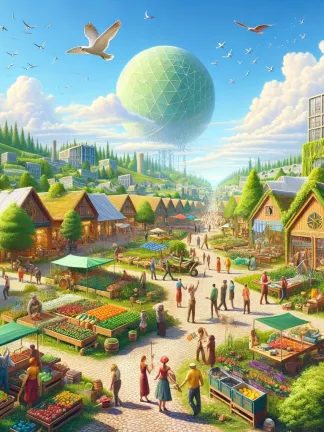
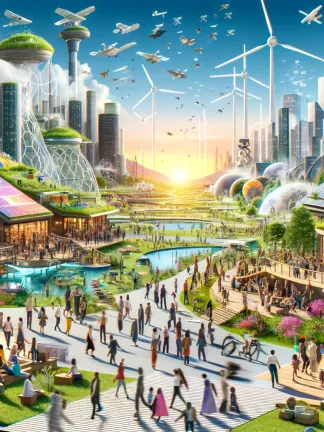
- An archipelago of gleaming, high-tech cities built on artificial islands in calm blue oceans…
- Futuristic underground settlements, populated by people living in freedom, growing in size and beauty with each passing year…
- Prosperous micro-nations—polities that began as “special economic zones” but are now fully emancipated centers of knowledge and advancement…
Okay, you can open your eyes.
You are not imagining a sci-fi story. You are seeing the future.
Nothing is inevitable, of course, but we have several reasons to believe that an era of greater independence and decentralization may be on the horizon. Indeed, some pioneers have begun taking the first steps toward this visionary future…
What begins with the Seasteading Institute exploring the concept of homesteads in the ocean—away from the coercive hand of Earth’s governments—doesn’t end there. The next step is building them. Growing them—from a single floating platform, or a toehold on a tiny artificial island, to a sprawling network of free polities in serene and sunny waters.
What begins with a special economic zone fighting for its independence against jealous and grasping statists doesn’t end there. These efforts will spread. They will grow. They will increase in autonomy until one day, a future generation will name them not among the old-style states, but as a new kind of polity: free, independent, and wildly prosperous.
The arc of history is bending in this direction. It has been for a long time.
I know that sounds hard to believe, given the technocratic dystopia toward which we appear to be headed…toward which it would seem we are being herded. But this is just a moment in history. The longer-term trend-line is moving in a better direction…
An evolutionary step
For much of human history, in most places, it was simply accepted that some were born to rule and others to be ruled. Now, that idea—which once appeared to be a permanent fixture of human life—is rapidly fading in our species’ rearview mirror. In an increasing number of cultures, the idea of fixed classes of highborn and lowborn is considered laughable.
This was part of a revolutionary shift in the course of human events. Indeed, it would be better to call it evolutionary, for it was truly an upgrade—a necessary step forward in the ongoing journey of individual liberty. In the historical blink of an eye, we moved from HumanGovernance 1.0 (monarchy, for shorthand) to 2.0. The modern democratic era had begun.
These new systems we created—modern democracies and republics—have turned out to be problematic, but the underlying philosophical motivations were spot-on. An idea that had long been simmering finally began to boil in the seventeenth and eighteenth centuries: the individual human person is not a mere subject, or a cell of a larger collective body. The individual has rights. The individual has worth as an individual.
If monarchy can be described as a condition in which the fate of the individual is in the hands of a few hereditary rulers, democracy was an attempt, however flawed, to improve upon this condition. Democracy was an attempt to give the individual greater control over his own life.
This control is something that individuals increasingly want, expect, and demand.
Revolutions in communication
It should come as no surprise that our evolutionary leap from 1.0 to 2.0 came shortly after the invention of the printing press. The rapid proliferation and democratization of information gave “regular” people access to powerful philosophical ideas, and the results changed the course of history.
Each revolution in human communication—spoken language, written language, the printing press, and telecommunications—has coincided with, and engendered, a shift in consciousness and the development of new modes of being. Each has also enabled greater freedom and growth.
Spoken language allowed for trade. Written language helped us reach new levels of organized cooperation and information sharing. The printing press fueled the Enlightenment, and telecommunications helped discredit communism and bring down the Soviet Union.
Today, we are experiencing the fifth revolution in human communication: the Internet. Information flow has been democratized in ways our ancestors could hardly have imagined. Despite the noise and inevitable propaganda, individuals are able to cut through the clutter and get around the gatekeepers. We can find the truth and share it with others—anywhere in the world. Though the internet has certainly exacerbated some human foibles, it is also spurring a kind of great awakening.
The internet is also driving a trend toward decentralization and customization based on individual preferences. Choice and variety are growing by leaps and bounds. Through technology, individuals now have unprecedented ability to tailor our lives—our work, play, lifestyle, commerce, relationships, and interests—to meet our individual preferences, without having to ask permission from any central authority. Today, we expect it. Tomorrow, we will take it for granted. The day after, we won’t be able to imagine life any other way.
In the face of this, modern governments are going to seem increasingly out of touch and oppressive.
What’s your political type?
Find out right now by taking The World’s Smallest Political Quiz.
The Empire Strikes Back and A New Hope
Needless to say, statists have engaged in a long and brutal counter-evolutionary effort. Every move forward is matched by a tightened grip. From conquerors and monarchs to commissars to the functionaries of modern democracies, government officials seem bent on controlling us, while maintaining their own special rights and privileges.
And yet, we are increasingly seeing through their racket.
Though it might seem a permanent fixture, the modern state is a comparatively recent phenomenon—arising around 1800 and quickly becoming the clunky, inefficient, warlike behemoth we’ve all come to know and tolerate. It is the source of modern-style nationalism (the notion that strangers on the other side of the world are somehow your dire enemy). It is the cause of all world-scale war and most of the oppression suffered by the individual.
As decentralization accelerates and more choice moves back into the hands of the individual, our tolerance for the modern state will continue to fall. It will be a slow, generational process, but it will happen. It is already happening.
There are also black swans that could accelerate the process. Economically, the modern state is on an unsustainable trajectory, hurtling at breakneck pace toward an inevitable precipice of sovereign debt and unfunded liabilities. (All the more reason why we need to be ready for what comes next, which is, ultimately, the subject of this piece.)
There is no reason to believe that the modern state is a permanent fixture in human life…
Technology is creating choice and liberating individuals from control. The democratized participation in the economy that began a few centuries ago has spurred unprecedented prosperity, and people are getting wise to the fact that the state does not create prosperity—it only parasitizes it. Individuals have been demanding increasing communion with their rights, and that process is only going to accelerate.
At some point, people are going to figure out that we don’t need our overlords any longer—that they are just holding us back.
Moving the ball downfield
So why am I writing this?
One benefit is certainly to push back against some of the black-pilled doomerism that afflicts so many of us who yearn for greater freedom. While a measure of concern is definitely warranted—and indeed, things can sometimes look rather bleak—there are many reasons to be optimistic and hopeful about the future.
Despair is self-reinforcing and dangerously contagious. When we surrender to it, we become paralyzed, and everything we fear becomes a fait accompli. So I am eager to do all I can to spread hope rather than fear.
That, however, was not my primary motivation for writing this. Rather, the idea came out of a conversation I had with my wife. I cannot recall my exact words, of course, but it was something like this:
If I had Musk/Bezos amounts of money, I would have already built a seastead and started my own country. I would have persuaded investors, attracted companies with a zero-tax free market, and invited the best and brightest to be part of the greatest incubator of innovation and advancement the world has ever seen.
Obviously, I don’t have that kind of money, and it is none of my business how Musk spends his. But I am free to consider the question.
Going to Mars is a worthy objective, but I believe we would benefit more from first establishing a blueprint for a new kind of “country” somewhere here on Earth. It might be a private-law jurisdiction, à la Hans-Hermann Hoppe. It could be an area in a market-anarchic condition, with jurisdictionally coterminous private agencies offering desirable services—security, justice, and roads—to willing customers. Or it could be a truly free “free city” or for-profit micro-country.
Whatever it is, we need something new.Something consensual. Something other than the model to which we’ve been subjected for most of the last few thousand years: a single entity forcibly imposing an involuntary, inescapable monopoly of authority on a captive people in a given area.
As I laid out above, I firmly believe we are headed toward this sort of future. It is still a ways off, of course, but someone like Elon Musk could speed up that timeline significantly.
Setting aside whatever critiques some may have of Musk’s choices or activities, the man clearly has vision, and he has developed a lot of clout over the last few years. If anyone could shorten the time until we see our first independent market-anarchic region, private-law jurisdiction, or for-profit “country,” it would be him.
Hey, Small Indebted Country X, I will pay off your entire national debt in return for this 200 square miles you’re not using. Or maybe this island. Or maybe just a small section of shallow ocean to build an island.
Imagine what would happen to the global discussion, and to the course of international laws governing such matters, if the richest man in the world were to go all-in on creating the world’s first truly free country.
Instead, he wants to go to Mars.
Freedom of space
I do not fault him for this ambition. I really don’t. But think about it. The governments of the world believe they own everything. They talk a good game now about treaties and the freedom of space, but the instant that exocolonies become a viable option, they are going to start carving up the stars like colonial European powers racing to carve up Africa.
You know they will.
If you and some friends liked the cold and wanted to create your own new society in Antarctica, you couldn’t. Seven countries have already carved up that continent like a roast. They have not just claimed whatever land they can homestead and transform (the only legitimate justification for land property claims). Nope…they claim the whole thing.
Musk, left to his own devices, would only claim that portion of Mars that he can homestead and transform. (And if he tried to claim beyond that, no one would take it seriously.) But governments will lay claim to the whole planet. Or it will be the United Nations, which is tantamount to the planet being claimed by the five permanent members of the UN Security Council.
And then it will be 1600 all over again. Going to beg the king for a “royal charter” to settle land that does not belong to that king in the first place. And then it‘s men dying to defend this country’s claim against that country’s claim. France vs. Britain. Britain vs. Spain. (Britain vs. everyone.)
Left to their own devices, settlers in the Americas would have had to find a way to make peace with native Indians. There would have been conflict, but nothing like the bloody tragedy that ensued. It was the power and ambition of states that fueled genocide.
Build the new world or ‘reform’ the old?
There is no useful unclaimed land left on Earth. Governments have signed treaties that make it almost impossible to form new polities on the sea. The Thai navy destroyed a tiny single-family seastead that wasn’t bothering anyone and hunted its owners like dogs, just because it was in their 200-mile “exclusive economic zone.”
States have already turned the Earth into Prison Planet, and if we don’t change direction, they’re going to do the same thing in space. The evidence of history should be obvious by now: their real objective is not to protect you or “secure” your rights. That’s just their cover story. The real objective is exploitation and control.
Musk has the resources and clout to set us on a new course. To start a new conversation. But if he goes to Mars now, with things as they are, they’re just going to make him dance to their rules, on a planet that they will claim as theirs. And that’s not good for the human race.
Elon Musk’s political awakening has been rapid and impressive, but he still has a way to go. Creating a new political party is, frankly, a step backward. Trying to “reform” democracy is a Sisyphean affair. Attempts to create and maintain so-called “limited government” are doomed to failure. There’s a better way to go.
But it’s hard to build the new world when one is still stuck in the old.

Christopher Cook is a writer, author, and passionate advocate for the freedom of the individual. He is an editor-at-large for Advocates for Self-Government, and his work can be found at christophercook.substack.com.
What do you think?
Did you find this article persuasive?