
















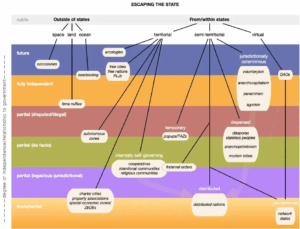


To advocate effectively for self-government, it helps to understand two main things and their overlap:
-
1. Politics – the jostling for influence within social frameworks (institutions)
-
2. Personhood – the basic identity of an individual human being with a unique combination of traits, abilities, preferences, and intentions to act
Since self-government is most readily discussed in contrast to more common forms of government, let’s start with politics. Once we understand the jostling for control of institutions, we can more intelligently, passionately, and ethically advocate for the “self-” version of government.
The ethics/morality of politics depends on:
- The nature of the jostling;
- The nature of the influence being sought;
- The nature of the social framework/institution itself.
Politics is in our families, workplaces, schools, religious institutions, and neighborhoods. People express their ideas and goals, and compete for influence in the minds of their kin, colleagues, and congregants.
What’s your political type?
Find out right now by taking The World’s Smallest Political Quiz.
Politics as Power
A problem arises when humans move from the activity of politicking to the establishment of violence-based institutions commonly known as governments. Throughout most of history, humans have conflated the jostling for influence (politics) with government. Since governments claim a monopoly on the use of “justified” violence, what we’ve really been doing is conflating politics with violence. We presume that we need government, and so support of politics becomes de facto support of violence and collectivism.
The Greek philosopher Aristotle thought of humans as “political animals” who benefit from competing with other people to achieve what he described as “higher” forms of social goods. He thought the city-states of his day were the “highest kind of community, aiming at the highest of goods.”
This aspirational view of politics reached a crescendo with Otto von Bismarck’s often repeated view that “Politics is the art of the possible, the attainable—the art of the next best.” Of course, both Aristotle and Bismarck–considered significant figures in Western history–were well-connected in the governments of their times.
Aristotle’s father was a physician in the royal court of Macedon, and after studying under another famous thinker, Plato, Aristotle tutored the future Alexander the Great and lived a life of privilege during Alexander’s reign. Bismarck was known as the “Iron Chancellor” for his ability to wage wars of unification among many Germanic states. His first major government position was chief minister to King William I of Prussia in 1862. However, while “technically deferring to William, in reality, Bismarck was in charge—manipulating the king with his intellect and the occasional tantrum while using royal decrees to circumvent the power of elected officials.”
It’s easy to see why those who benefit from the monopoly-violence institutions of their eras would look with such favor upon the activities of governments–and to claim the politics that led to their power was good. A more honest understanding of how politics works in the might-makes-right world of government and government-adjacent entities can be found in this fictional account from The Godfather Part III movie:
-
Vincent Mancini: Don Lucchesi, you are a man of finance and politics. These things I don’t understand.
-
Don Lucchesi: You understand guns?
-
Vincent Mancini: Yes.
-
Don Lucchesi: Finance is a gun. Politics is knowing when to pull the trigger.
Personhood and the Forgotten Man
All government models share the fundamental tenet that the individual human is subservient to the larger institution. From Aristotle’s belief that the individual could only reach his/her higher aims through the State to Bismarck’s dressing government force as the “art” of good possibilities to the government-wannabes of organized crime, they all miss something: the authority of personhood.
Without a firm understanding of and commitment to the authority of the individual human being, politics works for evil, not good.
Recall that the ethics/morality of politics depends on:
- The nature of the jostling;
- The nature of the influence being sought;
- The nature of the social framework/institution itself.
Governments, which treat individuals as citizens to be ruled, claim a monopoly on violence over the occupants of a defined territory. The kind of influence exercised by government is controlling, coercive, and imposed via a hierarchy that grants violence privileges only to a select few. Even if the jostling—the campaigning and vying for status—is done with complete honesty and virtue (hey, stop laughing!), the natures of the influence and the institution are inescapably violent and coercive.
Unfortunately, democracies and republics cannot solve the problem. The fact that some people get to vote for violence and coercion does not turn these into virtues. It simply means that people can be convinced to support the coercive force of government through flattery, fear, or the promise of goodies at others’ expense. Other types of governments skip the democratic pretense and just go straight for the force.
There are essential claims that anyone can make, pre-politically, simply because he or she is human:
- A claim to one’s own person as a living being (life).
- A claim to one’s intentional actions and consent-based, voluntary interactions with others (liberty).
- A claim to cultivated and duly obtained material goods not already validly claimed by another person (property).
Many theories of human freedom generally agree on those claims.
One view focuses on the belief that self-ownership and human rights are a natural part of life. In this school of thought, “natural” means pre-political, and “rights” means the individual’s valid claims to life, liberty, and property.
The most famous proponents of praxeology, a discipline combining psychology and human action, advocated for decentralized government. Yet they took the concept of decentralization to its logical conclusion. As Ludwig von Mises wrote, “If it were in any way possible to grant this right of self-determination to every individual person, it would have to be done.”
Economist and philosopher Hans-Hermann Hoppe carried this one step further with his concept of argumentation ethics, holding that what is just or unjust in social interaction “only arises insofar as I am, and others are, capable of propositional exchanges.” The fact that I jostle for influence affirms my personhood and its authority.
And spiritual traditions like Christianity identify the individual human being as uniquely loved and granted an innate worth (dignity) in his or her soul.
The authority of personhood is well-established in rigorous schools of thought and traditions. It stands in defiance of any attempt to make the group, rather than the individual, into the fundamental unit of social concern—especially if the group’s identity is used to justify the coercive force of government. The authority of personhood also confronts the objectification of persons by governments that operate external to (and, as the governments declare, superior to) the individual.
In other words, the path to self-government must travel the authority of personhood–of the self–and recognize the valid claims an individual human being can make as an individual.
Yes, individuals can jostle for influence within social frameworks/institutions. As long as the jostling, control, and institutional form are nonviolent, we can describe the politics as respectful of human dignity and agency.
This doesn’t mean that everything will go harmoniously for everyone involved, nor that everyone will enjoy the process and results. It simply means that limited, imperfect people have been, and can be, decent human beings to each other in exploring their very real differences.