



















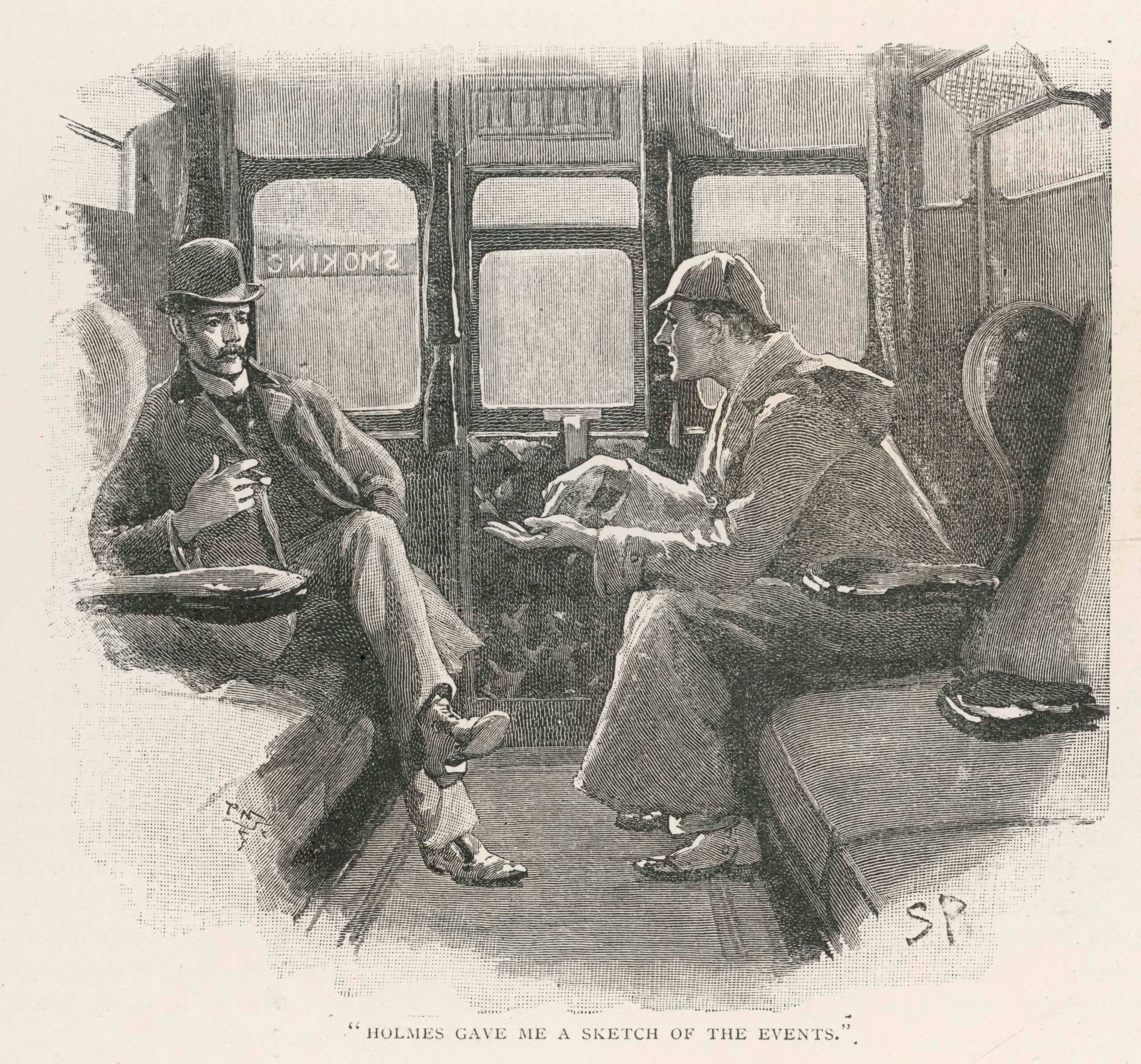
“No man has the right to play with another’s life in such a fashion.”
—Sherlock Holmes, The Priory School
What does it mean when we say—when Holmes said—that no one has the right to play with another’s life? We feel the truth of this, but do we know it? Can we prove it?
I believe we can. The answer lies in the very same methods Conan-Doyle’s famous character used to solve crimes.
Just claims or JUST claims?
In our recent discussion of consent, we established, as many have before, that each individual has a just claim to be secure in his person, property, and liberty. A just claim is better known as a right.
This isn’t a right to be provided with anything. It’s not a “right” to be given a house or furnished with education, healthcare, or anything else that comes at someone else’s expense. For this right to be respected, no one needs to do anything for you at all. They simply need to NOT do certain things TO you.
Everyone senses this right on a deep, visceral level. It is the baseline from which we operate: I was minding my own business when, suddenly, the guy just up and hit me!
“I was minding my own business.” There’s the first clue right there.
Everyone knows, down to the very core of their being, that there is no justification for an unprovoked attack upon our person. The knowledge is so deep, in fact, that if I were to tell you otherwise, you’d laugh in my face. Even animals, in their own way, have this fundamental knowledge.
We have this same understanding about unprovoked incursions upon our property and our liberty. There is no legitimate justification for robbery, oppression, or any sort of enslavement.
Angst and Agenda
People can, however, be talked out of this understanding. This is usually accomplished by one of two means.
Philosophy
Philosophy is a powerful tool. It opens up worlds of understanding: Why are things the way they are? What is THE GOOD? But there are many side-paths on the journey from here to there…
Logical thickets, where one false premise leads to disaster.
Distracting vistas that seem beautiful at first glance, but turn out to be mere murals on a wall.
Endless opportunities to feel good about clever reasoning that just happens to be wholly and utterly wrong.
And there is the angst that comes with such explorations. How can we truly know the truth? Who are we to say? This angst leaves people vulnerable to being talked out of what they already know—what all creatures know.
Ideology
Self-interested ideology often picks up where philosophy leaves off.
Who benefits from telling you that you do NOT have a right to be completely secure in your ownership of your own property?
Those who want to take your property.
Who benefits from telling you that you must submit to authority?
Those who want to rule you or control you.
Who benefits from telling you that you don’t have free will, or that you don’t have the right to be the sole author of your own choices?
Those who want to manipulate your choices to serve their own agenda.
Who benefits from telling you that individuals are mere sub-units of the collective?
Those who want to force you to surrender to the goals of the collective. (There is always a small group of people who tell us what the collective’s goals are, and those same people always seem to benefit when those goals are implemented. How convenient.)
What’s your political type?
Find out right now by taking The World’s Smallest Political Quiz.
But…but…but…
Whatever the cause—angst, agenda, or philosophical befuddlement—some people will still fret:
We may CLAIM we have the right to be secure in our person, property, and liberty, but it’s only a claim. How do we know that it’s a JUST claim?
Justice is natural
In our quest for truth, it is easy to overcomplicate things—to lose the moral forest for the philosophical trees. Justice and morality aren’t just moral abstractions. They are biological realities, processed by brain structures evolved to encourage good behavior and discourage wrongdoing.
The effects of moral choices are easily observed in daily life, and the fundamentals of morality are cross-cultural and universal. The need for creatures to be free from interference is woven into the very fabric of reality.
Every cell in your body recognizes an injustice. If someone attempts to attack you, steal your stuff, or rob you of your liberty, you are going to resist. If you are powerless to resist, you are going to resent it. You have been wronged. You know you have been wronged.
If you have somehow managed to overcome this natural impulse, you need to look very carefully at why and how—because it is the deepest and oldest knowledge in the biological world.
A simpler way to know
If that alone is unsatisfying, there is a more foolproof equation:
Our claim actually exists in reality.
All claims to the contrary do not.
Let’s allow the Great Detective to explain.
Eliminating the Impossible
Whenever I quote Sherlock Holmes, I always find myself saying it’s from “one of my favorite” Sherlock Holmes stories. Apparently, they’re all my favorites.
This particular favorite is The Sign of Four, and the line is one of his most famous:
“When you have eliminated the impossible, whatever remains, however improbable, must be the truth.”
So let’s eliminate the impossible.
The Real
As we have previously explained, your domain of self-ownership exists in reality. You have exclusive, inalienable, personal control over your thoughts, actions, and choices as a fact of your existence. You, and you alone, have dispositive decision-making authority over your own being—over your body, identity, and agency; your property; and the sphere of personal freedom you need to exercise this authority.
Dispositive decision-making authority is the primary characteristic of a property right. You own yourself. You own your life—not as a purely moral abstraction, but quite literally. We are not pleading for a moral right here; we are stating an inescapable fact: You are the boss of you.
That is what is real. The really interesting part is what is not real.
The Unreal
You can look high and low. You can look near or far. You can look in a boat; you can look with a goat.
You can look wherever you like, with whomever you like, for as long as you like, and you will never find—throughout the entire universe and across the whole of reality—any rightful license for anyone else to be the boss of you. We will call this the absence of ontological supremacy.
Formally stated,
Ontological supremacy—that is, any inherent, birthright, or automatic license to exercise control over the person, property, or liberty of another—does not exist.
People claim to have such license—commissars and kings, presidents and politicians, administrators and aristocrats—but their claim has no actual basis. In reality, all authority must be either granted or imposed; it is never a natural fact. (Parents and children are a special case to be discussed elsewhere.)
What Remains
Here then, we have our Holmesian move:
- Self-ownership exists as a fact
- Ontological supremacy does not exist as a fact
Those two propositions jointly eliminate every possible coherent ground for someone else to:
- overrule your will,
- commandeer your body,
- seize your property, or
- override your liberty.
We have eliminated the impossible. That which remains is the truth.
Thus, we can stop wringing our hands over whether or not our claim is “just.” Our claim is real. The burden of proof is on those who would claim authority over us. They are the ones making a claim whose justice must be established. And it cannot be, for it is not real.
Other options?
Some may worry that Holmes’ formulation is incomplete. Have we really explored all the alternatives and ruled them all out as impossible?
Here too, we need but turn the burden of proof around. What alternative “just claim” would not require the existence of ontological supremacy?
Those who wish to justify authority may sputter and fume, but in the end, everything they offer will likely be a variation on the same theme:
- “You have a social duty to obey.” → Requires supremacy.
- “Some people do have natural authority.” → Requires supremacy.
- “Society requires your subordination.” → Requires supremacy.
- “The majority may rule you.” → Demands collective supremacy.
- “You have no rightful domain.” → Implies supremacy of others over everything you are.
Since ontological supremacy does not exist, every alternative collapses into contradiction.
Our Claim IS Just
The individual right of self-ownership is not invented or inferred. It is not graciously granted by overlords.
It is entailed by the facts of the universe.
We are not crafting a moral system; we are discovering the only coherent one.
This morality is not relative. It is not dependent on culture or institutions, power or preferences. It is embedded in the structure of reality. Respecting self-ownership is the only non-contradictory interpersonal arrangement.
It doesn’t get more just than that.
And, of course, some part of you already believes this.
You will spend the rest of your life acting according to the principle that you have a right to your own body, property, and freedom. You will be sure—absolutely sure—that it is wrong for criminals to steal from you, threaten you, or exploit you in any way.
Ideologies, philosophies, or your own doubts will try to sway you, yet you will still live your life in the surety that your claim is just. Your body knows. Your heart knows.
The Great Detective showed us that when the impossible has been eliminated, what remains must be the truth. And the truth is simple. Your self-ownership is real. The supposed authority to violate it is not.
And whether the violations come from criminals or governments makes no difference at all.
Questions? Input? Concerns? Feel free to email me at chriscook@theadvocates.org

Christopher Cook is a writer, author, and passionate advocate for the freedom of the individual. He is an editor-at-large for Advocates for Self-Government, and his work can be found at christophercook.substack.com.
What do you think?
Did you find this article persuasive?