
(Year “Zero”)
The following Saturday morning found the Kane family walking the short distance to the community hub — a cluster of low buildings and shaded pavilions that served three different neighborhood covenants. Today was an open house day, and a couple dozen micro-schools had set up displays across the grounds. In a community this size, there were always a lot of options — with many more organized quietly among smaller family groups.
Lana led the way, tablet in hand, already scrolling through reputation scores. “The Horizon Group has a 4.8 average this quarter,” she announced. “Their math track uses real project work instead of worksheets. But the Liberty Academy is pushing harder on economics and history — they just brought in a new Austrian econ instructor from the coastal enclave.”
Phillip kicked a pebble along the path. “I just want the one with the best workshop. I’m tired of building stuff on the kitchen table.”
Ellen skipped beside Sara, clutching a sketchbook. “I just want stories. And art. And maybe animals?”
Alex smiled, squeezing Sara’s hand. This was one of his favorite rituals: watching his children navigate real choice instead of being assigned somewhere by zip code and central mandate.
They started at Horizon Group, a very popular option permanently housed in a bright, modular building funded by participating families. A cheerful coordinator greeted them at the door.
“Welcome! We run on Lex-2 baseline with our own added covenants emphasizing collaboration and practical skills. No mandatory curriculum, obviously. Parents set the outcomes they want, and we compete to deliver.”
Inside, small groups of kids worked on everything from coding simple drones to dissecting a business plan for a pretend market stall. Lana’s eyes lit up during the math session; they were calculating risk and return on a mock insurance pool. Phillip lingered in the workshop, already asking about tool access hours.
But Sara noticed Ellen hanging back.
“Too loud for you, sweetheart?” she whispered.
Ellen nodded. Soon the family thanked the coordinator and moved on to Liberty Academy, a slightly more structured provider two pavilions over. Here, the reputation scores generally showed strong marks in critical thinking and individual responsibility, but slightly lower on “student happiness” this quarter.
A parent volunteer gave them the tour. “We use Equitas-certified materials and follow a Lex-1 commerce protocol for the student-run businesses. Last semester, the kids ran a real pop-up market — profits went into their own accounts or toward field trips. We also have a strong economic philosophy track. Rothbard for the older ones, Bastiat for the younger.”
Alex watched Lana debate a point about spontaneous order with one of the instructors. She was in her element. Phillip, however, looked restless; the workshop here was smaller and more supervised.
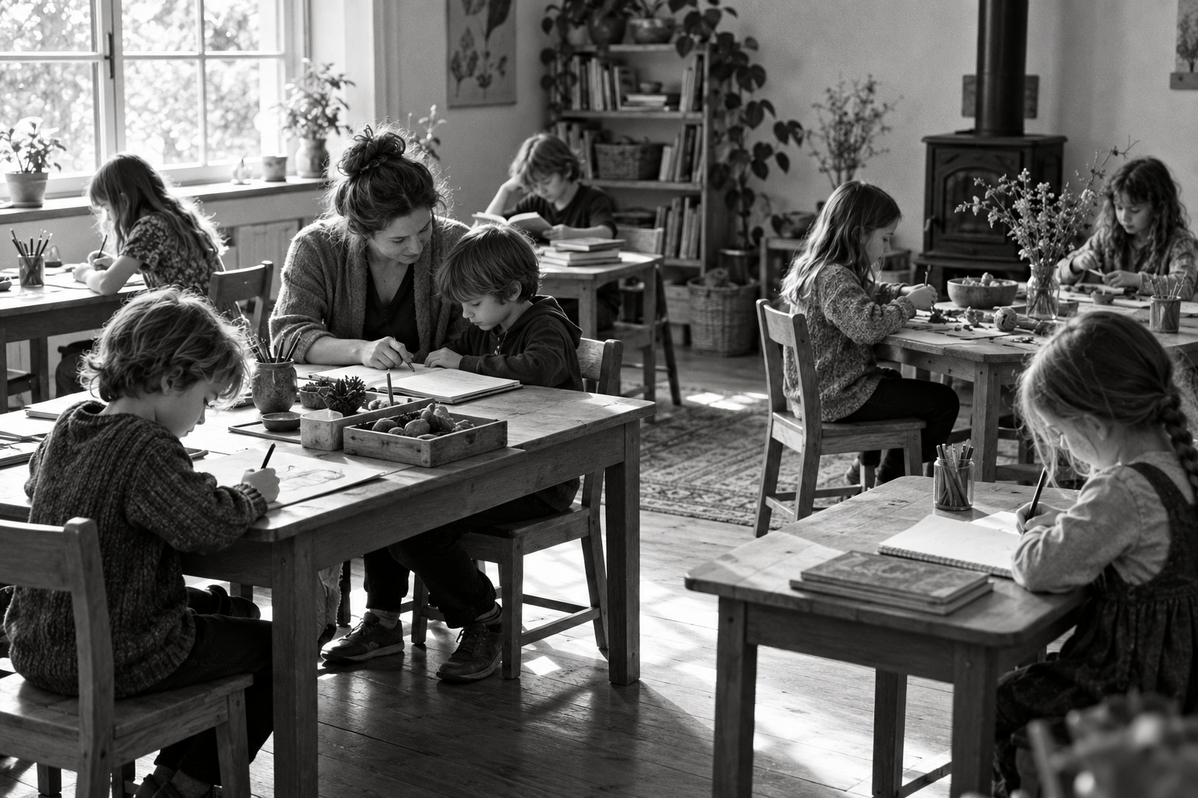
By the time they reached the third option — Greenleaf Learning, an eco-focused co-op with strong arts and nature programs — Ellen was beaming. They spent nearly an hour in the garden classroom, where kids learned biology through actual planting and storytelling circles under the trees.
On the walk home, the family compared notes over shaved ice from a Lex-1 vendor cart.
“I like Horizon for math and building,” Phillip declared.
“Liberty for me,” Lana said firmly. “I want the economics depth.”
Ellen clutched her new sketch of a garden classroom. “Greenleaf. Please?”
What’s your political type?
Find out right now by taking The World’s Smallest Political Quiz.
Take the QuizSara laughed. “Good thing we don’t have to pick just one.”
That was the beauty of it. The Kane family, like most in their area, mixed and matched. Lana would attend Liberty Academy three days a week for the advanced track. Phillip would split his time between Horizon’s workshop and supplemental sessions at home. Ellen would join Greenleaf’s morning program and stay with Sara for philosophy and other supplemental subjects in the afternoons.
No single bureaucracy decided what education meant. No taxes funneled into failing monopolies. Instead, competing co-ops rose and fell on reputation, results, and parent satisfaction. Word spread fast through the shared review networks. A poor co-op lost students (and revenue) quickly. Excellent ones expanded, hired better tutors, and kept innovating.
Back at home, they sat on the back porch while Alex updated the family education budget on his tablet.
“This year will run about twenty percent less than last, even with the split schedule,” he said. “And we’re getting better outcomes. That new drone delivery co-op even offered us a discount on supplies because two of their kid-entrepreneurs came out of Liberty last year.”
Sara leaned against him. “Remember worrying that school here wouldn’t be as good as the old system we left? We were terrified we’d ruin our kids by not having ‘proper’ schooling.”
Lana snorted. “Proper meaning government-approved indoctrination.”
“Exactly,” Alex said. “Now look at you three. Different interests, different paths, all thriving. That’s what choice does.”
Phillip was already sketching a new workshop layout on scrap paper. “Can I take an engineering elective at Horizon next quarter? They have a guy who used to build real protection agency drones.”
“Run the reviews first,” Sara reminded him. “And we’ll check their safety certs.”
Ellen tugged Alex’s sleeve. “Will I still get bedtime stories if I go to Greenleaf?”
“Every night,” he promised, ruffling her hair. “Some things we don’t outsource.”
As the sun dipped lower, painting the covenant rooftops in warm gold, Alex felt a deep satisfaction settle in his chest. This was the world he wanted his children to inherit — not one where a distant authority dictated what they learned, but one where parents and communities built the options, weighed the trade-offs, and adjusted when something wasn’t working.
Different rules. Different schools. Same freedom.
And tomorrow, they would finalize the schedule and sign the individual learning contracts — short, clear, and voluntarily chosen by all.