


We were all raised to believe that democracy (and most especially the constitutional republican kind in the United States) is the ultimate achievement in human political organization. We’ve been taught that being able to vote and run for office makes any such system “consensual.” We’ve been told that democracy means freedom and power to the people.
Friends, colleagues, and long-time readers know that I stopped believing this mythology quite some time ago.
My realizations on this front were simmering on the back burner for many years. Like most people, I languished under a variety of cognitive biases that made it difficult to face the truth—a truth that contradicted everything I had grown up believing.
A few years ago, these realizations went from a simmer to a rolling boil, and I could no longer stick my proverbial fingers in my ears and pretend the realizations weren't there. The mythology—the mystique with which democracy has been imbued—simply did not work on me anymore.
The American Founders generally had the right principles, and they gave us the catalyst we needed to move away from the hereditary rule of the ancien régime that had dominated much of humanity’s history. Unfortunately, the system they gave us does not fully actuate those principles, and similar systems throughout the world are no better.
Plus ça change, plus c'est la même chose.
In a democracy, the fate of the individual human person is still a plaything in the hands of others. A system of voting simply substitutes majorities for monarchs. Democracy, like all forms of involuntary governance, directly violates human self-ownership. As such, it shares several primary characteristics in common with slavery: it is an ongoing, nonconsensual condition in which individuals are forced to labor for the benefit of others and are punished if they resist or escape. Lysander Spooner identified one of its worst flaws back in 1867:He sees, too, that other men practise this tyranny over him by the use of the ballot. He sees further that, if he will but use the ballot himself, he has some chance of relieving himself from this tyranny of others, by subjecting them to his own. In short, he finds himself, without his consent, so situated that, if he use the ballot, he may become a master; if he does not use it, he must become a slave. Is this what you want for your children, and their children, for all time? An endless battle to gain control of the system before the other guy does?
The Endless, Unwinnable Fight
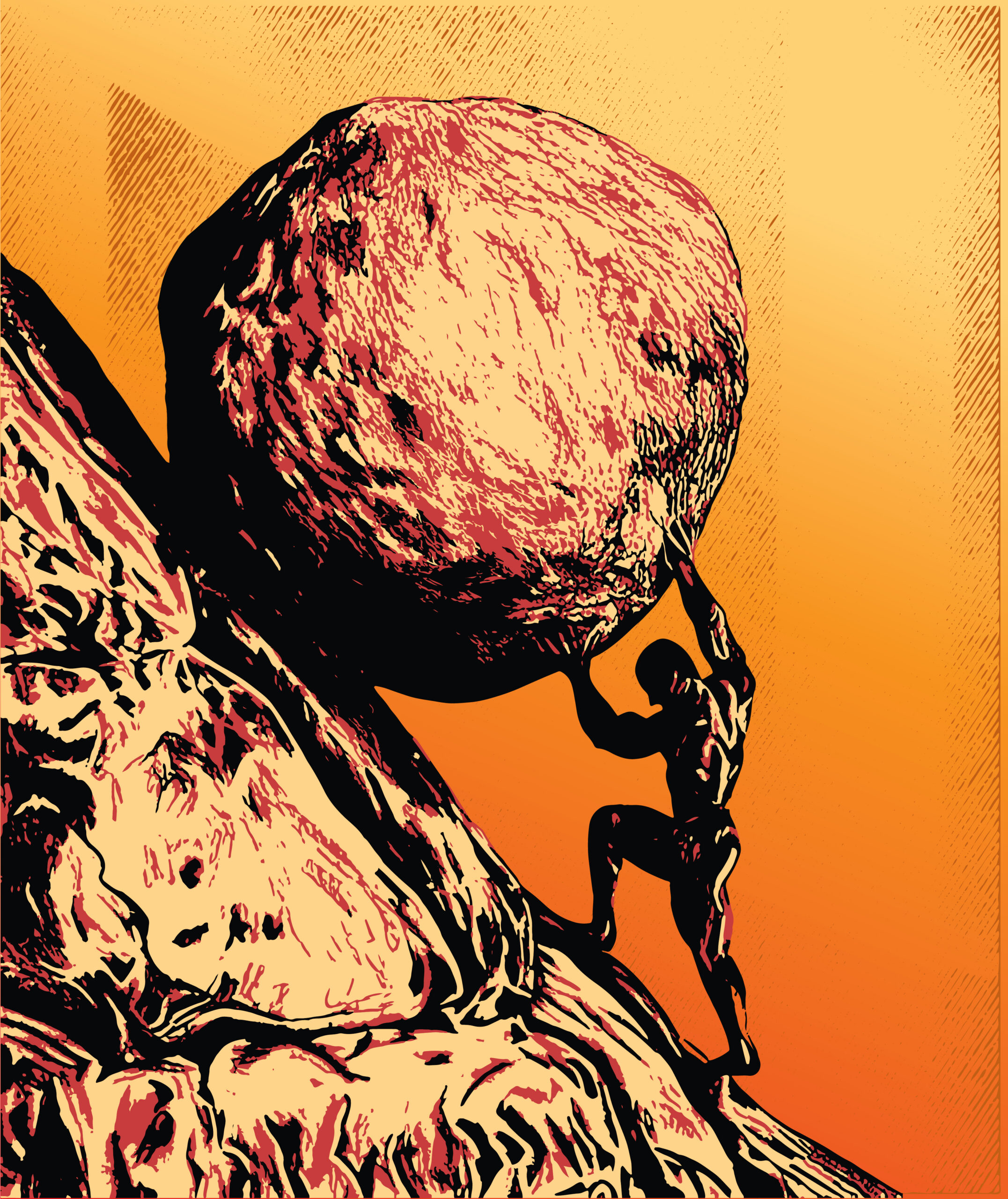
You will recall that in Greek mythology, Sisyphus was punished in Hades with the task of pushing a boulder to the top of a hill. The torture, of course, was that the boulder could never reach the top—it would roll back down every time, just as he neared the summit. Thus, he was cursed with never-ending failure and frustration—a pointless exercise for all eternity. Did Sisyphus, in his hubris, believe that his task was achievable? If so, that makes it all the more horrid. This time, Sisyphus thought, I’m gonna get that boulder up there. Over and over, forever.Listening to friends and colleagues talking about how we “fix” the terrible predicament in which we find ourselves (here in the U.S. and throughout Western civilization), it finally dawned on me: democracy is Hell, and we are Sisyphus.
When you stop to think about what we are actually doing, it's really quite ugly.
We gather in groups and fight to gain control of the government so that we can either
A) impose our agenda on others, B) prevent others from imposing their agenda upon us, or C) a combination of A and B.
Let us assume that we classical liberals are—especially in this era of soft-totalitarianism—mostly attempting to accomplish B. We just want to be left alone. We keep telling ourselves that if we can elect the right people, and those people can pass the right laws, this goal is achievable. I even hear some people imagining that we can somehow “restore the Founders’ vision” of what they intended this nation to be, before it was 'corrupted.'
Does any of this seem even remotely possible?
Let us set aside arguments, which I and numerous others have made elsewhere, that corruption and runaway growth are inherent in the system, and thus that we are on a one-way decline. Let us simply look at the way things actually work, and have worked, in our system:
We pick a team. We vote. We democracy really, really hard.
Even if everything goes right—we elect the right people and they pass the right laws—the best we ever achieve is marginal improvement…
And then the rock rolls right back down the hill.
Two years…four years…ten years—eventually, that rock is coming back down. Every time. Yet every election cycle, it’s the same thing: if we can just pick the right monkey to rule the monkey cage, we can fix everything.
This time, Sisyphus thought, I’m gonna get that boulder up there.
The Definition of Insanity
We have long placed so much hope on the next election, the next leader, the next policy decision. We have put so much effort into rolling that rock up the hill, again and again and again. I even occasionally hear people expressing a belief that we can somehow root out corruption in government and fix things permanently, through some miraculous reform to the system. Yet that is clearly impossible. The exit door is within view. We don't have to keep doing this. At the very least, we don't have to continue believing that there is no other way. But we cannot walk through that door, or even know that it is there, until we first recognize that we’re stuck in a Sisyphean exercise in futility. We have begun a new year—a time of promise and hope. Will 2026 be the year we stop repeating the same failed task over and over, expecting a different result each time?"In truth, in the case of individuals, their actual voting is not to be taken as proof of consent, even for the time being. On the contrary, it is to be considered that, without his consent having even been asked a man finds himself environed by a government that he cannot resist; a government that forces him to pay money, render service, and forego the exercise of many of his natural rights under peril of weighty punishments. He sees, too, that other men practice this tyranny over him by the use of the ballot. He sees further, that, if he will but use the ballot himself, he has some chance of relieving himself from this tyranny of others, by subjecting them to his own. In short, he finds himself, without his consent, so situated that, if he use the ballot, he may become a master; if he does not use it, he must become a slave. And he has no other alternative than these two. In self-defence, he attempts the former. His case is analogous to that of a man who has been forced into battle, where he must either kill others, or be killed himself. Because, to save his own life in battle, a man attempts to take the lives of his opponents, it is not to be inferred that the battle is one of his own choosing. Neither in contests with the ballot-- which is a mere substitute for a bullet--because, as his only chance of self-preservation, a man uses a ballot, is it to be inferred that the contest is one into which he voluntarily entered; that he voluntarily set up all his own natural rights, as a stake against those of others, to be lost or won by the mere power of numbers. On the contrary, it is to be considered that in an exigency into which he had been forced by others, and in which no other means of self-defence offered, he, as a matter of necessity, used the only one that was left to him.
—Lysander Spooner, “No Treason”