

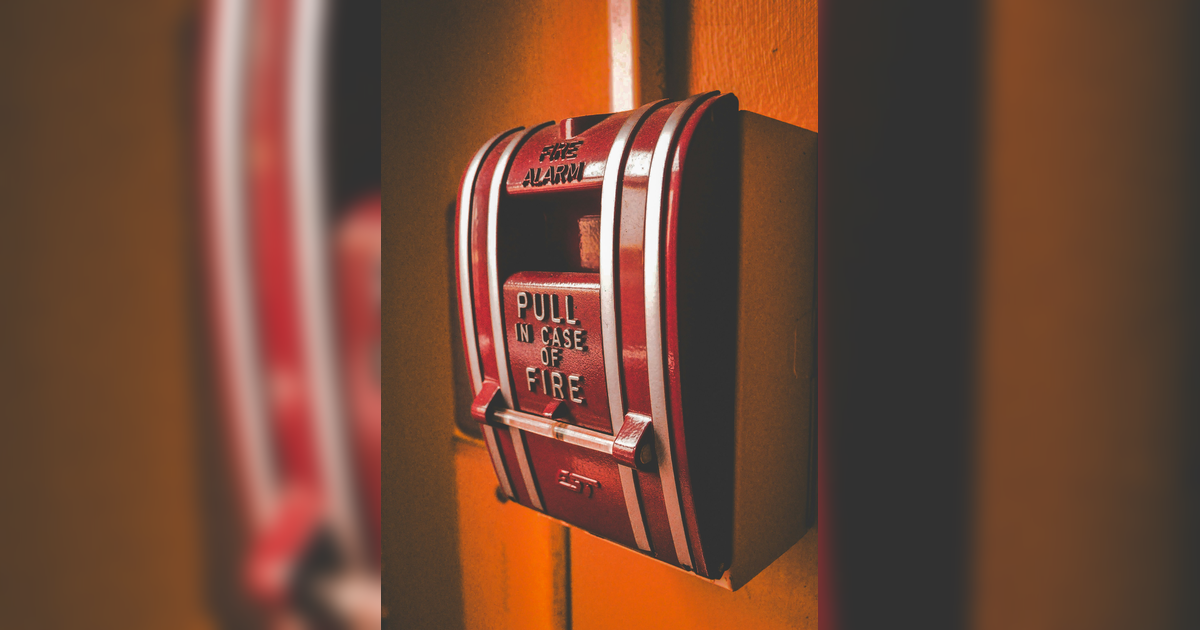
Photo by liam ward
The era of global warming has ended. The era of global boiling has arrived.
—António Guterres, Secretary-General of the UN in 2023
For unvaccinated, we are looking at a winter of severe illness and death — if you’re unvaccinated — for themselves, their families, and the hospitals they’ll soon overwhelm.
—Joe Biden, president of the US in 2021
I assure you that I am utilizing this power for the proclamation of martial law vested in me by the Constitution for one purpose alone, and that is, to save the Republic and reform our society.
—Ferdinand Marcos, president of the Philippines in 1972
Ever notice how rules go out the window in an emergency? Fear takes over—for good reason. Will I and my loved ones be hurt, displaced, or killed? Will there be enough food, water, and medicine? Will we have a future?
Life is dangerous and uncertain; a sudden shock can shatter our world and deepen that uncertainty. Politicians are quick to capitalize on that fear:
We face a grave threat. But give the government a little more power, and we can handle it. Give up some freedoms. You’ll get them back later.
When crisis hits, extraordinary government powers can feel necessary, and voters often demand them. As the crisis drags on, the population adapts to the new restrictions. Over time, people integrate them into their lives and may even defend their continuation. In the end, the state grows and individual freedom shrinks.
The Emergency-Power Script
Governments use crises to expand their power. Some may call that statement a conspiracy theory. It is not. It reflects a sound understanding of psychology and incentives. Crises reward decisiveness and quick action. The public demands that someone take control. Politicians in power feel compelled to act. And they are happy to do so. The urge to shape our surroundings is human. Being listened to confers a sense of responsibility and purpose. It feels good to have an impact. But while no one is forced to do what you say in the private sphere, this changes in public office. Politicians express the human desire for influence in the worst way: coercion. They seek to control others by force. Hence, your elected representatives are quick to “offer help.” The script is the same across centuries and borders: Calamity: A danger emerges somewhere. Something deviates from the norm, and this deviation is exaggerated. “There are unprecedented wildfires.” Claim: Loud politicians set the narrative, assign blame, and insist that only more state power can protect you. “Climate change is rampant. We must impose stricter rules. This is the only way to save society.” Concession: Rattled by uncertainty, citizens trade liberty for promises of safety, allowing intrusions they would not accept on an ordinary day. “We have a solution: You’re simply not allowed to enter the forests for a few weeks.” Consolidation: Emergency measures expand surveillance, spending, and force. Goals are announced, but the goalposts move. “You may re-enter the forests only when experts decide there is no longer any risk.” Continuation: Wrapped in patriotic slogans, the new authorities are locked in. Some rights return, but much of the emergency machinery remains. “To prevent this catastrophe from happening again, you will continue to need a permit.”A History of Crises
Over the last century, the world has become interconnected and perpetually switched on. From newspapers to social media, demagogues have long used publicity tools to exploit crises and expand their power. Berlin, 1933 On February 27, 1933, the Reichstag building was set ablaze. Germany’s parliament, a symbol of national unity, suffered heavy damage. Dutch communist Marinus van der Lubbe was arrested inside and confessed. Nonetheless, Adolf Hitler was quick to proclaim that he had to save the German people and state by suspending constitutional protections of individual rights. The next day, the Reichstag Fire Decree was issued. Barely a month after Hitler’s appointment as chancellor, the Nazis secured sweeping powers. Individual liberties weren’t seen again for more than a decade. New Delhi, 1975 Indians learned that their rights are far from guaranteed in a democracy. Prime Minister Indira Gandhi’s 1971 election victory was invalidated by the Allahabad High Court for electoral malpractice. In a crisis of Gandhi’s own making, protests erupted, and at her request, President Fakhruddin Ali Ahmed proclaimed a national emergency on June 25, 1975. It was justified as necessary to save the nation. Opposition was suppressed and censorship imposed. During this period, a coercive family-planning campaign was implemented that sterilized roughly 11 million people in the name of population control. “The Emergency” (as it came to be known) ended in March 1977, and some freedoms were restored. Emergency-declaration powers were curtailed. But the precedent endured, and in the years that followed, everyday freedom-limiting tools were embedded in other laws. New York and Virginia, 2001 9/11 was the defining terrorist attack of recent decades. Two planes hit the World Trade Center’s Twin Towers, and a third struck the Pentagon. The public demanded that politicians do something. Fear was palpable. Within weeks, the Patriot Act was introduced. It was signed into law on October 26, granting sweeping surveillance powers that curtailed privacy. The Patriot Act limits individual rights, and civil liberties groups have long argued that parts of the law are unconstitutional. It’s easy enough to see why some feel compelled to believe that the attack was an inside job.Effective Politicians
The trend line is unmistakable: individual liberties erode, step by step. In calm periods, a handful of liberty advocates push back and blunt the most radical interventions. But in storms, freedom-minded voices are muffled and sweeping interventions are implemented, then normalized. When chaos erupts, the public is afraid and demands that someone take the reins. Your arguments for individual responsibility and against sweeping mandates fall on deaf ears. In step with this, fearmongering from government and media rises. Need I point to the covid situation? As the dangerous virus narrative faded from the headlines, politicians returned to and amplified another decades-old alarm: climate change. The climate rhetoric has become so intense that many young people see no future. A 2021 Lancet study, surveying “10,000 children and young people (aged 16–25 years) in ten countries” within and outside of the West, found that 39% were “hesitant to have children” due to climate change, 56% believed “humanity is doomed,” and 50% felt “guilty.” While politicians are abysmal at meeting their own stated goals, on climate fear, they hit the bull’s-eye. The same study found that 64% of respondents said governments are not “doing enough to avoid a climate catastrophe.” Goal achieved: Stoke fear so the public demands that politicians take more power. In parts of Canada, the first soft climate lockdowns were enacted recently. The entire climate-change situation is the perfect example:- Politicians identify a calamity.
- They make and repeat strong claims.
- Citizens make concessions of their freedom.
- Officials consolidate their powers.
- A state of crisis continues.