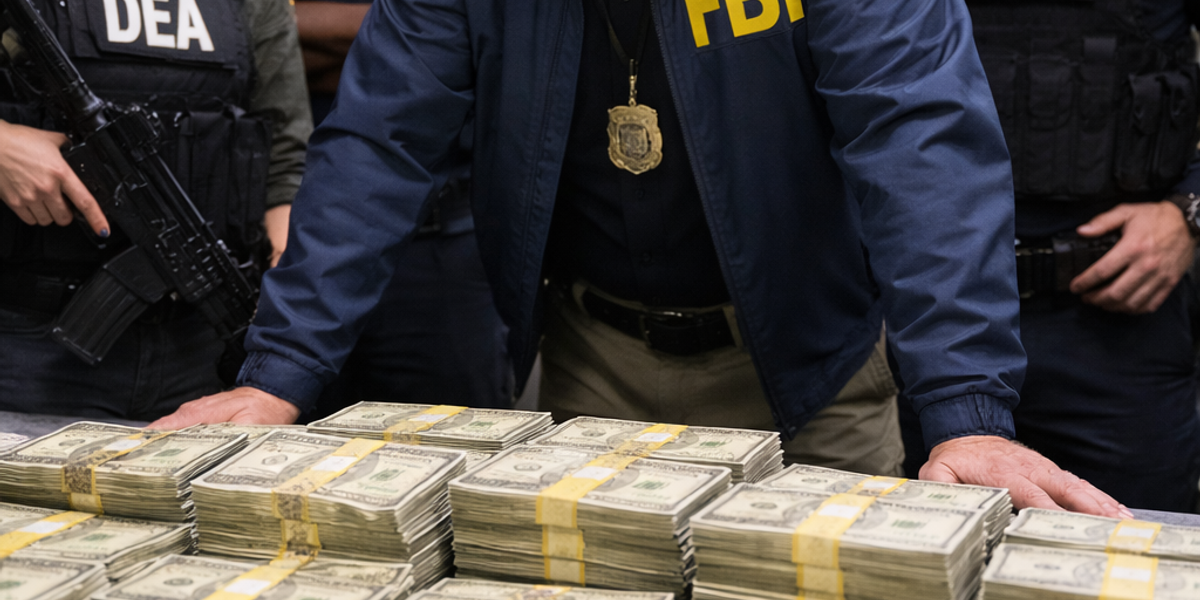
It’s hard to imagine being caught up in a scenario where law enforcement, backed by the full force of the state, reaches into your life and takes what you earned, saved, inherited, or set aside for your future — all this without charging you with a crime, without proving your guilt, without even promising to make you financially whole afterward.
This is not law enforcement as protection. It’s a form of extraction. A nationwide criminal racket of legalized theft, dressed up in paperwork and procedure, where your property is presumed guilty and your innocence is treated as an inconvenience.
Not fined.
Not taxed.
Taken.
Civil asset forfeiture lives in that moment. It is not an abstract legal doctrine. Rather, it’s a mechanism that quietly redraws the boundary between what you own and what the government can claim, and it does so in a way that challenges the very idea of economic sovereignty in a free society.
If property is the extension of labor, time, intention, and future possibility, then forfeiture is not merely about money or cars. It is about whether you are truly sovereign in your own life.
How Property Became the Defendant
Civil asset forfeiture allows law enforcement to seize property suspected of being connected to crime, even when no criminal charges are filed. The case is brought against the property itself, not the person. The cash is “guilty.” The car is “guilty.” The house is “guilty.”
This legal fiction matters because it flips the moral order. Instead of the state proving wrongdoing, individuals must prove innocence to recover what is theirs. In practical terms, this often means navigating complex deadlines, unfamiliar courts, and legal costs that exceed the value of what was taken.
Historically, forfeiture expanded dramatically during the War on Drugs, fueled by laws that allowed agencies to keep some or all of what they seized. Once proceeds became budgetary oxygen, forfeiture stopped being a rare tool and became routine.
The quiet truth is this: systems do not drift accidentally. They move toward what they reward.
When Revenue Replaces Justice
Prevalence of civil asset forfeiture continues to emerge across states and agencies. Assets both small and large can be seized, yet the owners are not charged. Contesting the seizure costs more than surrendering, so most people give up.
Thousands of forfeiture cases each year end without criminal charges. In many jurisdictions, law enforcement agencies retain forfeiture proceeds, creating incentives that distort policing priorities and erode due process protections.
This is not a conspiracy. It is intentional.
And intentionality can shape illegal behavior.
Two Lives, Two Wins, Zero Justice
Consider two real cases.
Brian Moore Jr., a U.S. Army veteran, had $8,500 seized at an airport. He was not charged with a crime. He fought back, won, and still faced years of litigation just to recover attorney’s fees. His victory came not because the system worked, but because he had the rare capacity to endure it.
Crystal Starling, a small business operator, had $8,040 seized from her home. She was never charged. She represented herself, stumbled over procedural traps, resurrected her case on appeal, and still faced a government maneuver designed to avoid making her whole.
This is the hidden cost of forfeiture: even when you “win,” you often lose time, stability, and a sense of trust.
The Taoist Diagnosis: When the State Overreaches
Taoist philosophy does not require legal training to recognize imbalance. Lao Tzu observed that excessive control produces the very disorder it claims to prevent. Heavy-handed governance, he warned, impoverishes the people while empowering officials.
Civil asset forfeiture is governance by force disguised as administration. It assumes suspicion before relationship, extraction before understanding, control before harmony.
From a Taoist lens, the problem is not only that forfeiture takes property. It is that it violates
wu wei, the principle of non-coercive order. It creates fear where trust should live. It inserts friction into the natural flow of economic life.
When people cannot trust that what they earn is secure, they do not innovate freely. They do not save boldly. They do not move confidently through the world.
They shrink.
Property as Freedom, Not Privilege
Here is a question most discussions avoid:
What does property mean in your own life?
Your savings account is not just money. It offers freedom and options. Your car is not just transportation. It is mobility. Your cash is not just currency. It is a future choice.
Civil asset forfeiture treats property as a conditional privilege granted by the state, rather than as an extension of personal agency. And once that shift occurs, freedom becomes theoretical.
Economic sovereignty means you can plan, build, fail, recover, and try again without fearing that an uncharged suspicion can erase months or years of effort.
A society that weakens property security weakens autonomy itself.
The Constitutional Echo
Western law reaches similar conclusions from a different angle. Due process, proportionality, and protection against excessive punishment are not technicalities. They are guardrails against arbitrary power.
When property can be seized without conviction, when the burden of proof rests on the individual, and when the government benefits financially from the taking, those guardrails start to bend.
And once they’re curved, they rarely snap back on their own.
Forfeiture thrives on silence, confusion, and the belief that “this only happens to other people.” It persists because the cost of resistance is deliberately high and the harm is deliberately fragmented.
Taoism reminds us that what is ignored does not disappear. It accumulates.
The Real Question
Civil asset forfeiture forces a deeper reckoning than most policy debates allow:
Are you a citizen with inherent economic sovereignty, or a provisional participant whose property can be confiscated, frozen, or erased at the state’s convenience?
The answer is not found in statutes alone. It is found in whether people notice, care, and insist that power remains accountable.
A government that seizes first and justifies later has already stepped off the path. Lao Tzu would call it imbalance. Confucius would call it unjust. Mencius would call it illegitimate.
Call it what you want. Just don’t call it freedom.