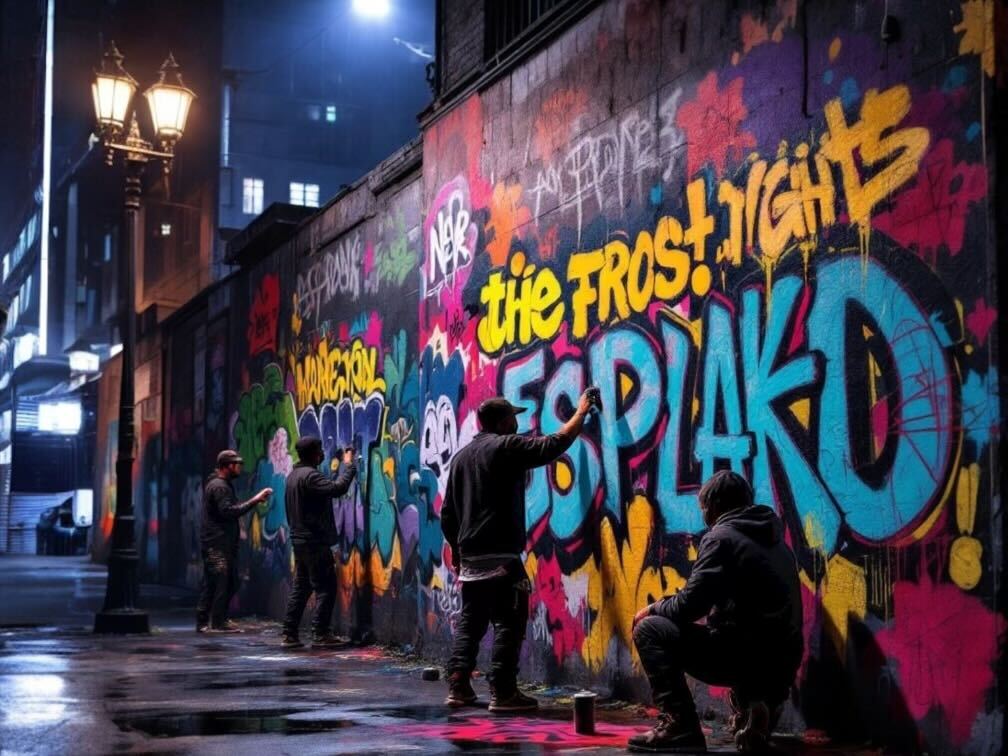
There’s a peculiar kind of holiness in a tagged wall.
You can feel it in the raw declaration, the bold curve of a name, the drip of paint defying the sterilized logic of the city grid. Some people see vandalism; I see living proof that the human soul refuses to be domesticated.
For me, public art is the state’s curated dream. Graffiti is the people’s unfiltered truth. And truth, like life, is messy.
I learned this in the gritty streetscapes, along the underpasses, and in the back alleys and quiet corridors of the cities where I either visited or lived.
Growing up in Columbus, Ohio, before moving to Indianapolis, Chicago, Denver, Sacramento, and San Diego, among other cities, I found teachers in brick and rivet, in steel and crosstie.
The lesson repeated, simple and stubborn: freedom is never tidy. It won’t hang still long enough to be framed, and it won’t sit quietly under a plaque. It keeps insisting on itself, sprayed, scribbled, etched, scrawled. It symbolizes the non-negotiable footprint of a person who will not be invisible.
The graffitied wall is not a crime scene; it’s a birth certificate.
Free Expression: The Breath We Don’t Ask Permission to Breathe
We talk about free expression like it’s a luxury—something framed in gallery white, announced by press release, and guarded by endowments. But free expression is older than museums and governments. It is primal, like hunger and prayer.
A child dragging a crayon across a hallway is not committing vandalism; they are discovering the power to mark the world and hear it answer back.
Somewhere between childhood curiosity and adult compliance, we are trained to believe that only sanctioned voices count, only curated platforms matter, only approved aesthetics deserve light.
Graffiti rebels against all of that. It is an unlicensed expression. Unfiltered presence. Unapologetic existence. It is the child’s spirit returned, seasoned by frustration, hope, rebellion, and aerosol.
A free society isn’t proven by its galleries. It’s proven by what it allows on its walls without permission.
Democracy needs ballots, yes. But it also needs an unsanctioned voice. Remove the latter and the former becomes theater. A city stuffed with rules and signage, but empty of human handwriting, isn’t a city; it’s an exhibit about a city.
Zhuangzi, bell hooks, and the Urgency to Speak
Note: The author bell hooks chose to have her name written in all lowercase to emphasize her message rather than her own identity.
Zhuangzi, the merry wanderer of Chinese lore, grinned at the spectacle of human certainties. Freedom, in his telling, is not the right to do as you’re told; it’s the capacity to move without needing a script.
The fish flows with water, the bird with sky, the sage with the Tao. Graffiti flows with the wall—not against it, not for it, but with it, using its seams, rivets, rain streaks, and surface history as part of the stroke.
bell hooks added an essential key: liberation demands visibility. It demands presence. It demands the right to gaze back and to name our lives rather than be endlessly named by others.
“The function of art,” she reminded us, “is to do more than tell it like it is. It’s to imagine what is possible.” Street writing does both. It tells truths that press releases won’t and imagines a world where anyone can speak, not just those with a permit.
When I walk through neighborhoods where signage is plentiful but human mark-making is banished, I feel a strange, curated quiet. hooks taught me to ask: Whose quiet is this? Who benefits from silence? The answers are rarely democratic.
The wall that cannot be answered is a wall that has already chosen sides.
A Winter Train & the Sacred Act of Marking
In Chicago winters I used to stand on the Lake/Wells platform, coffee steaming, watching train cars roll past in the metallic hush of snow. Each car was a shifting gallery: memorial names scrawled for the dead, love notes to the living, block-letter boasts, wildstyle riddles, whispered warnings, prayers in pigment. You could almost hear them:
I was here.
I am here.
I will not disappear quietly.
In that bitter wind, tags felt like small fires with each one lit by someone who refused to bow to silence. There is a poetry to survival, and this was survival in motion. A kinetic scripture on steel.
Not every piece was legible to my eye. That was never the point. The point was presence. The point was refusal to vanish. I respect anyone who has ever stood in the cold with shaking hands and said to themselves, “I refuse to be erased.”
If the museum is a mausoleum, the freight line is a heartbeat.
Fred Moten & the Sovereignty of Refusal
Contemporary American poet, cultural theorist, and public intellectual
Fred Moten teaches the politics of refusal—the way oppressed people make new worlds by refusing to comply with the ones built to deny them.
Graffiti is that refusal embodied. Refusal to disappear. Refusal to be told where beauty belongs. Refusal to leave the city’s surfaces to billboards and bureaucrats.
Authority says: Ask first.
Graffiti replies: I already answered.
You can punish an act; you can’t punish a soul that has already chosen freedom. In Moten’s universe, fugitivity is creativity. The rooftop runner at 2:03 a.m., the culvert calligrapher, the kid mapping a name across the boxcar of a train—they aren’t just breaking rules; they are stepping into a sovereign state of being: unsupervised, unowned, unafraid.
A refusal is not a no; it’s a yes to another way of being.
Lao Tzu’s Wild Brushstroke: Expression Without License
Lao Tzu’s whisper carries across centuries: “The world is sacred, it cannot be improved.” And yet we keep trying to improve expression by controlling it, identity by marketing it, creativity by licensing it.
The Tao laughs. It knows no license. It spills where it will. The more tightly we seize, the more certainly it finds another crack.
Graffiti is water returning to a concrete desert. The hiss of paint is the sound of pressure releasing—the pressure of people instructed to behave like décor in their own neighborhoods.
Free expression is a river. Contain it too tightly and it makes new channels. To tag is to trust impermanence and to act anyway. To paint publicly is to breathe publicly. You cannot inhale permission and call it oxygen.
Order that cannot survive a poem on a wall was never order; it was fear in uniform.
Aesthetic Hygiene & the Perils of Polished Cities
I love Fort Collins’ curated beauty—cozy storefronts, creative culinary menus, artistically infused alleyways. But I’m wary of cities where nothing looks out of place.
Perfection hides the poor. Curation erases the unapproved. So does “hostile architecture,” the spikes under bridges, the benches that won’t let you lie down—these are lines written by power. The visual regime of a city tells you everything about who is welcome and who must move along.
A wall without scars is a wall that hasn’t lived. Graffiti restores the pulse. Sometimes I catch a freight rolling through the open land here in Fort Collins, letters rippling like movement in still water, and I feel peace—not the peace of cleanliness but the peace of truth not fully contained.
If the Tao is the way things move when unforced, then graffiti is the way a city breathes when it remembers it is made of people, not marketing decks.
Sanitized streets are not safer; they are sleepier.
Sovereignty on the Wall
Sovereignty begins with naming. Not the naming done to us, but the naming we do for ourselves. A tag is a name flung into the commons, a declaration of presence that doesn’t request stage time or buy an ad.
In neighborhoods where people are told to be grateful for being “revitalized,” the first revitalization is always voiced. Sovereignty looks like this: unmediated inscription, uninvited color, unsponsored emphasis.
Is all graffiti sacred? No. Some of it harms, some of it harasses, some of it tramples others’ sovereignty. The Tao is not a license; it’s balance. But the existence of harm is not an argument for universal silence. It is a call to cultivate richer vocabularies of public speech, not narrower ones. It’s a prompt to design cities that can metabolize human expression rather than pathologize it.
The alternative to abuse is not absence; it’s abundance with accountability.
The Commons Versus the Billboard
We are told that “public space” belongs to the public. That is, until the public speaks in ways the city permit process cannot predict. Meanwhile, billboards and corporate advertising wraps colonize entire facades, pouring commercial speech into our eyes at every intersection. That asymmetry reveals the real hierarchy: profit speaks freely; everyday people speak only when allowed.
The wall tells the truth the billboard cannot afford. It says: We are here. We mourn here. We love and argue here. We are not just demographics shuffling between purchase points. If a city cannot tolerate that human grammar across its surfaces, it is not a public; it is a mall.
When commerce has more speech than citizens, democracy is whispering in a wind tunnel.
Impermanence: The Discipline of Letting Go
Most graffiti will be buffed. The sun will bleach the pigments. Rain will slough the edges. A new layer will arrive. The wall becomes a palimpsest, a living skin of the city’s ongoing argument with itself. The ephemerality is not a bug; it’s the Taoist lesson. Don’t cling. Make the mark that must be made and let the wind carry the rest. The act transforms the actor. That is enough.
Some days I think permanence is our least interesting obsession. We pile permanence atop permanence and forget how to live. A fleeting line, a one-night throw-up, a silver fill shimmering for a week before it disappears. These are breaths, not monuments. And breath is how life proves it’s alive.
To leave a mark is to breathe twice.
The Risk and the Ritual
There is risk in the unsanctioned, and that risk is part of the rite. The body knows it is alive when it feels the night air, when it listens for footsteps, when it calculates the time before dawn and chooses a line anyway.
It is not merely adrenaline; it is agency. In a world that routineizes us with calendars and passwords and performance reviews, there is something clarifying about a moment that answers only to necessity: I need to say this and the wall is the page available to me.
Risk without purpose is noise. Risk yoked to expression becomes ritual. Call it midnight calligraphy. Call it a sermon no church would host. Call it a secular sacrament in latex gloves and paint-speckled shoes.
Some prayers are whispered. Some are written twelve feet high in chrome.
What the Tao Might Say to the City
If the Tao spoke to planners and police chiefs, to neighborhood councils and arts boards, I suspect it would say: Trust the flow over fear. Create many outlets for expression. Expect your walls to talk back.
Host more murals. Yes, and also host more friction. Leave legal walls open. Sponsor youth crews and intergenerational crews. Teach letterforms in the daylight and history in the afternoon. Provide pathways to mastery that don’t require betraying the urge that started it all.
And for the rest of us, the Tao might say: Stay porous. Let the mark that offends you today become the conversation that grows you tomorrow. Learn to read the scripts that were never meant for you but still include you in the human we. The city is not décor; it is dialogue.
If your order requires silence, it isn’t order; it’s obedience.
The Closing Mark
Graffiti is not the point. Freedom is. Free expression is not the decorative edge of liberty; it is the bloodstream. When people stop marking walls, speaking loudly, writing boldly, or dreaming publicly, oppression has already begun its victory lap, tidy and polite.
So the next time you pass a scribbled name on a train bridge or a messy burst of spray on concrete, consider something radical: maybe this is not disorder. Maybe this is life refusing to apologize. Maybe it is the Tao itself in its wild, imperfect, and unbiddable manner finding a surface, borrowing a body, and signing the city with its wandering hand.
The wall will be buffed. Another will be written. The dialogue will continue.
And if we are lucky, we will keep listening.