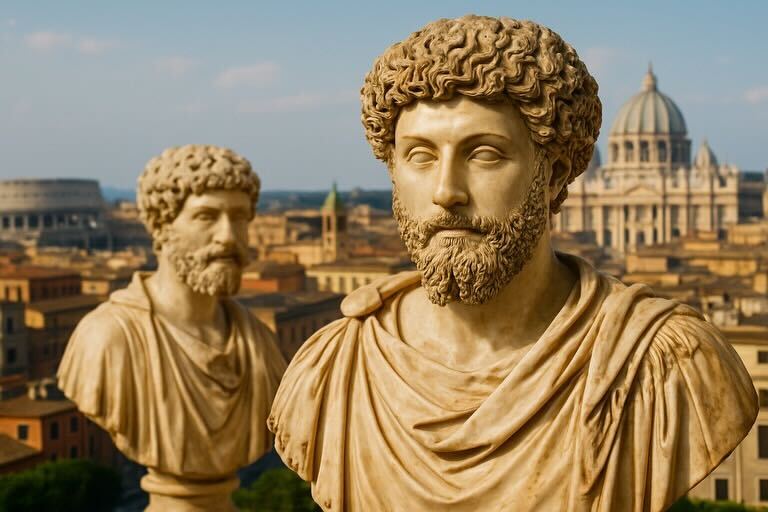
Modern life often teaches us to outsource our power. We lean on institutions, leaders, employers, partners, even strangers, hoping someone else will bring order to our chaos.
Yet the more we outsource, the more we erode the very muscle required for freedom: self-governance.
Stoicism offers a radical counter-move.
Govern yourself first, or nothing outside you will feel governable.
The ancient Stoics never used the phrase “self-sovereignty,” but every line from Epictetus to Marcus Aurelius hums with the same truth. Freedom is not granted from the outside. It is built internally.
Contemporary author and Stoic thought-leader Ryan Holiday reminds us, “The world is going to push you around. The only thing you can control is how you respond.” That response is not simply emotional. It is structural. It is the foundation of a self-governing life.
Holiday believes that self-governance through four virtues (wisdom, justice, courage, and discipline) is the key to mastering your inner world as well as external events, emphasizing that the essence of freedom lies in controlling your reactions, not outer circumstances.
Stoicism crystallizes this into a practice for me that is reflected in the following:
My life is mine to steer. My choices are mine to own. My outcomes are mine to cultivate.
This is the blueprint for sovereignty.
And that word—blueprint—signals the perfect moment to bring in another philosopher of freedom.
The Blueprint: Dr. King’s Call to Build a Life Engineered for Excellence
Long before the resurgence of Stoicism, the civil rights leader Martin Luther King Jr. delivered one of the most profound teachings on self-governance in his 1967 speech “
What Is Your Life’s Blueprint?”
Dr. King told a group of students:
“You must have as a basic principle the determination to achieve excellence in your various fields of endeavor. You’re going to be deciding as the days and the years unfold what you will do in life. The question is whether you have a proper, a solid, and a sound blueprint.”
A solid and sound blueprint.
A sovereign design for one’s life.
He went further:
“Number one in your life’s blueprint should be a deep belief in your own dignity, your worth, and your own somebodiness.”
This is Stoicism in a modern tongue.
The inner citadel Marcus Aurelius tended every morning.
The self-mastery Epictetus insisted upon.
The sovereignty Holiday calls us back to.
Dr. King was offering not only a moral vision but a structural one.
Build your life from the inside out.
Design your agency.
Protect your dignity.
Engineer your future.
A person without a blueprint becomes dependent on systems, institutions, and leaders to do the internal work they avoided. A person with a blueprint becomes their own governor.
And that brings me to my own path.
The Agorist Journey: Fire That Hardens the Will
My journey has been an agorist one. Not metaphorically. Literally. I have fought for autonomy in seasons when life pressed its weight squarely between my shoulders. I have stumbled financially, rebuilt creatively, wandered nomadic landscapes, stared down uncertainty, and taught myself to survive the quiet violence of self-doubt.
I learned this the hard way:
No one is coming. I must be the steward of my own fate.
Self-governance is not an ideology. It is an inner architecture that must be tested by wind, weather, and consequences. My blueprint became forged not on good days, but in the trenches. And yes, I have earned a measure of success not because the world made it easy, but because I chose to rule myself despite the difficulty.
Stoicism gave me the steel.
Taoism gave me the flow.
The Internal Fortress and the River That Shapes It
Stoicism thrives because it is centered in the one place where true power resides: the mind. Governments can change, economies can wobble, friends can disappear, and life can overturn itself overnight. The Stoic remains grounded by asking a simple question:
What part of this is mine to shape? What part must I release?
Taoism completes this picture.
Where Stoicism fortifies the will, Taoism softens it.
Where Stoicism disciplines, Taoism harmonizes.
Taoist sages teach that sovereignty is not only control, but alignment. Flow with what is. Bend but do not break. Allow the river to teach you. The sovereign is not rigid. The sovereign is responsive. The sovereign is free because they do not fight life; they cooperate with it.
A self-governing existence is the dance of sturdy Stoic roots and free Taoist branches.
The Lie of External Dependence
We are conditioned to believe the right government, the right leader, the right policy, or the right support system will rescue us. But history has rarely been kind to those who hand their agency away. Dependence creates fragility. Sovereignty creates resilience.
Stoicism, Taoism, and Dr. King’s blueprint converge on one truth.
Build the strength within so no storm, no politician, no crisis, and no opinion can uproot you.
In a world of passengers, choose to be the driver.
The Invitation: Become the Governor of Yourself
If your life feels chaotic or directionless, take it as a signal. Your internal government is understaffed. Your inner governor may be asleep. Your blueprint may need revision.
Begin again.
Strengthen the citadel.
Flow with the river.
Build the blueprint.
Your sovereignty is waiting.